
The IB mock exam schedule problem nobody admits
You can be the kind of IB student who studies every day and still feel panic when you sit a timed paper. Not because you don’t know the content, but because exam performance is its own skill: pacing, stamina, and decision-making under pressure.
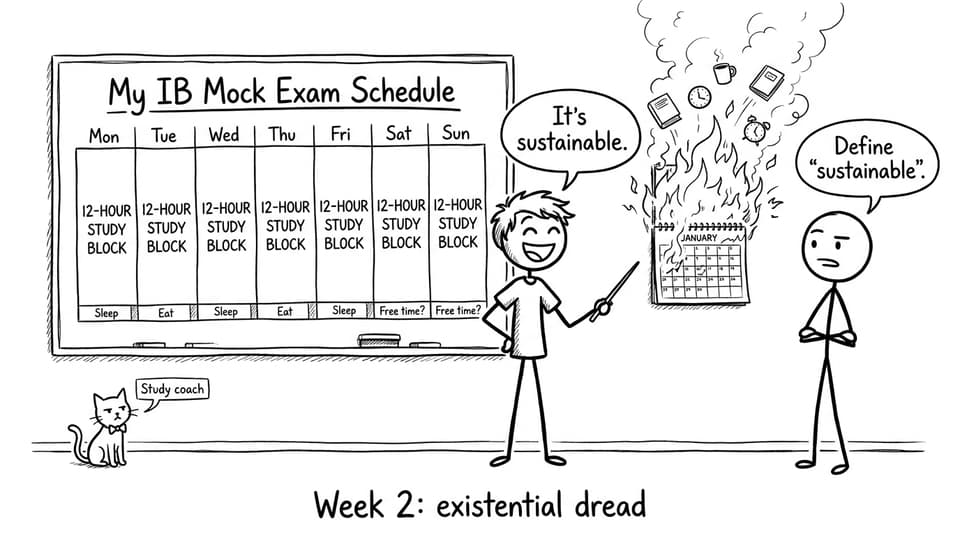
That’s why an IB mock exam schedule matters. Not “do lots of mocks.” Not “save everything for the last week.” A schedule that builds you up gradually, then peaks at the right time.
Quick checklist: a sane IB mock exam schedule
Use this as your default IB mock exam schedule rule-set:
-
Start 8--10 weeks before your final IB exams.
-
Begin with mini-mocks (25--45 minutes) to diagnose weak areas.
-
Keep one mock-style session per subject per week early on.
-
In the final 6 weeks, do one full mock per subject per week.
-
Review the same day. If you don’t review, it wasn’t really an IB mock.
If you want your practice to feel like the real thing without spending hours building resources, RevisionDojo’s Custom IB Mock Exams guide shows how to generate targeted papers fast.
When should IB students start mock exams?
For most IB students preparing for exams, the sweet spot is 8--10 weeks out.
That timeline is long enough to run multiple feedback cycles (attempt, mark, fix, reattempt), but short enough that your effort stays tied to exam performance. Earlier than that, mocks can become a confidence drain because you’re testing content you haven’t properly learned yet. Later than that, you don’t have time to convert mistakes into habits.
A practical way to start is:
-
Week 10--8: timed sections only (mini-mocks).
-
Week 7--6: mixed practice (some full papers, some targeted sections).
-
Week 5--1: full-paper simulations become your weekly anchor.
RevisionDojo’s Online IB Mock Exams guide is useful here because it frames mocks as a repeatable loop, not a one-off event.
How often should you do IB mock exams per week?
The best IB mock exam schedule is the one you can review properly. So frequency depends on your ability to mark, reflect, and fix.
Early phase (8--10 weeks out): one mock-style session per subject per week
In this phase, you’re building accuracy and awareness. Your goal is to catch patterns like:
-
losing marks on command terms (explain vs evaluate)
-
running out of time on structured questions
-
writing too much where marks are capped
A mock-style session can be:
-
a timed essay
-
a single paper section
-
a data-response set under exam conditions
Pair that with high-quality drilling from a question bank. If you’re not sure how to structure that practice, RevisionDojo’s IB Question Bank strategy is a solid blueprint.
Middle phase (6--7 weeks out): add realism, not just volume
Now your IB mock exam schedule should include at least:
-
one longer timed sitting per subject each week (45--90 minutes)
-
one targeted “fix session” based on your last results
This is where RevisionDojo’s ecosystem helps: learn quickly with Study Notes, drill recall with Flashcards, then pressure-test with a mock.
Final phase (last 6 weeks): one full IB mock per subject per week
This is the phase students remember, because it’s where confidence becomes physical: you stop guessing whether you can finish on time.
-
Do one full timed mock per subject per week.
-
For heavy HL subjects, add one extra mini-mock focused on the hardest section.
-
Keep the rest of your week lighter and more targeted (practice sets + review).
If you want more realism for full-paper rehearsal, RevisionDojo’s IB Predicted Papers can be used as structured exam simulations alongside your mock cycle.
The part that actually raises your grade: review
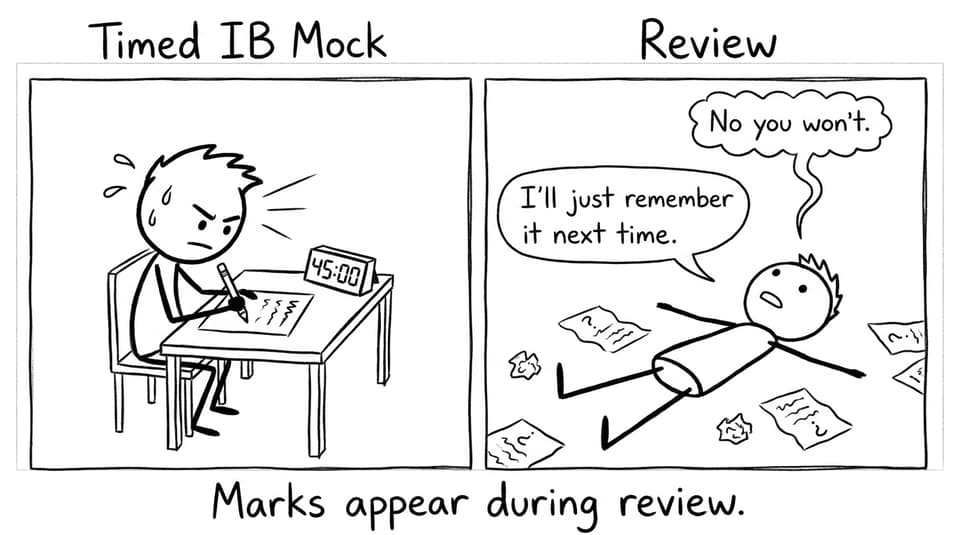
The most common IB mistake is treating mocks like a fitness test: you do it, you get a score, you move on.
But marks don’t appear during the mock. They appear during review.
A productive review loop looks like this:
-
Mark: identify exactly where marks were gained or lost.
-
Name the pattern: “I don’t define terms precisely” or “I don’t link back to the question.”
-
Create one rule: a sentence you’ll follow next time.
-
Drill: do a short set targeting that specific weakness.
-
Retake: redo a similar question 48 hours later.
RevisionDojo is designed for this kind of IB loop: practice in the Questionbank, get fast feedback, and use connected tools (Notes, Flashcards, AI Chat, Grading tools, Mock Exams, Predicted Papers, Coursework Library, Tutors) so you don’t lose momentum switching platforms.
FAQ
How many IB mock exams should I do total?
Most IB students don’t need a heroic number. A realistic target is one mock-style session per subject per week starting 8--10 weeks out, then one full mock per subject per week in the last 6 weeks. That usually gives you enough repetitions to build timing and confidence while still leaving space for learning and correction. The real limiter is review time, not motivation. If you can’t review a mock properly, doing another one often just repeats the same mistakes faster. Aim for fewer mocks with better feedback loops.
Should HL and SL follow the same IB mock exam schedule?
They can follow the same structure, but not the same intensity. HL subjects typically demand more time because they test broader content and deeper application, and many HL papers punish slow pacing. In the last 6 weeks, HL students often benefit from an extra mini-mock (a hard section under time) in addition to the weekly full mock. SL subjects usually respond best to steady consistency: one full mock a week plus targeted practice sets. The key is to adjust based on evidence from your results, not on stress. A good IB mock exam schedule adapts to what your data reveals.
What if I’m doing mocks but my IB scores aren’t improving?
First, check whether you’re reviewing at the level of patterns rather than answers. Improvement usually comes from fixing repeatable mistakes: command terms, structure, definitions, or time allocation. Second, make sure your follow-up practice is targeted, not random. After each IB mock, pick two weaknesses and drill them using exam-style questions before your next timed session. Third, shorten the gap between attempt and feedback; waiting a week to review makes it harder to change habits. Tools that speed up marking and analysis can make a big difference here, because they compress the time between “I made the mistake” and “I know how to fix it.”
Bring your IB mock exam schedule back to one simple idea
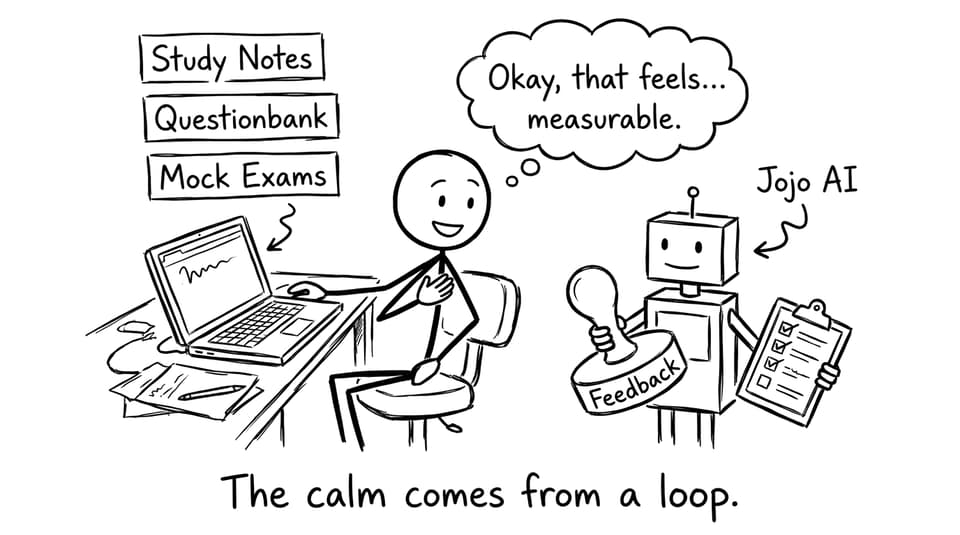
A strong IB mock exam schedule is not about doing as many timed papers as possible. It’s about building a calm, repeatable loop: attempt under pressure, get feedback, fix the pattern, then retest.
If you want one place to run that loop without juggling documents and guesswork, start with RevisionDojo’s RevisionDojo for IB hub and build your routine around Study Notes, Flashcards, the Questionbank, AI Chat, Grading tools, Mock Exams, Predicted Papers, the Coursework Library, and Tutors. Your next IB mock should feel less like a verdict and more like a plan.
