
The moment your IB Math IA gets real
There’s a specific kind of panic that only shows up when your IB Math IA stops being “something I’ll do later” and becomes an empty document with a blinking cursor.
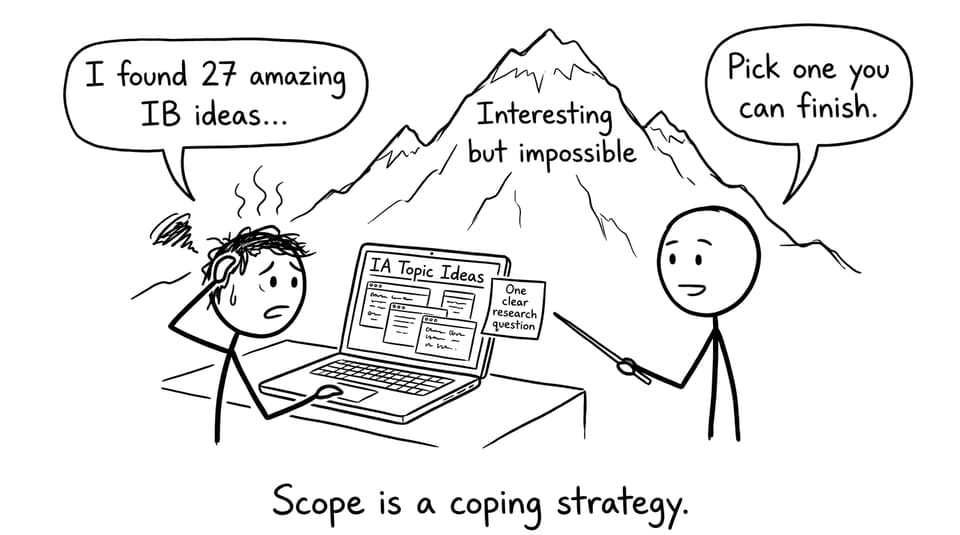
You search for topic ideas. You find dozens. Most look impressive. Then you realise the hidden cost: every “cool” idea quietly asks for clean data, a defendable method, and a research question that fits the word limit.
That’s why statistics and probability are such a smart IB choice. They let you turn real-world mess into mathematics you can explain, justify, and evaluate. This guide shares 2025’s smartest picks for an IB Mathematics IA in statistics and probability, plus the small decisions that separate a readable exploration from a high-scoring one.
A quick IB checklist for choosing a strong stats/probability IA
Before you commit to any IB topic idea, run it through this simple filter:
-
One clear research question (not a theme).
-
Measurable variables with units and definitions.
-
Enough data to model and test (often 30-50+ points, depending on your plan).
-
Math beyond description (regression, distributions, hypothesis testing, simulation).
-
Interpretation and evaluation (limitations, assumptions, improvements).
If you want to revise the required techniques while you plan, keep the syllabus strand open as you work: Statistics & Probability for IB Math AA.
What IB examiners reward in statistics and probability
A good IB statistics or probability IA is rarely the one with the fanciest dataset. It’s the one where the student makes deliberate choices and explains them like a thinker, not a calculator.
In practice, that means:
-
You justify why a method fits the question.
-
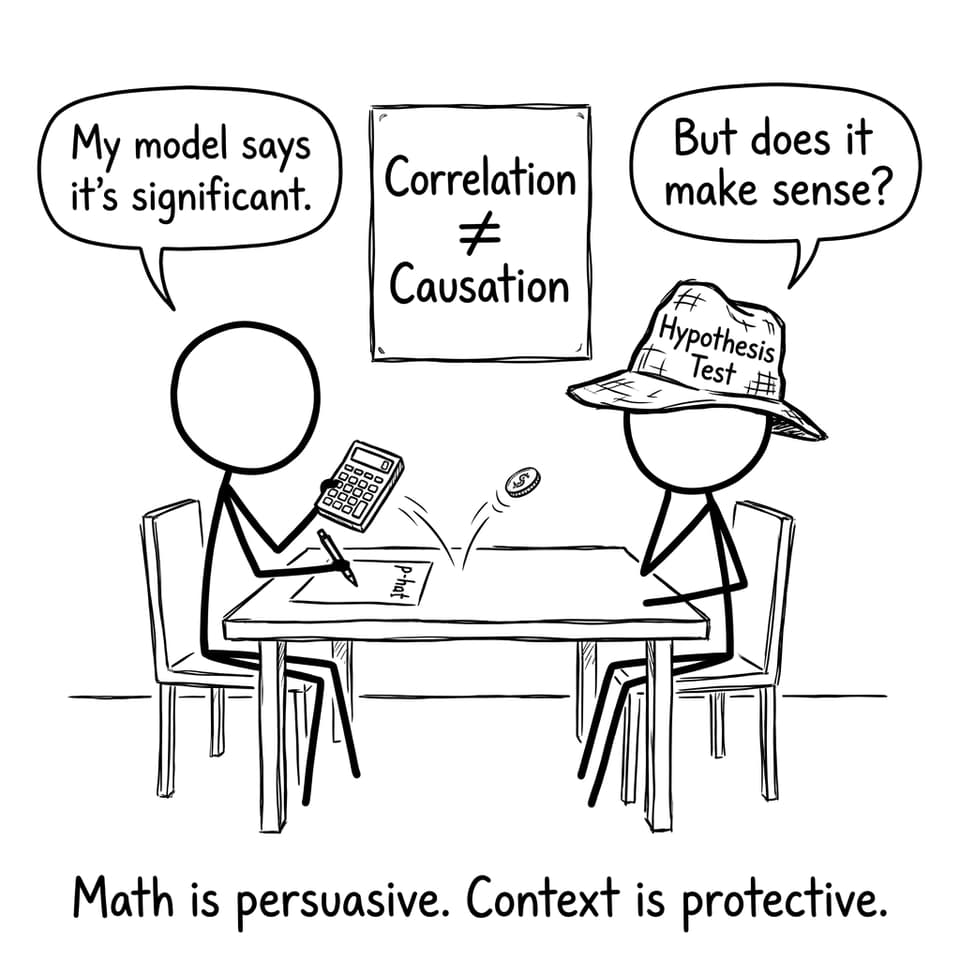
You interpret results in context (what it suggests, and what it does not prove).
-
You reflect on reliability: bias, sample size, measurement error, outliers.
-
You show mathematical communication: clear graphs, correct notation, meaningful commentary.
If you struggle to write the explanation part (most IB students do), this guide helps you turn calculations into examiner-friendly reasoning: How to Explain Statistical Analysis in an IB Math IA.
IB Math IA topic ideas for statistics (2025’s smartest picks)
Each idea below is built to be realistic for IB timelines, rich enough for marks, and flexible across AA/AI and SL/HL (your depth changes, not the whole direction).
Social media and attention economics (regression + evaluation)
Core question idea: How do post characteristics predict engagement?
Example research questions:
-
“To what extent does caption length predict engagement rate on my chosen platform?”
-
“Is there a relationship between posting time and engagement, and does a linear or non-linear model fit better?”
Math you can include (IB-friendly): scatter plots, correlation, linear regression, residuals, transformations, model comparison.
Built-in evaluation: algorithm effects, confounding variables, platform changes, outliers.
Health, sleep, and performance (survey + hypothesis test)
Core question idea: Do measurable habits relate to measurable outcomes?
Example research questions:
-
“Is there evidence that students who sleep more than 7 hours have higher self-reported focus scores?”
-
“Does caffeine intake associate with reaction time in a simple at-home test?”
Math you can include: sampling design, summary statistics, confidence intervals, hypothesis testing, chi-square for association (where relevant).
Built-in evaluation: self-report bias, placebo effects, small samples, ethics and consent.
Climate and local change (trend + distribution thinking)
Core question idea: Are changes visible in a dataset over time, and how reliable is your model?
Example research questions:
-
“Has the variability of daily temperatures changed over the last 20 years in my city?”
-
“How well does a normal model represent rainfall amounts in a chosen month?”
Math you can include: measures of spread, z-scores, normal distribution modelling, time-series comparison, regression.
Built-in evaluation: station changes, missing data, seasonal effects.
Sports analytics (consistency + prediction)
Core question idea: Model performance and test whether patterns hold.
Example research questions:
-
“Is a player’s scoring consistent enough to model with a normal distribution?”
-
“Do home vs away results show a statistically significant difference for a team?”
Math you can include: distributions, expected value, confidence intervals, hypothesis testing, regression.
Built-in evaluation: small sample windows, opponent strength, rule changes.
Pricing, inflation, and consumer behaviour (model comparison)
Core question idea: Compare markets, regions, or time periods.
Example research questions:
-
“How does the price variance of a common basket item differ across regions?”
-
“Which regression model best fits the trend in a chosen index over time?”
Math you can include: regression, logarithmic/exponential models, residual analysis, discussion of causation vs correlation.
If you want a broader list of directions (including non-stats ideas), cross-check with: IB Math IA Ideas for AA & AI.
IB Math IA topic ideas for probability (high scoring when explained well)
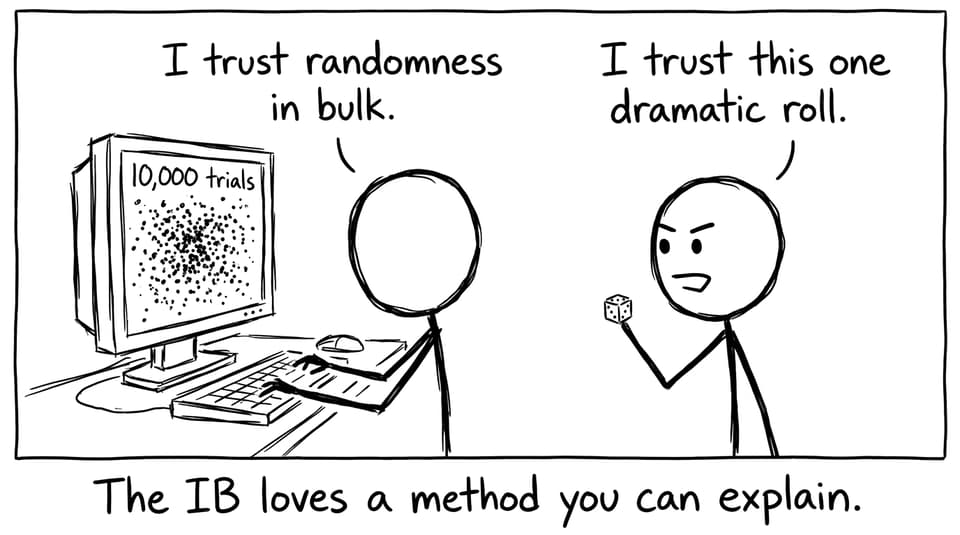
Probability IAs often score well when the uncertainty is the point, not a decoration. The best IB probability explorations treat randomness as something to model, simulate, and critique.
Games, fairness, and strategy (expected value + simulation)
Example research questions:
-
“Is a chosen party game fair, and how would changing one rule alter expected value?”
-
“How many trials are needed before the simulated win rate stabilises within a chosen margin?”
Math you can include: probability trees, binomial model, expected value, variance, simulation.
To revise binomial ideas precisely, drill targeted practice like: Binomial Distribution Questionbank (IB Math AA).
Risk and decision-making (real life probability)
Example research questions:
-
“What is the probability my commute is delayed beyond X minutes, using historical data?”
-
“How do different thresholds change risk for an event plan?”
Math you can include: conditional probability, distributions, modelling assumptions, expected value, sensitivity analysis.
Monte Carlo modelling (clear method, strong reflection)
Example research questions:
- “Using Monte Carlo simulation, estimate the probability of [event] under [assumptions], and test how sensitive it is to parameter changes.”
Math you can include: random number generation, repeated trials, convergence discussion, error/uncertainty, comparison to a theoretical model.
How to structure your IB stats/probability IA so it reads like a story
A reliable IB structure keeps you from over-writing and under-explaining:
-
Introduction: context, why you chose it, and the exact research question.
-
Data and methodology: what you collected, where it came from, why it’s valid enough.
-
Mathematical process: show the method, then show why it fits.
-
Results: not just numbers, but what they mean in the real situation.
-
Reflection: limitations, assumptions, improvements, and what you would do next.
-
Conclusion: answer your research question directly.
If you’re still deciding what’s manageable, these are useful sanity checks: Simplest Math IA Topics for IB Math Success and High-Scoring IB Math IA Topic Ideas.
How RevisionDojo helps you turn an IB idea into a finished IA
A topic idea is only 10% of an IB IA. The rest is execution under time pressure.
RevisionDojo is built for that stretch:
-
Use Study Notes and Flashcards to lock the statistics and probability language you must write with.
-
Use the Questionbank to practise the exact techniques you’re using (so your IA math is confident, not fragile). A practical guide: Targeted Revision Using the Questionbank.
-
Use AI Chat when you need help translating a result into clear interpretation.
-
Use Grading tools to self-check your alignment with the IB criteria. If you want rubric clarity for AA: Maths AA IA Coursework Exemplars and Grader.
-
When exams are close, build stamina with Mock Exams and Predicted Papers: IB Predicted Papers and the strategy behind them: IB Predicted vs Specimen Papers: What They Mean.
FAQ
How do I know if my IB Math IA stats topic is “too simple”?
A topic is usually too simple when the mathematics stops at descriptive statistics: means, medians, and graphs with no modelling choice. In an IB exploration, you want at least one moment where you decide between methods or justify an assumption. For example, choosing a linear model and then checking residuals already creates mathematical decision-making. You can also add depth by comparing two models, testing significance, or discussing whether a distribution fits. The simplest-looking topics can score highly if the reasoning is clear and the evaluation is honest. If you can explain why each step exists and what its limits are, your IB topic is probably not too simple.
How much data do I need for an IB statistics and probability IA?
Enough data means enough to support the method you claim to be using. Many IB students aim for roughly 30-50 data points because it stabilises summary measures and makes regression and testing more meaningful. But the better rule is “enough for your model plus enough to discuss reliability.” If you only have a small dataset, you can still succeed by focusing on uncertainty and limitations, or by using simulation thoughtfully. What matters is that you show the examiner you understand sampling issues, bias, and the difference between a pattern and a proof. In an IB IA, a smaller dataset with excellent evaluation can beat a massive dataset with shallow commentary.
What makes a probability IA feel “IB-level” instead of like a puzzle?
Probability becomes IB-level when you connect the randomness to assumptions, then test those assumptions. A puzzle ends when you compute a probability; an IB exploration continues into interpretation, sensitivity, and reflection. For example, in a game fairness IA, you can change a rule and analyse how expected value shifts, then discuss what “fair” should mean in context. Simulation (like Monte Carlo) can add depth, but only if you explain your process, how many trials you used, and why. You should also evaluate whether a theoretical distribution fits your situation or whether real-world behaviour breaks it. The key is communicating the logic so the examiner can follow your decision-making.
Closing: choose the IB idea you can finish well
The smartest IB Math IA topic is rarely the most original. It’s the one that lets you collect reliable data, apply statistics and probability with purpose, and write reflections that sound like you understand uncertainty.
Pick a question you can answer. Use methods you can explain. Then use RevisionDojo to tighten the mathematics with Study Notes, practise with the Questionbank, and polish with AI Chat and Grading tools. When your IA is done, keep building confidence for IB exams using Mock Exams and Predicted Papers, because good work deserves a strong finish.