


If your IA is due soon, you know the feeling: you sit down to “just tidy the data,” and suddenly it’s 1:47 a.m., your spreadsheet looks like a modern art exhibition, and an AI tool is offering to “generate realistic results.”
In that moment, the temptation feels practical, not immoral. Your experiment failed. Your survey got five responses. Your graph looks wrong. And the IA is still worth a serious chunk of your grade.
But here’s the quiet truth: the IB isn’t testing whether you can produce perfect numbers. It’s testing whether you can show honest thinking. When IA data becomes AI-generated nonsense, you don’t just risk losing marks, you risk losing trust.
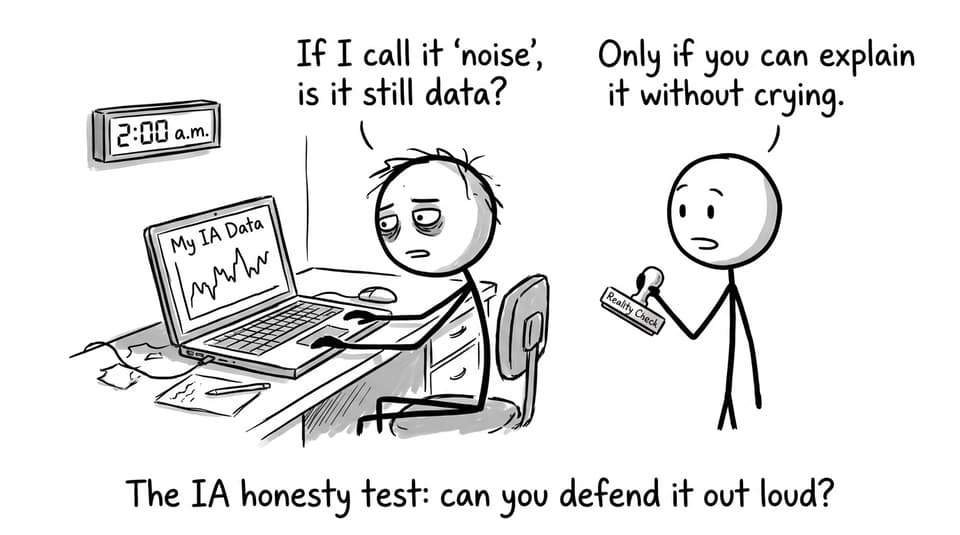
The 60-second checklist: is your IA data “safe” or “nonsense”?
Use this quick filter before you change anything. Your IA data is heading into danger territory if you cannot do most of the following:
-
Explain exactly how each value was produced (method, tool, conditions, assumptions).
-
Show raw evidence (photos, logs, screenshots, instrument readings, survey export files).
-
Justify why the values make sense with the science/math/context you wrote about.
-
Repeat the method and get results that are at least similar in pattern (not identical).
-
Describe limitations and uncertainty without needing to hide anything.
If that list makes your stomach drop, don’t panic. A risky IA can be repaired. But it has to be repaired honestly.
What the IB Internal Assessment is actually testing (and why IA data matters)
A strong IA is not a “results showcase.” It’s a process narrative: you pose a focused question, choose a method, collect or select evidence, analyze it, and reflect on what it means.
That’s why examiner-written guidance repeatedly rewards:
-
Clear research question choices
-
Methodological logic
-
Transparent treatment of data
-
Critical evaluation and reflection
In other words, your IA is graded on thinking you can defend.
If you want a rubric-driven overview of what each subject expects, start with the IB IA Guides hub. It’s one of the fastest ways to stop guessing what “good” looks like.
If your IA data is AI-generated nonsense, what can happen?
Let’s be concrete. If you submit an IA containing fabricated or AI-generated data presented as real, the IB can treat that as academic misconduct (fabrication and/or misrepresentation of authorship).
Here’s the usual chain of reality:
Teacher authenticity checks come first
Your teacher is required to verify the authenticity of your IA. If something feels off, such as values too perfect, patterns too clean, or a method that doesn’t match the results, they may question you or require evidence.
Examiners and moderation can surface red flags
Even if a draft slips through locally, moderation exists for consistency. When an IA reads like it was reverse-engineered from an ideal textbook outcome, it can stand out.
Consequences can be severe
Penalties vary with the case, but the risk is real: you may receive no marks for the component, and serious cases can threaten the diploma.
If you want calm, student-friendly guidance on what “misconduct” actually means, read IB Misconduct Explained: Avoid Plagiarism and Collusion and keep it open while you clean up your IA.
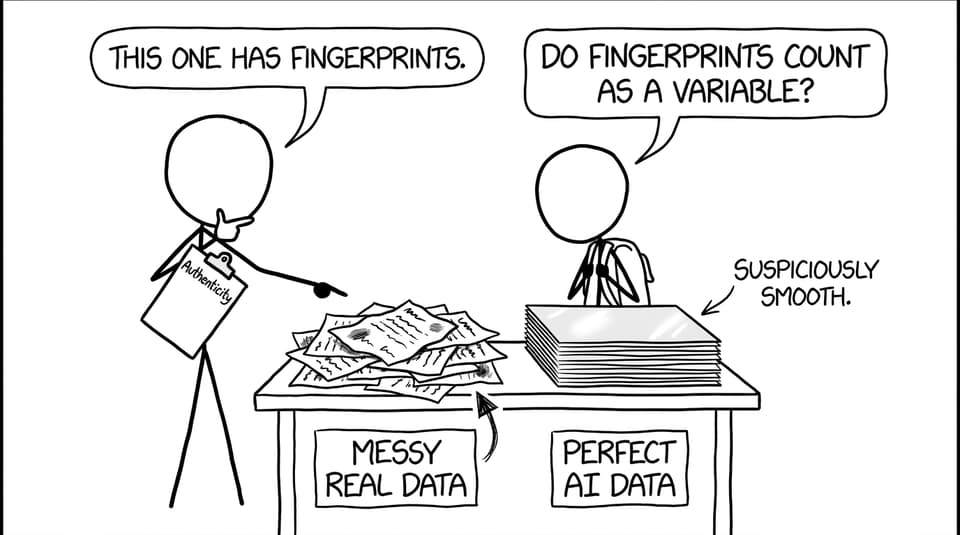
Why AI-generated IA data fails the “defend it out loud” test
Most students don’t get caught because of a magical detector. They get caught because the work can’t survive basic questioning.
AI-generated IA data often creates problems like:
-
Unrealistic smoothness: too linear, too perfect, too low-noise.
-
Inconsistent methodology: the method describes one thing, the numbers behave like another.
-
Missing fingerprints: no raw data trail, no instrument uncertainty, no human mess.
-
Overconfident analysis: claims that don’t match limitations.
The IB rewards students who can say, “Here’s what went wrong, here’s what I did anyway, and here’s what that means.” AI nonsense blocks that sentence.
If you’re anxious about AI rules in general, IB AI Ethics: Use AI Tools Without Breaking Rules is the clearest “line in the sand” explanation.
Acceptable vs unacceptable AI use in an IA (practical version)
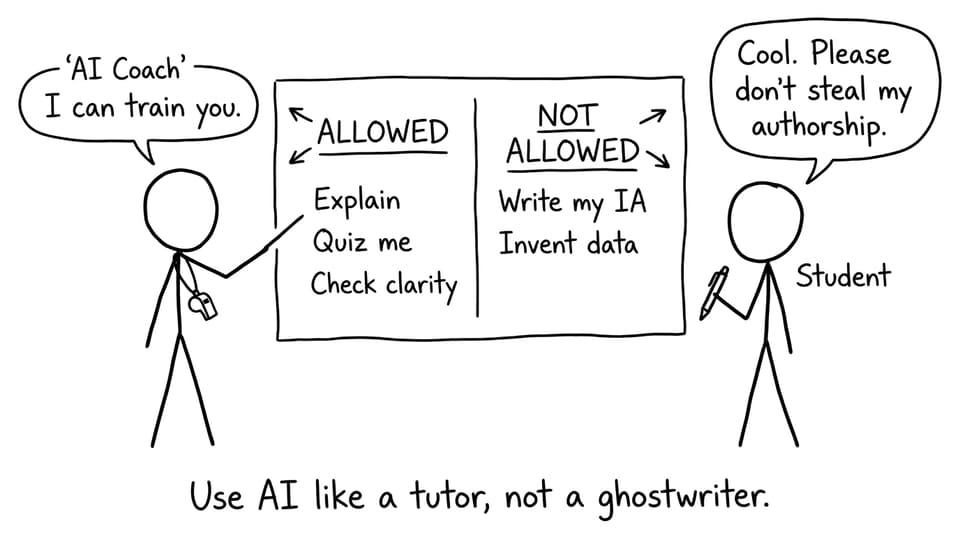
AI isn’t automatically the enemy of your IA. The problem is authorship and truth.
Acceptable uses (usually)
-
Asking AI to explain concepts you don’t understand (so you can write your own explanation).
-
Using AI to help you plan a method checklist or identify variables to control.
-
Generating graphs from your real dataset (and keeping the raw file trail).
-
Getting feedback on clarity: “Where am I being descriptive instead of analytical?”
RevisionDojo’s AI Chat is best used in exactly this way, like a tutor that helps you move, not a machine that replaces you.
Unacceptable uses (high risk)
-
Inventing values you didn’t measure or obtain from a valid cited dataset.
-
Copying AI-written evaluation/analysis as your reflection.
-
Making your method sound legitimate while the evidence was generated.
For a deeper look at how the IB evaluates AI misuse, Can IB Detect ChatGPT? AI, Integrity, and Smart Study is worth reading before you finalize your IA.
What to do if you already used AI-generated nonsense in your IA
This is the part most students avoid. And it’s the part that protects you.
Tell your teacher early (before the work is finalized)
Early honesty gives you options. Late discovery removes options.
Replace fantasy with reality, even if reality is smaller
A smaller, real dataset with good evaluation can score far better than a large fabricated dataset. In many subjects, thoughtful limitations and error analysis are literally where marks live.
Use approved alternatives properly
Depending on your subject, it may be legitimate to use simulations, databases, or secondary sources, but you must be transparent and cite properly. The key is that your IA must truthfully represent what you did.
Build a “process proof” pack
Save:
-
drafts and version history
-
raw data files and timestamps
-
lab notes, photos, and screenshots
-
citations as you go
If you’re worried about an investigation already, Accused of Academic Misconduct in the IB? What Happens explains the process without drama.
A safer rebuild plan: turn a shaky IA into an authentic IA in 7 days
You don’t need a miracle. You need a sequence.
Day 1: Freeze the draft and label what’s real
Highlight every table, graph, and value. Mark each as:
-
measured by you
-
sourced from a credible published dataset
-
generated by simulation (with settings saved)
-
unknown or invented
Day 2: Pick the smallest honest question you can answer
If your scope is too big, you’ll feel pushed toward shortcuts. Use this guide to narrow cleanly: Refine Your IA Research Question for Clarity and Focus.
Day 3-4: Collect or replace data ethically
Re-run, simplify, or swap to properly cited sources. Your IA becomes safer the moment you can show receipts.
Day 5: Rebuild analysis around what the data can actually support
Don’t force “big conclusions.” Write smaller, truer ones. Then evaluate limitations sharply.
Day 6: Grade it against the criteria (before your teacher does)
Use the IB Coursework Grader to get rubric-aligned feedback, then revise deliberately. This is where RevisionDojo’s Grading tools help you see what’s missing while there’s still time.
Day 7: Stress-test your IA like an examiner
Ask yourself: “If someone points to any number, can I explain where it came from?” If yes, your IA is getting safe.
How RevisionDojo helps you keep your IA authentic (and still score higher)
The hardest part of an IA is that it collides with exam prep. You need coursework integrity and exam stamina at the same time.
RevisionDojo is built for that reality:
-
Study Notes to clarify the content your analysis depends on
-
Flashcards to keep key definitions and method language sharp
-
Questionbank to stay exam-ready while coursework takes time
-
AI Chat to unblock concepts without copying phrasing
-
Grading tools to align your draft to criteria early
-
Predicted Papers and Mock Exams to keep exam timing real
-
Coursework Library to calibrate what strong structure looks like
-
Tutors when you need a human to pressure-test your plan
A good starting point is the IB Internal Assessment: A Complete Guide, then use the IA tag archive to find subject-specific support.
FAQ
Can I still get a good grade if my IA data is messy or limited?
Yes, and in many subjects it’s more normal than students admit. A strong IA is often built on imperfect data with excellent explanation: uncertainty, limitations, and realistic improvements. Examiners don’t punish you for being human; they reward you for being honest and analytical. If your dataset is small, focus on the quality of processing and the clarity of your reasoning. Make your evaluation specific rather than generic, and show you understand why the method produced the pattern it did. In practice, “messy but defensible” beats “perfect but suspicious” almost every time.
What if my experiment failed and I have almost no usable results?
A failed attempt can still become a valid IA if you handle it correctly. First, document what happened clearly: what you expected, what occurred, and what evidence supports that claim. Second, adjust your design in a way that’s realistic in your time and resource limits, then collect a smaller set of better-controlled trials. Third, use your evaluation section to explain precisely how you would improve reliability and validity with more time. If you truly cannot collect more data, ask your teacher about using a properly cited secondary dataset or an approved simulation method, but make the switch transparent. The goal is to restore honesty and defensibility.
Is it okay to use AI tools to help write my IA if I change the wording?
Changing wording is not the same as authorship, and that’s where students get burned. If an AI tool produced the substance of your IA, including the analysis, the evaluation logic, and the argument structure, then “editing it into your voice” can still be misconduct because it misrepresents who did the thinking. The safer approach is to use AI for tutoring actions: explaining concepts, checking clarity, generating practice questions, or pointing out gaps. Then you write from scratch, using your own reasoning and your own evidence trail. If AI influenced something meaningfully, follow your school’s expectations for disclosure. Your best protection is being able to explain every sentence and every number out loud.
Closing: your IA isn’t a performance, it’s a record
If your IA data is AI-generated nonsense, the fix is not better nonsense. The fix is returning to something the IB actually respects: an honest method, an evidence trail, and reflection that sounds like a real student doing real work.
Your IA doesn’t need to be flawless. It needs to be defensible.
If you want the calmest next step, start on RevisionDojo: use the IA Guides to match the rubric, run a check with the Coursework Grader, and keep your exam momentum with the Questionbank, Flashcards, Predicted Papers, and Mock Exams. Then use AI Chat and Tutors for support that strengthens your authorship instead of replacing it.
Because the best feeling in IB isn’t submitting something perfect. It’s submitting something you can stand behind.