In the IB, the worst feeling isn’t getting a question wrong.
It’s doing a lot of work and realizing you’re still the same student you were last week.
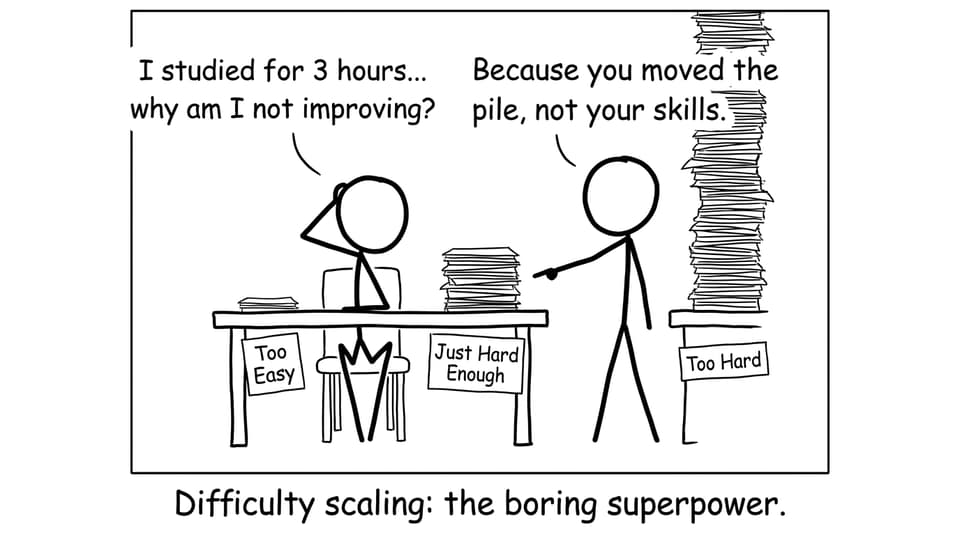
Most of the time, that happens because your practice is the wrong kind of hard. Too easy, and you collect comfort. Too hard, and you collect panic. IB difficulty scaling is the middle path: practice that meets your current skill level today, then nudges it upward tomorrow.
Comic about too easy vs too hard vs just hard enough
IB difficulty scaling, in one practical checklist
Use this quick checklist to make IB practice actually translate into marks:
Start with a short diagnostic set (10--15 questions).
Aim for “stretch success”: roughly 60--80% accuracy.
Increase difficulty only after two stable sessions.
If accuracy collapses, drop difficulty and patch the exact gap.
First, the “I feel productive” trap: you repeat familiar questions, so you move fast, score high, and learn very little. Second, the “I’m behind” trap: you jump to the hardest questions because they look like the exam, but you’re missing the foundation that makes those questions solvable.
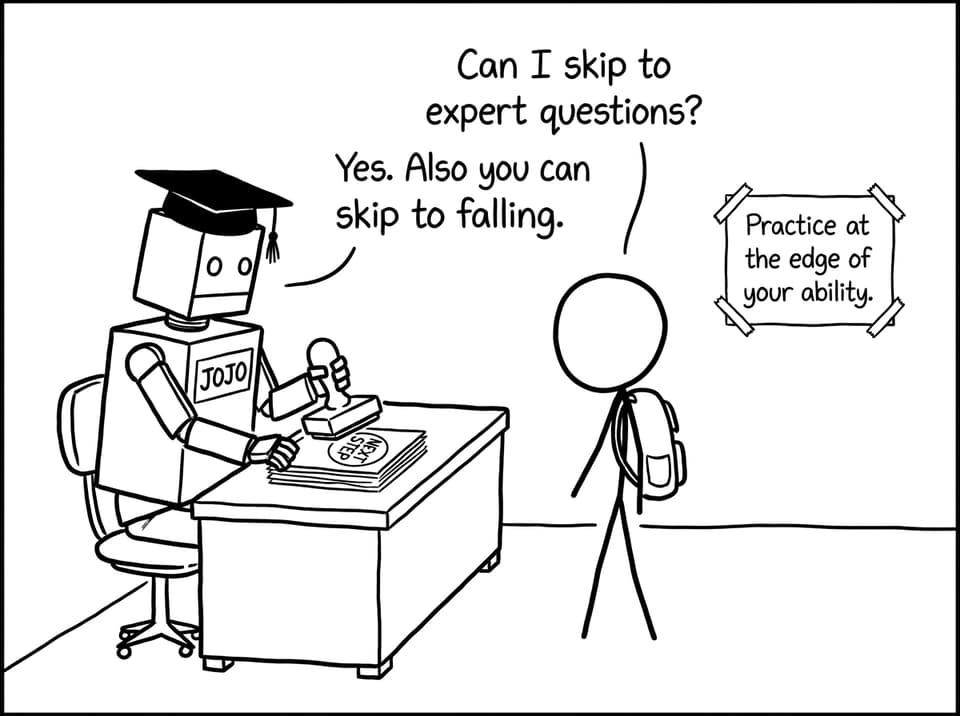
The IB is cumulative. A fragile definition today becomes a lost method mark tomorrow. That’s why difficulty scaling matters: it keeps you practicing at the edge of your ability, where growth is most likely.
Topic-level patterns show where marks leak, even when your overall score looks “fine.”
That’s the difference between guessing your level and testing it.
On RevisionDojo, you can combine adaptive practice with targeted tools: build clarity in Questionbank, lock recall with Flashcards, and get unstuck mid-session with Jojo AI Chat inside the platform.
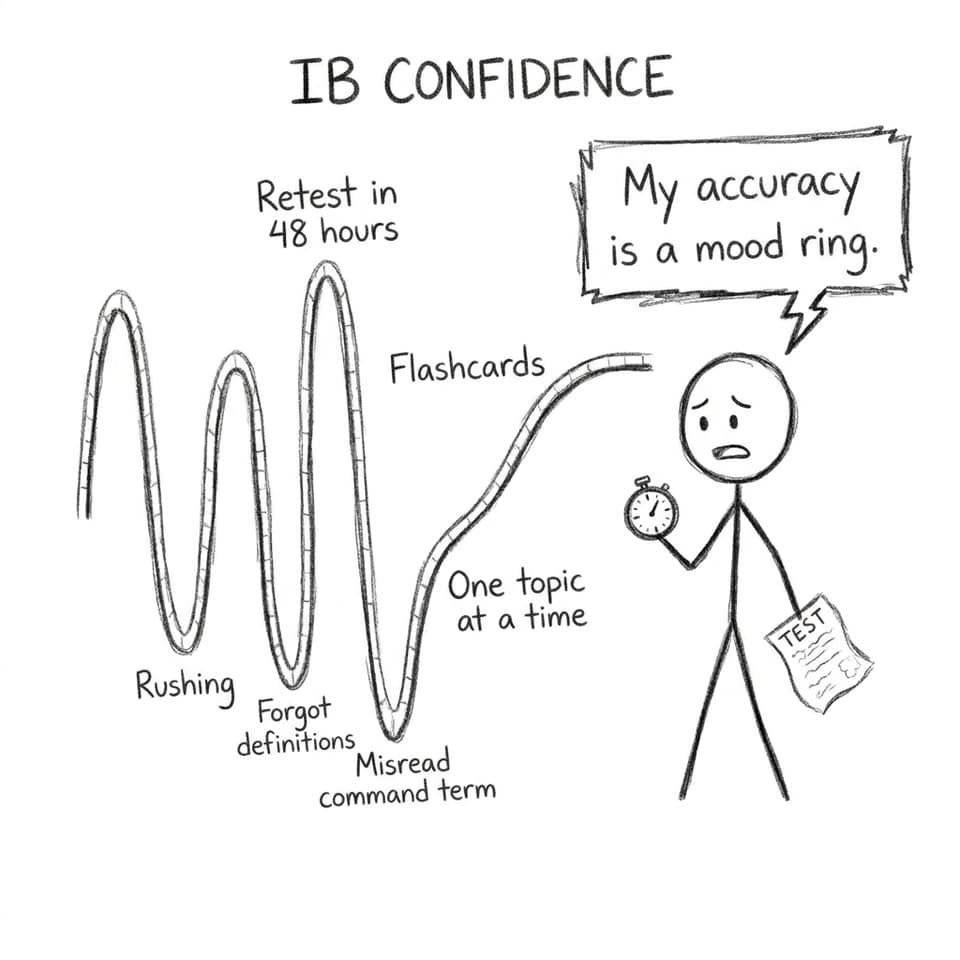
Comic about confidence rollercoaster and retesting
A simple IB workflow for scaling difficulty over time
Here’s a sustainable way to use IB difficulty scaling week after week.
Start in “revision mode” before you try full simulations
Common misconceptions IB students have about difficulty scaling
Many students assume scaling means “staying comfortable.” It doesn’t. It means earning the right to struggle productively.
Others think adaptive practice removes responsibility. In reality, it asks for more honesty: you can’t hide behind random worksheets when your patterns are visible.
And some worry that lowering difficulty is regression. In IB revision, lowering difficulty is often repair. Repair prevents future collapses.
FAQ
How do I know if my IB practice is the right difficulty?
In the IB, the right difficulty feels like you have to concentrate, but you’re not drowning. A useful range is often 60--80% accuracy, especially in the middle phase of revision. If you’re getting 95% consistently, you’re probably rehearsing, not improving, even if it feels efficient. If you’re stuck at 20--40%, the set may be too hard or too broad, and you’ll spend most of your time confused rather than learning. The best sign is this: after reviewing feedback, you can explain why you lost marks and what you would do differently next time. If you can’t describe the fix, change the difficulty or narrow the topic.
Should I only use adaptive difficulty and never do timed IB papers?
Adaptive difficulty is a training tool, not the finish line. IB exams demand stamina, pacing, and the ability to stay calm through unfamiliar phrasing. That means you still need timed practice, but it should arrive at the right moment in your progression. Start with untimed or lightly timed sets to build clean thinking, then add short timed blocks once your accuracy stabilizes. Finally, build realism with full exam-style sessions using RevisionDojo’s Mock Exams and Predicted Papers features, so pressure becomes familiar rather than shocking. The smartest approach blends both: adaptive practice for growth, timed practice for transfer.
What should I do after an adaptive set if I keep making the same IB mistake?
Repeated mistakes are a gift because they’re specific. In the IB, the quickest gains come from turning one repeated error into one repeatable rule, like “define before I explain” or “state the principle, then apply it to the data.” After your set, open your feedback and tag the pattern: content, command term, method, or time. Patch content with Study Notes, then immediately do a smaller re-test set (3--8 questions) focused only on that weakness. Convert the mistake into Flashcards so it resurfaces before you forget again. If the mistake is conceptual and sticky, ask Jojo AI Chat to explain the idea using a different angle, then re-attempt with your new explanation in mind.
Bring IB difficulty scaling into your daily routine
The goal of IB difficulty scaling isn’t to make practice easier. It’s to make progress predictable.
If you want that feeling of steady upward momentum, build your loop inside RevisionDojo: practice with the Questionbank, patch confusion with Study Notes, retain details with Flashcards, get unstuck with AI Chat, validate readiness with Mock Exams and Predicted Papers, and refine written work using Grading tools, the Coursework Library, and Tutors when you need human-level feedback.
In the IB, confidence isn’t a personality trait. It’s the side effect of training at the right level, consistently, until hard becomes normal.
Rachel earned an MSc in Environmental Management and has taught IB Geography and ESS for 18 years across schools on four continents, including roles in Nairobi, Kuala Lumpur, and Sao Paulo. Her focus is IB Geography and ESS, weaving current case studies into structured answers and the fieldwork-based internal assessment.