

The night before an IB exam, most students do the same small ritual: they line up pens, charge the calculator, and promise themselves they’ll “just look up the formula” if they blank.
And then the exam starts.
Suddenly the IB Data Booklet isn’t a comforting safety net. It’s a time-eating booklet you flip through with shaky fingers while the clock does its slow, smug walk across the room.
The difference between a stressful booklet and a powerful one is not intelligence. It’s familiarity. In IB exams, speed comes from knowing where things live, what’s given, what’s not, and how to convert a page of symbols into method marks.
IB Data Booklet quick-start checklist
Use this as your simple IB routine (and keep it consistent):
-
Get the right booklet early (subject + syllabus version).
-
Spend 15 minutes learning the layout before doing any timed practice.
-
Do question practice with the IB Data Booklet open from day one.
-
Identify your “top 10” most-used pages/sections.
-
Drill unit awareness (the booklet often gives you the clue you need).
-
Run timed sets where you’re allowed to use only what the exam allows.
If you want a structure that makes this automatic, combine booklet practice with RevisionDojo’s Questionbank and tight topic review loops.
Why the IB Data Booklet matters more than you think
The IB isn’t testing whether you can hoard formulas in memory like a spreadsheet. It’s testing whether you can:
-
choose the right relationship,
-
apply it correctly,
-
communicate working clearly, and
-
keep your logic clean under time pressure.
The IB Data Booklet supports that philosophy. It standardizes constants and core equations so your grade depends less on recall and more on application.
But there’s an uncomfortable truth: examiners expect you to use the booklet fluently. If you lose two minutes hunting for something basic, you don’t just lose time. You lose calm. And in IB, calm is often what keeps method marks intact.
How to use the IB Data Booklet during revision (the smart way)
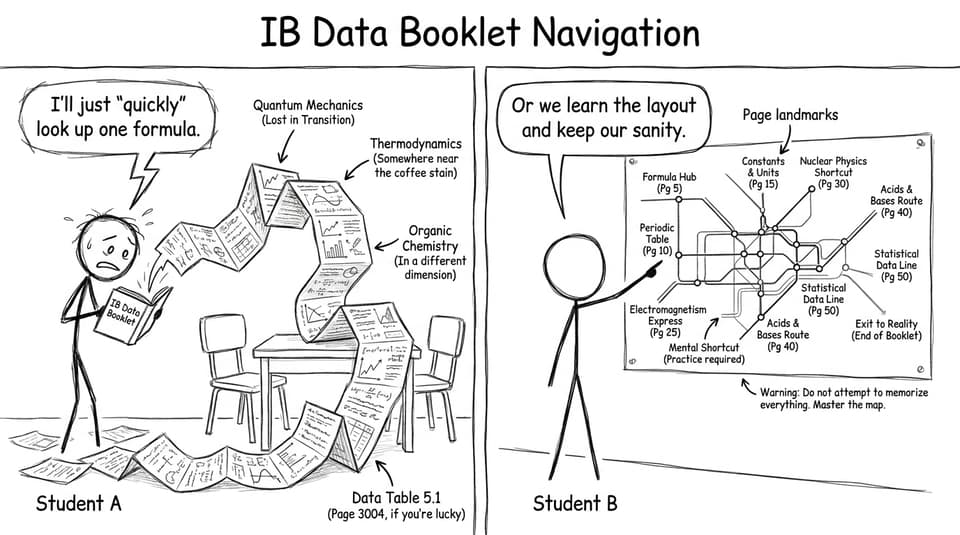
Learn the layout like it’s a map, not a document
Treat the booklet like a city you’re going to navigate in a storm. You don’t need to memorize every street. You need landmarks.
Do one calm session where you simply flip through and label sections mentally:
-
“This is where constants live.”
-
“This is where statistical distributions appear.”
-
“This is where core calculus identities tend to sit.”
If you’re doing Math, RevisionDojo’s IB Mathematics AA Data Booklet is a clean, exam-aligned reference to train with. If you’re doing Chemistry, use the IB Chemistry Data Booklet alongside your topic practice.
Practice questions with the booklet open from the start
Most IB students only open the booklet when they’re stuck. That creates a bad habit: the booklet becomes a panic button.
Instead, use it while you’re not stuck. When you do practice questions, deliberately confirm:
-
the exact symbols the booklet uses,
-
the exact form of the equation,
-
what units are implied.
This is where RevisionDojo becomes a multiplier: you can do targeted sets in the IB Question Bank guide mindset, but with the IB Data Booklet always in play.
Build “booklet fluency” with timed micro-drills
Try this IB drill 3 times a week:
-
Set a 12-minute timer.
-
Choose 6 questions that require booklet use.
-
Your goal is not just accuracy. It’s: find, select, apply, show working.
Then review like a scientist. Ask: did you lose time finding the page, or applying the idea?
For broader planning, borrow the weekly loop in How to Study for IB Exams: Step-by-Step Guide.

How to use the IB Data Booklet in the exam (without bleeding time)
Decide fast: booklet or memory?
In IB exams, you often know the formula. Still, checking the booklet can prevent tiny errors (signs, exponents, definitions). The trick is to check with purpose, not anxiety.
Use the booklet when:
-
you’re unsure of the exact form,
-
you need a constant/value,
-
units are about to trap you,
-
you want to verify a relationship before committing.
Let units and definitions do part of the thinking
A surprising number of IB mistakes come from treating the booklet as “math wallpaper.” Don’t.
Read the small details. Subscripts, conditions, and units are often the difference between a full-method solution and an almost-correct one.
Keep method marks in mind
The booklet gives you tools, not marks. You still need to show the working that earns credit. If you want more practice with examiner-style expectations, RevisionDojo’s IB Predicted Papers are built to rehearse realistic pacing and mark allocation.
Common IB Data Booklet mistakes (and quick fixes)
-
Learning it too late: Fix by doing one “layout session” early, then micro-drills weekly.
-
Over-relying on it: Fix by pairing booklet use with concept clarity from IB Physics Revision Notes or the wider IB Subject Note Collections.
-
Ignoring exam-day rules: Fix by practicing messy at home but remembering the exam booklet must be clean.
-
Flipping without a plan: Fix by building mental landmarks and timing your lookups.
FAQ
Do I still need to memorize formulas if the IB Data Booklet exists?
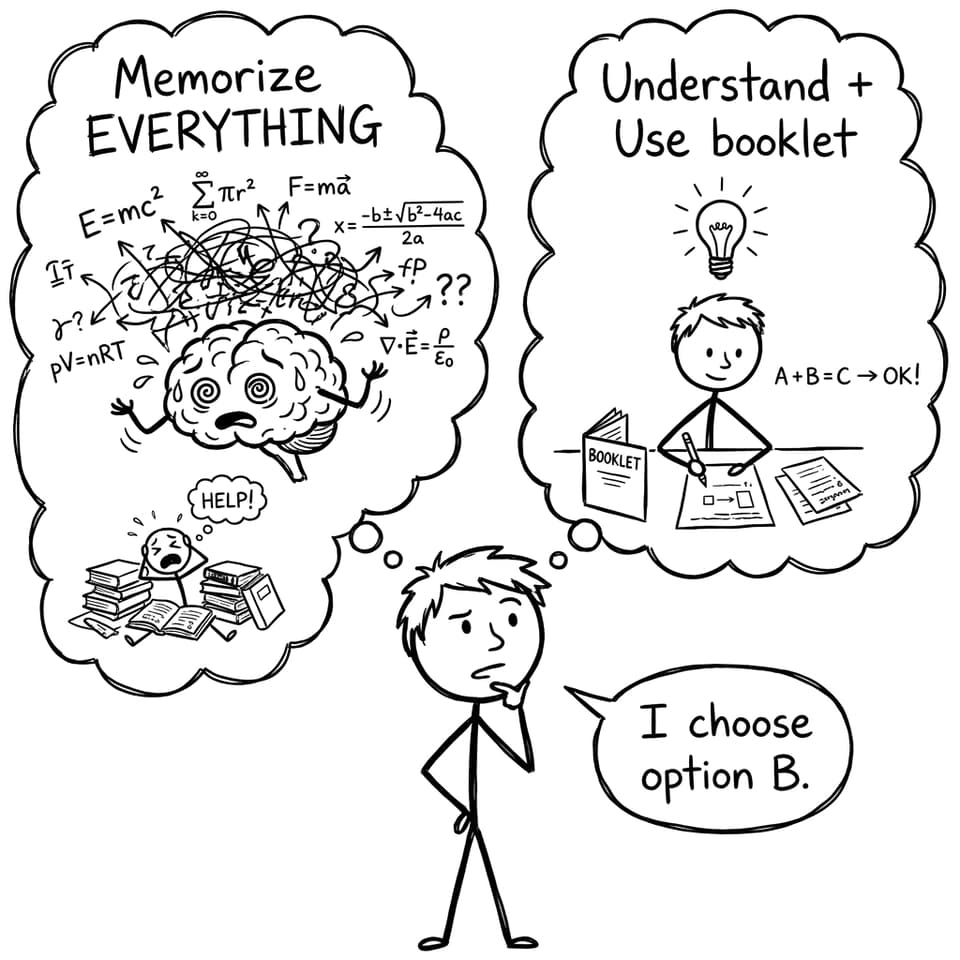
Yes, but not in the way most IB students fear. The IB Data Booklet includes selected formulas and reference values, not everything you might ever use. Even when a formula is provided, you still need to recognize when it applies, what each symbol means, and how to rearrange it correctly. Memorizing a small set of high-frequency relationships can still save time, especially for multi-step problems. But the bigger win is understanding: if you understand the idea, the booklet becomes a confirmation tool rather than a crutch. When you combine understanding (Study Notes) with application (Questionbank), the memorization load feels lighter and more strategic.
Can I annotate or highlight my IB Data Booklet?
In the real IB exam, you should assume the official booklet must remain unmarked, and your school will provide what is allowed for that session. That means no personal sticky notes, no highlighting, and no handwriting in the booklet you use in the exam room. However, for revision, many students learn faster by using an annotated copy at home. The key is to use annotations to learn the layout, not to replace understanding. Your goal is that by exam day you no longer need the tabs, because your navigation is already trained. Practice messy, bring clean.
How often does the IB update the Data Booklet?
The IB updates materials periodically, most commonly around syllabus changes. That’s why it matters to download or access the correct booklet for your specific course (subject and level) and your exam session. Using an older booklet can lead to wasted time if sections are reorganized or if formula sets differ slightly. A simple habit helps: at the start of revision season, confirm you’re using the current version and stick to it. Then do all your timed practice with that same reference so your page memory stays consistent. Consistency is what turns the booklet into speed.
The calm advantage: turn the IB Data Booklet into a habit
The IB Data Booklet is most powerful when it stops feeling like a document and starts feeling like a familiar tool. You don’t rise to the occasion in an exam. You fall back to what you’ve rehearsed.
If you want the simplest next step, build a loop inside RevisionDojo: clarify with Study Notes, lock recall with Flashcards, drill with the Questionbank, get unstuck with AI Chat, and rehearse timing with Mock Exams and Predicted Papers. The goal is exam-day confidence that comes from repetition, not hope.
For a final exam-week routine, keep What to Do the Night Before IB Exams nearby and make your IB preparation feel boring in the best way: predictable, practiced, and ready.