
There’s a particular kind of quiet panic that shows up in the IB.
It’s not the day before an exam.
It’s the moment you realize your final result isn’t waiting in May papers alone; it’s already hiding inside drafts you wrote at 1:13 a.m., in paragraphs you’re “pretty sure are fine,” and in a rubric you haven’t read carefully since your teacher first mentioned it.
That’s why IB coursework grade prediction matters. Not because it promises certainty, but because it turns vague anxiety into something you can actually manage: a realistic estimate, a few clear levers, and a plan.
Why IB coursework grade prediction changes your exam season
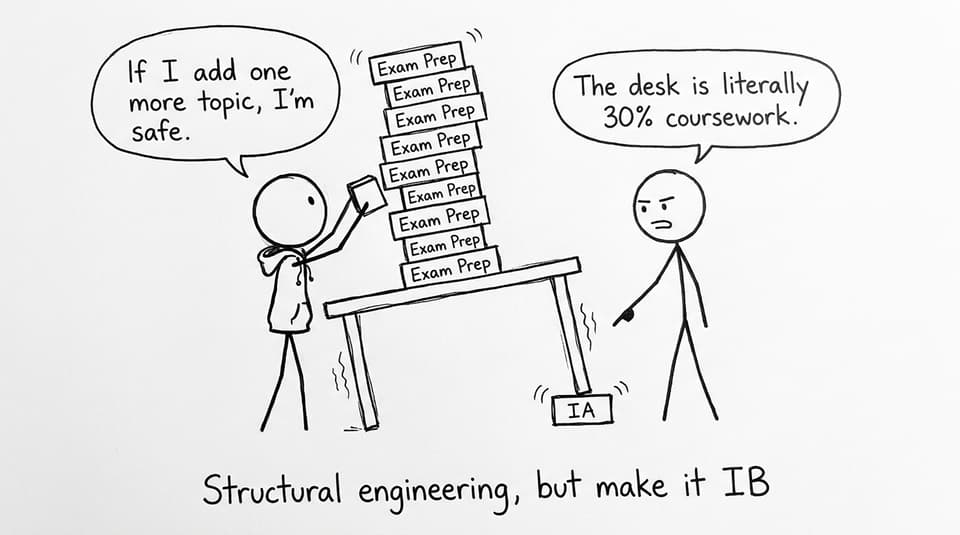
In many IB subjects, your Internal Assessment (IA) counts for roughly 20-30% of the final grade. Then you add core components like the Extended Essay (EE) and TOK assessments, and suddenly a large share of your diploma outcome is influenced before you sit your final papers.
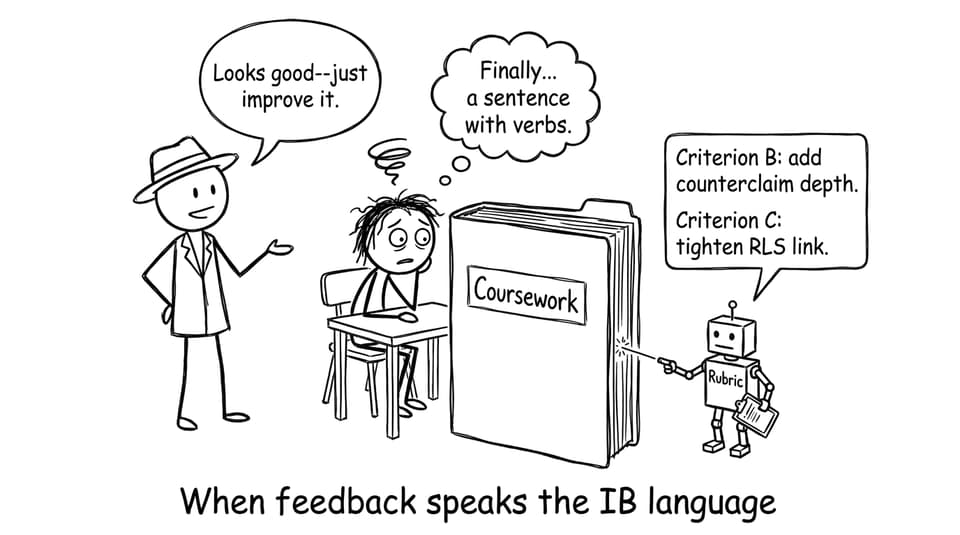
The hard part is that coursework feedback often arrives late, or it arrives as comments that feel like weather reports: “good,” “needs depth,” “be more analytical.”
IB coursework grade prediction helps you translate that fog into numbers and criteria. It gives you a way to:
-
Estimate where your IA/EE/TOK draft currently sits
-
See strengths and weaknesses in rubric language
-
Decide what edits actually move marks
-
Set realistic exam targets based on your coursework trajectory
A good prediction doesn’t replace your teacher. It replaces guesswork.
Quick checklist: estimate your IB final score using coursework + evidence
Before you try to predict anything in the IB, gather inputs that are defensible:
-
Your latest IA, EE, or TOK draft (even if it’s messy)
-
The official rubric/criteria language for that task
-
A realistic range for exam performance (from timed practice, not vibes)
-
Your session/timezone grade boundaries for exam conversion
-
A target outcome (for a subject grade or 0-45 total)
If you want the clearest overall estimate, pair coursework prediction with a diploma-level calculator like the IB Grade Calculator and the IB Grade Boundaries.
What an IB coursework grade prediction tool actually does
Think of a strong IB coursework predictor as a “rubric simulator.” It tries to approximate how an examiner would read your work: not as a friend, not as a fan, but as someone scanning for specific evidence that matches descriptors.
RevisionDojo’s approach lives inside the IB Coursework Grader. You upload a draft, select the subject and task (IA, EE, TOK), and receive rubric-aligned feedback that breaks performance down by criterion.
In practice, a good IB coursework grade prediction output usually includes:
-
Estimated marks/bands per criterion
-
A predicted overall coursework score (task-dependent)
-
Action steps focused on the highest-impact criteria
-
Language that mirrors what the IB rewards (not generic writing advice)
It’s formative. It’s guidance. And it’s most powerful when you use it iteratively.
What coursework you can predict in IB (and why that’s useful)
Your final IB score is not one monolithic thing. It’s a bundle of components, each with its own scoring logic.
Internal Assessments (IA)
Most students underestimate how “mechanical” IA marking can be. Small structural improvements can unlock disproportionate marks.
If you’re still building your foundation, start at the hub: IB IA Guides. For broader context, this overview helps too: IB Internal Assessment: A Complete Guide.
And if your draft feels blurry, the fastest win is often the research question itself: Refine Your IA Research Question for Clarity and Focus.
Extended Essay (EE)
The EE has a special talent for swallowing weeks. A prediction tool can help you spot when you’re writing “more” but not writing “better.”
If you need a starting map, use EE Guides and then go deeper with:
TOK
TOK is where smart students sometimes lose marks simply because the thinking is not made visible. Prediction helps because it forces the draft to behave like a rubric-driven argument.
If you’re rebuilding structure, start here: Structuring for Success in IB TOK Essays.
How IB coursework grade prediction works (the practical version)
Here’s the simplest way to understand IB coursework grade prediction: it searches for criterion evidence.
Not “is this interesting?”
But:
-
Did you define what you mean by key terms?
-
Did you justify choices with method and reasoning?
-
Did you evaluate limitations and implications?
-
Did you link claims to evidence clearly enough that marks are easy to award?
In an IA, that might look like tightening analysis and evaluation rather than adding background.
In an EE, it might look like moving from summary to critical discussion.
In TOK, it might look like balancing claim and counterclaim and explicitly evaluating conditions.
The point is not to chase perfection. The point is to locate the bottleneck.
A simple step-by-step: estimate your final IB score using RevisionDojo
If you want a clean workflow that matches how examiners think, use this loop:
Upload and predict coursework first
-
Open the IB Coursework Grader.
-
Upload your IA/EE/TOK draft.
-
Review the criterion breakdown and predicted score.
-
Pick 1-2 criteria to improve (not everything).
Convert prediction into exam targets
Once you have a reasonable coursework estimate, move to total planning:
-
Use the IB Grade Calculator to translate your current exam marks into an estimate.
-
Adjust inputs conservatively (use ranges if needed).
-
Compare outcomes to your target grade.
Build a feedback loop for exam improvement
This is where RevisionDojo becomes more than a calculator.
Use:
-
Study Notes to patch knowledge gaps fast (see: IB Subject Note Collections)
-
Flashcards to keep daily recall alive
-
Questionbank to turn understanding into marks under pressure
-
AI Chat to unblock confusion quickly
-
Grading tools to learn what examiners reward
-
Predicted Papers and Mock Exams to train timing and decision-making
-
Coursework Library to calibrate what “good” looks like
-
Tutors when you need a human to diagnose the real issue
If you’re ready to simulate full exam conditions, explore IB Predicted Papers and learn the strategy behind them in IB Predicted vs Specimen Papers: What They Mean.
Tracking progress over time: the underrated advantage
Most IB students treat coursework like a one-time submission. But your results improve fastest when you treat drafts like data.
A prediction tool becomes valuable when you upload multiple versions and watch:
-
Which criteria are trending upward
-
Which criterion is stubbornly limiting your mark
-
Whether your improvements are “cosmetic” or actually mark-moving
This is how you reduce stress without lying to yourself. You’re not hoping you improved; you’re checking.
Common mistakes that break IB grade predictions
Even good IB coursework grade prediction tools can only work with the inputs you give them. These are the errors that make predictions less useful:
Using your best day, not your typical day
If your exam mark inputs come from one unusually good quiz, your total estimate will be inflated. Use timed practice you can repeat.
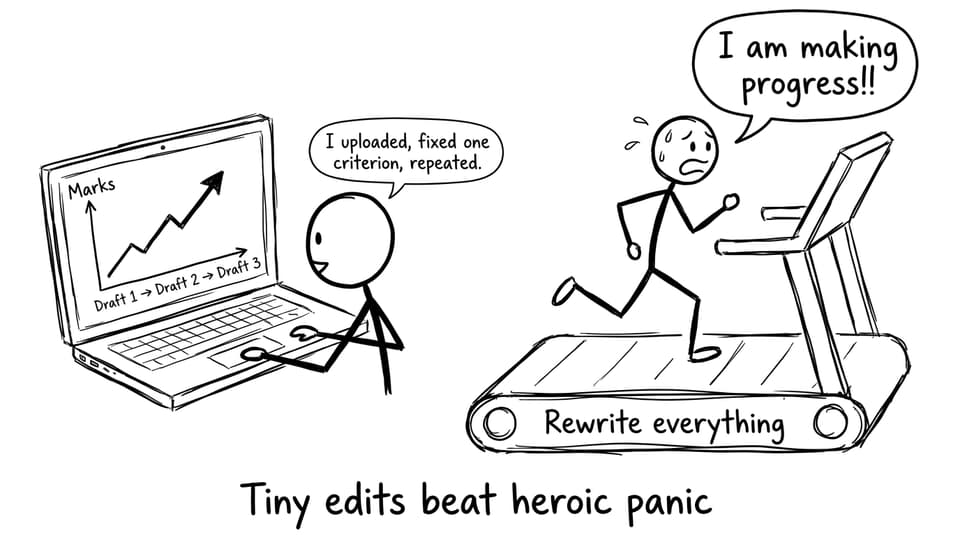
Editing everything instead of improving one criterion
Most rubrics reward depth, not breadth. If Criterion B is low, fix Criterion B first.
Confusing “more writing” with “more marks”
In the IB, word count is not a mark scheme. Clarity and evaluation usually win.
Ignoring boundaries/timezone/session
For final totals, boundaries matter. Keep IB Grade Boundaries bookmarked and treat them like reality.
FAQ: IB coursework grade prediction
How accurate is IB coursework grade prediction?
Accuracy in IB coursework grade prediction depends on two things: how rubric-aligned the model is, and how representative your draft is of what you will actually submit. A prediction is most reliable when your work is already in a near-final structure: clear sections, explicit reasoning, and visible evaluation. It becomes less reliable when the draft is incomplete, heavily outlined, or missing core elements (like method, data handling, or source evaluation). Another key factor is moderation and teacher marking differences, especially for IAs, where internal marks are adjusted externally. That’s why you should treat predictions as a range, not a single guaranteed number. Used correctly, an IB prediction gives you direction and priority, which is often more valuable than perfect precision.
Does an IB coursework predictor replace teacher feedback?
No, and it shouldn’t try to. Teacher feedback carries context: your school’s expectations, your supervisor’s guidance, and practical knowledge of what you can realistically change before deadlines. But teacher feedback is also limited by time, and it can be intentionally cautious or broad. An IB coursework grade prediction tool complements teachers by giving you fast, criterion-based feedback whenever you need it, so you can iterate without waiting weeks. The best approach is to combine both: use the predictor to generate targeted revisions, then ask your teacher focused questions about the exact criteria you’re improving. In the IB, clarity wins, and a tool that helps you ask clearer questions is genuinely useful.
How many drafts should I run through an IB coursework grade prediction tool?
Enough to create momentum, but not so many that you procrastinate behind “one more upload.” For most IB students, 2-4 prediction cycles is a sweet spot: one early draft to catch structural issues, one mid-draft to tighten analysis, and one near-final draft to polish criteria alignment. If you’re close to a deadline, one prediction can still be valuable if you use it to select the highest-impact edits. The key is to treat each round as a hypothesis test: change one or two things, then see if the criterion score moves. That’s what makes IB coursework grade prediction feel like progress rather than noise. And it helps you protect time for exam preparation, which still matters enormously.
Closing: turn IB uncertainty into a plan
The honest truth about the IB is that uncertainty never fully disappears.
But it can shrink.
When you use IB coursework grade prediction properly, you stop asking, “Am I doing enough?” and start asking, “Which change is most likely to earn marks?” That’s a calmer question. And it leads to better work.
If you want to estimate your final score with less guesswork, start with the IB Coursework Grader, then connect it to your diploma plan using the IB Grade Calculator and IB Grade Boundaries.
RevisionDojo is built for the full IB loop: learn with Study Notes, retain with Flashcards, practice with Questionbank, get help fast via AI Chat, tighten writing with Grading tools, rehearse with Predicted Papers and Mock Exams, and lean on the Coursework Library and Tutors when you need certainty from a human.
Predict earlier. Improve smarter. Walk into exams with an IB plan you can defend.