

Precision is a strange kind of confidence.
In the IB Math IA, you can feel certain you did the mathematics correctly… and still lose marks because the reader cannot follow your thinking. It’s like arriving at the right destination with no map, no signs, and no explanation of why you took that route.
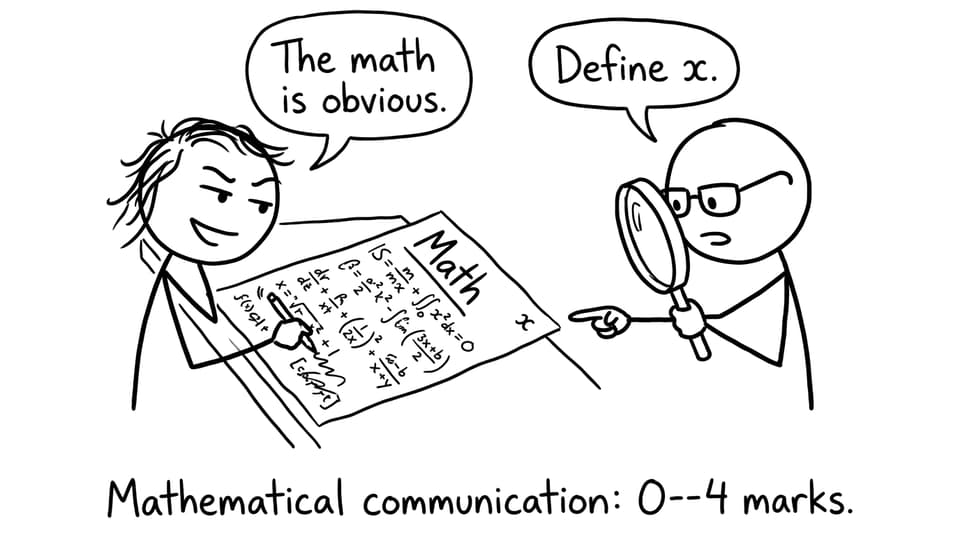
Examiners are not only awarding “correctness.” In IB coursework, they reward mathematical communication and use of mathematics that is clear, consistent, and justified. Your calculations are the skeleton. Your explanations are the muscle that makes the work move.
A quick precision checklist (use it before you submit)
Use this mini scan to catch the most common clarity leaks in an IB Math IA:
-
Do I state the purpose of each section before I start calculating?
-
Have I defined every variable and parameter the first time it appears?
-
Are units and domains stated where they matter?
-
Do my steps connect with logic words (therefore, hence, since)?
-
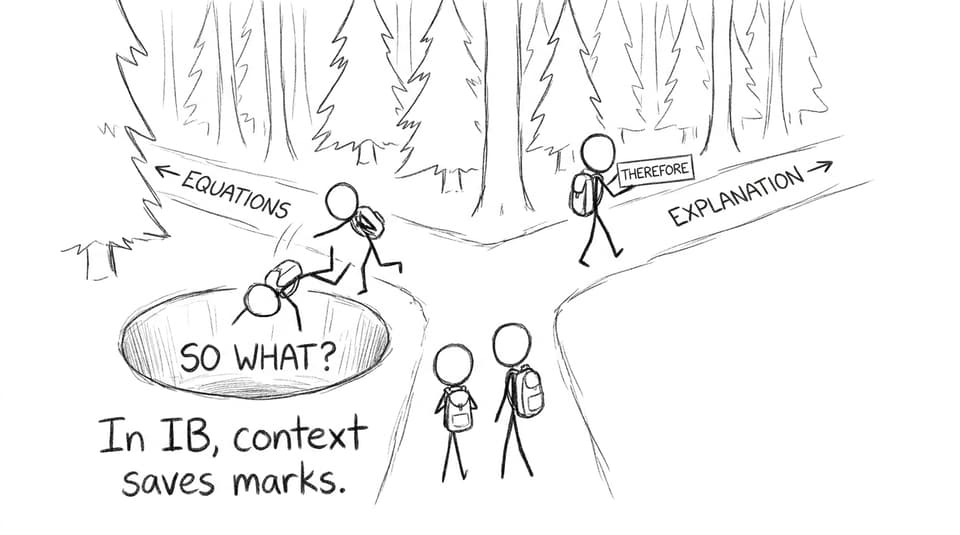
After important results, do I interpret what the number means in context?
-
Is notation consistent from start to finish (no surprise symbols)?
If you want a rubric-aligned reference while you check, keep the RevisionDojo guides open: start with IB Internal Assessment Guides and the course-specific math guide that matches your syllabus.
Why mathematically precise explanations matter in the IB Math IA
A precise explanation does two jobs at once:
-
It proves you understand why the mathematics is appropriate.
-
It helps the examiner award marks quickly without guessing your intent.
This aligns directly with rubric language about clarity and correct notation. If you want to see what “mathematical communication” is really asking for, read Criterion B: Mathematical Communication and the companion rubric overview Unpacking the IB Math IA Assessment Criteria.
The hidden truth: in the IB, the cleanest paper often feels “simpler” than a messy one, even when the messy one contains harder math. Examiners can only reward what they can reliably read.
Start with purpose, not process
The fastest way to sound mathematically mature is to begin each section with a one-sentence purpose statement.
Instead of:
Differentiate the function.
Write:
To find the maximum value of the model, I differentiate (f(x)) and set (f'(x)=0), since turning points occur where the gradient is zero.
That single sentence signals method and meaning, which is exactly what an IB examiner needs.
For structure ideas that naturally create this “guided tour” style, borrow a framework from How to Structure the IB Math IA for Maximum Clarity.
Define variables like you’re writing for a stranger
In an IB Math IA, definitions are not decoration. They are reader safety rails.
A strong habit is to define variables immediately before the first major formula that uses them:
-
“Let (t) be time in seconds.”
-
“Let (h(t)) be height in meters at time (t).”
-
“Let (k) be the decay constant (units (s^{-1})).”
Then keep the notation consistent. Don’t swap (t) for (x) later because your calculator did.
If you’re unsure what counts as a “must-define,” the math IA essentials page is a helpful anchor: Essentials of the Internal Assessment.
Link each step with cause-and-effect language
Most unclear writing isn’t “wrong.” It’s unconnected.
When you write, imagine the examiner asking, “Why does this line follow from the previous one?” Answer that question using short logical connectors:
-
“Since …”
-
“Therefore …”
-
“It follows that …”
-
“By substitution …”
You don’t need to narrate every algebra move. But when you change methods (for example, from regression to residual analysis, or from differentiation to interpretation), you should signal the transition.
To practice this skill deliberately, use a model checklist from How to Communicate Mathematical Reasoning Clearly in the IB Math IA.
Interpret results immediately (numbers are not conclusions)
A calculation earns its value when you translate it back into meaning.
Weak:
(k=0.21)
Strong:
The value (k=0.21) suggests the quantity decreases relatively quickly; specifically, the model predicts a reduction by a factor of (e^{0.21}) per unit time, which matches the steep drop seen in the data.
In the IB, interpretation is often where Reflection and Communication quietly improve too, because you are showing awareness of context and limitations.
If you want examples of how to land a conclusion without sounding vague, see How to Write a Strong IB Math IA Conclusion.
Use complete sentences around key equations
Equations should not sit alone like abandoned luggage.
Try this pattern:
-
Sentence to introduce the equation (what it represents).
-
The equation.
-
Sentence to explain what it implies or how you will use it.
Example:
The model for the relationship is assumed to be exponential, so I use (P(t)=P_0e^{kt}) to represent growth over time.
This style reads cleanly and keeps your IB mathematics accessible even when the methods are advanced.
Be concise about mechanics, detailed about choices
A surprisingly common mistake: explaining easy algebra in paragraph form, then skipping the justification for a big decision.
A better trade:
-
Skip routine rearrangements unless they’re non-trivial.
-
Explain assumptions, parameter choices, technology settings, and why one method is appropriate.
If you want a compact set of editing tips that targets commentary quality, use 10 Essential Tips to Write a Strong IB Math IA Commentary.
How RevisionDojo helps you write with IB-level precision
When you’re drafting, it’s hard to hear your own gaps. That’s why the best workflow mixes tools:
-
Use Study Notes to sanity-check definitions and conditions before you write.
-
Use the Questionbank to practice explaining method marks in full sentences, not fragments.
-
Use Flashcards to lock in formal phrasing (domain, assumptions, “therefore” transitions).
-
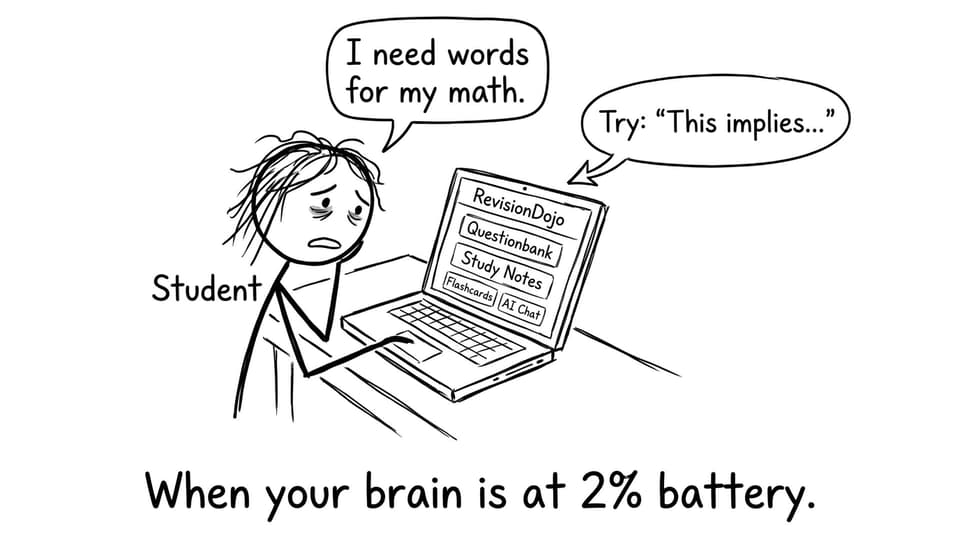
Use AI Chat to generate alternative wording when your explanation feels repetitive.
-
Use Grading tools to rubric-check communication and clarity while you still have time to fix it.
-
Use Mock Exams and Predicted Papers to pressure-test whether your explanation style holds up under time constraints.
-
Use the Coursework Library to compare against high-quality exemplars.
-
Use Tutors when you need a human to challenge your logic and tighten your narrative.
A practical starting point for many IB students is the rubric tool: IB Maths AI IA Grader.
Closing: your math deserves a clear voice
The IB does not punish you for being simple. It punishes you for being unclear.
When you write mathematically precise explanations, you’re not adding fluff. You’re making your understanding legible. And that’s what turns correct calculations into awarded marks.
If you want a fast way to tighten your draft, use RevisionDojo to run a loop: open the IB Mathematics Applications & Interpretation (AI) IA Guide, compare your section against an exemplar from the Coursework Library, then rubric-check with the grader. Your goal is calm clarity: every symbol defined, every step connected, every result interpreted. That’s IB writing that holds up under pressure.