
How to Write an Effective Introduction for the IB Math IA (and why it matters)
You can feel it in the first ten seconds.
An examiner opens your exploration, scans the first paragraph, and quietly decides whether they trust you. Not as a person, but as a mathematical thinker. That first page is a small moment with outsized consequences: it signals whether the work ahead will be focused, coherent, and worth following.
That’s why How to Write an Effective Introduction for the IB Math IA is not a “nice-to-have.” It’s the part that turns a pile of calculations into an investigation with purpose.
Your introduction should do one calm, powerful thing: make the reader believe your exploration has direction. The best introductions feel like a well-lit hallway. You can see where you’re going. You know why you’re walking there. And you trust the steps.
If you want a rubric-aligned model to copy for tone and structure, pair this guide with How to Structure an IB Math IA Effectively and How to Write a Top-Scoring Math IA (2025 Guide).

A quick checklist before you write your intro
Before you draft, make sure you can answer these in one line each:
-
What real-world context (or conceptual curiosity) starts your exploration?
-
What is your mathematical aim in a single, precise sentence?
-
What methods will you use (model, regression, calculus, probability, technology)?
-
What variables will appear repeatedly, and what are their units?
-
What assumptions or simplifications will you make (briefly)?
-
What will the reader see next (a 1-2 sentence roadmap)?
This checklist is also a great moment to use RevisionDojo as a “second brain”: use AI Chat to pressure-test clarity, the Coursework Library to calibrate what strong writing looks like, and Grading tools to check whether your opening aligns with criterion language early.
Start with a hook that’s mathematical, not cinematic
The hook is not there to entertain. It’s there to locate your mathematics in a situation.
A strong IB Math IA hook usually does one of these:
-
Introduces a personal observation (sports, music, games, routines) that naturally contains measurable variables.
-
Points to a real pattern you noticed in data.
-
Poses a simple “why does this behave like that?” question.
Example hook (applied, measurable):
Watching basketball shots, I noticed that small changes in launch angle seemed to change the range dramatically. This led me to explore how projectile range depends on angle using quadratic and trigonometric modeling.
If your hook is too broad (“Math is everywhere”), your reader can’t see the investigation. If it’s too story-heavy, the math feels like an afterthought. The sweet spot is human curiosity plus measurable quantities.
For more examples of what “authentic but focused” looks like, browse How to Write the IB Math IA Introduction Like a Pro and then compare with a few exemplars from IB Maths AA IA Examples.
State the aim with enough precision that you could test it
This is the sentence that makes the examiner relax.
Your aim should be:
-
Specific (not “explore basketball”)
-
Mathematical (mentions relationships, models, optimization, error, fit)
-
Achievable (fits your time and data access)
Example aim:
This exploration aims to model the relationship between launch angle (\theta) and horizontal range (R) using a quadratic projectile model and compare it to experimental measurements.
When students ask How to Write an Effective Introduction for the IB Math IA, this is usually the missing piece: they have a topic, but not a testable direction.
If you still feel unsure whether your aim is “IA-sized,” use topic inspiration from The Best IB Math IA Topics for 2025, then tighten your aim until it can be answered with your chosen methods.

Add a short rationale that sounds like ownership
Your rationale is where you earn personal engagement without turning the intro into a diary entry.
Two sentences is often enough:
-
One sentence on why you chose it (genuine curiosity, relevance, personal experience)
-
One sentence on why it matters mathematically (modeling, prediction, limitations, fit quality)
If you want a deeper guide to writing engagement without “trying to be engaging,” read Personal Engagement in the IB Math IA. Then use RevisionDojo’s Tutors if you need quick feedback on whether your motivation reads as authentic.
Preview the mathematics and tools (but don’t teach it yet)
This is where you signal depth without doing the work too early.
A good preview might mention:
-
the key concepts (e.g., regression, derivatives, correlation, distributions)
-
the tech you’ll use (GeoGebra, Desmos, spreadsheet regression)
-
how you’ll evaluate quality (residuals, error analysis, limitations)
Example preview:
The investigation will use trigonometric identities and quadratic modeling to derive a theoretical range function, then apply regression to compare predicted and measured distances. Limitations will be discussed by analyzing error sources and model assumptions.
This “preview” is also where RevisionDojo’s ecosystem helps you stay consistent: Study Notes to refresh the exact technique you plan to use, Flashcards to keep key definitions active, and the Questionbank to practice the same math under exam-style pressure (because coursework and exam skills should reinforce each other, not compete).
For targeted practice, you can pull questions from IB Mathematics AA Calculus Questionbank or use the broader course hub at IB Mathematics Analysis and Approaches Resources.
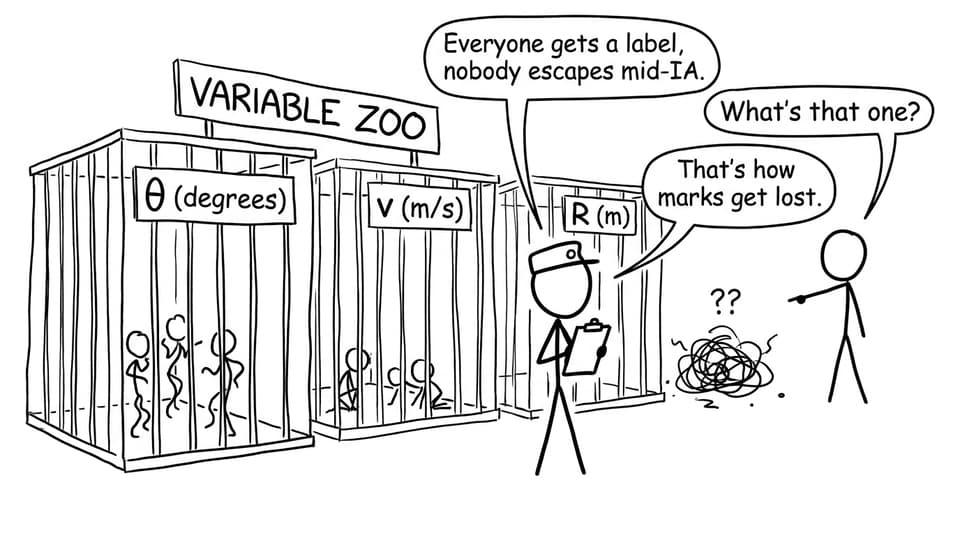
Define variables and units early (it’s quiet professionalism)
This looks small. It isn’t.
When variables appear without definitions, the reader has to do extra work. And extra work is where confusion starts.
In the intro, define only the variables you’ll use immediately and repeatedly.
Example:
-
(\theta): launch angle (degrees)
-
(v): initial velocity (m/s)
-
(R): horizontal range (m)
Then stay consistent. The examiner should never wonder whether (t) is time in seconds or “trial number.”
Offer a roadmap and assumptions in 3-4 lines
A roadmap is a promise: “I won’t make you guess what comes next.”
Example roadmap:
First, I will develop a theoretical model for projectile range under simplified conditions. Next, I will collect measurements and compare them to model predictions using regression and error analysis. Finally, I will evaluate the validity of assumptions and suggest improvements.
Keep assumptions brief, but visible:
-
negligible air resistance
-
constant gravitational acceleration
-
consistent measurement conditions
If you’re unsure what the IB expects in setup and formal requirements, review Essentials of the Internal Assessment. And when you’re formatting your final draft, use How to Format and Present Your IB Math IA Professionally so presentation doesn’t cost you marks.
Closing: make the first page do its job
A great introduction isn’t dramatic. It’s dependable.
It tells the examiner what you’re exploring, why it matters, what mathematics you’ll use, and how the journey is structured. That’s the heart of How to Write an Effective Introduction for the IB Math IA: you’re not writing an opening paragraph; you’re building trust.
When you’re ready to tighten your draft, use RevisionDojo as your full workflow: Study Notes for the methods you mention, Flashcards for definitions and variables, Questionbank to keep your skills sharp for exams, Mock Exams and Predicted Papers to build timed confidence, and Grading tools plus Tutors to polish your IA against the rubric. Start by anchoring your structure with How to Structure Your IB Math IA Logically, then draft your introduction like a roadmap the examiner can’t get lost in.

