
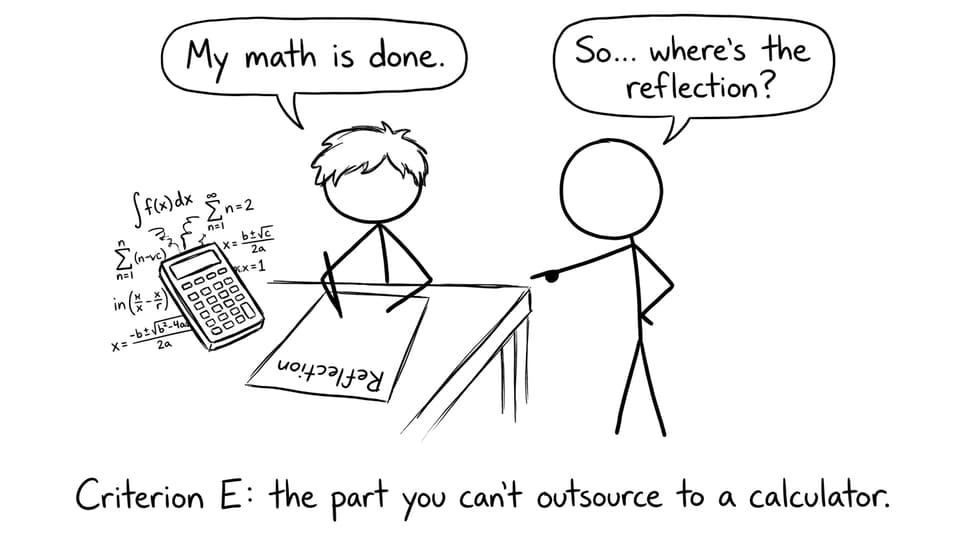
A strange thing happens when you finish your IB Math IA: the math looks complete, the graphs look clean, and yet the report still feels unfinished.
That unfinished feeling usually lives in one place: the reflection section.
In IB, reflection is where you prove you weren’t just following steps. You were thinking. You noticed what changed, what broke, what surprised you, and what the mathematics is actually saying. If you treat reflection like a polite goodbye paragraph, you quietly give away marks.
IB reflection in the Math IA: what examiners really want
A strong reflection section in an IB Math IA reads like a student who can stand next to their model and speak honestly about it.
Examiners are typically looking for three signals:
-
Awareness: you can identify assumptions, constraints, and why they matter.
-
Evaluation: you can judge whether your method and results actually support your aim.
-
Growth: you can show how your understanding evolved (not just what you did).
If you want the criteria language and expectations in one place, start with Essentials of the Internal Assessment. It’s a calm reminder that reflection should be integrated throughout, not bolted on at the end.
Quick checklist for a strong IB Math IA reflection section
Before you write, skim this list. If you can’t answer an item, that’s your reflection content.
-
What did you initially expect to happen, and what did you observe instead?
-
Which assumption mattered most, mathematically?
-
Where did your model work well, and where did it fail (range, outliers, residuals)?
-
Which method choice saved you, and which one limited you?
-
What would you change if you repeated the exploration with more time or better data?
-
What mathematical idea became clearer because of this IA?
RevisionDojo students often turn this into a repeatable writing process by pairing the Flashcards for Internal Assessment (IA) with their draft, so the reflection includes correct course language (functions, parameters, error, interpretation) without sounding scripted.
Write your IB reflection like a story of decisions (not feelings)
The best IB reflection sections feel like a trail of decisions: I chose this because… I noticed this… so I changed that… which caused…
This is the difference between reflection and summary.
A summary says: “I used regression and found a curve.”
A reflection says: “I tried a linear model first, but the residuals showed a curved pattern, so I tested an exponential model to match the structure of the error.”
If you struggle to keep that “decision trail” tone, the guidance in IB Math: 10 Tips for a Strong IA Commentary helps you sound analytical without becoming robotic.
A useful sentence frame for IB reflection
Use one of these and fill it with specific math:
-
“This suggests… because…”
-
“A limitation of this method is… which means…”
-
“The model fits well when… but breaks down when… likely due to…”
-
“If I repeated the investigation, I would… to reduce…”
Those words force you into evaluation, which is exactly what IB rewards.
Reflect on meaning: what do your results say?
A reflection section earns marks when it interprets results rather than restating them.
Ask:
-
What does the parameter you found represent in context?
-
What does the shape of the curve imply about change over time?
-
What does your model predict that is interesting, useful, or questionable?
To strengthen this part, it can help to reread your aim and compare it to your conclusion. If you need to tighten your opening aim, How to Structure an IB Math IA Introduction That Captures Examiner Interest is a quick reset.
Limitations are not weaknesses in IB; they’re evidence of maturity
Many IB students hide limitations because they think it “makes the IA look bad.”
In reality, thoughtful limitations make it look real.
Write limitations in three layers:
-
What the limitation is (assumption, measurement, sampling, technology constraint)
-
Why it matters mathematically (bias, restricted domain, unstable parameter estimates)
-
So what you would do to improve it (new variable, different method, more data, different model)
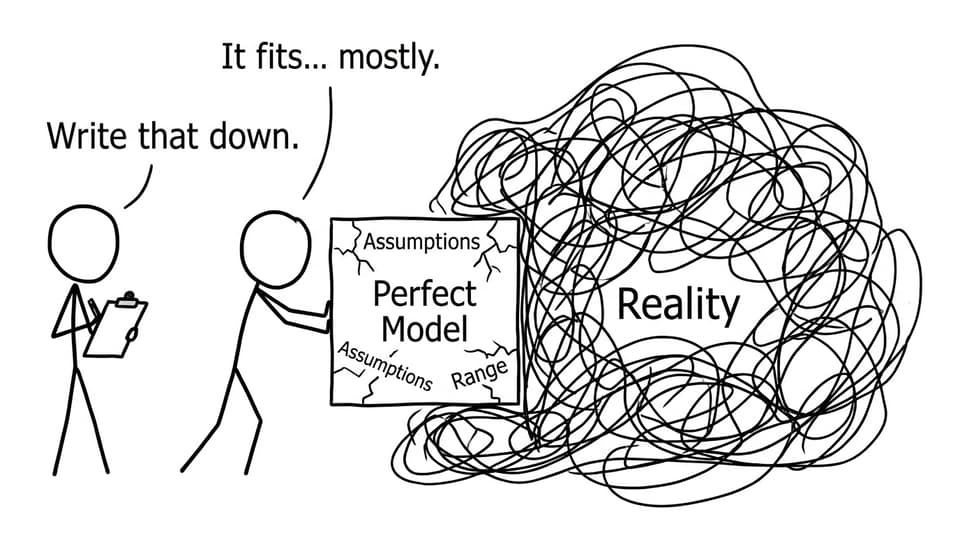
For structured examples and phrasing that stays professional, use How to Reflect on Model Limitations in the IB Math IA. It’s one of the fastest ways to turn “I know it’s imperfect” into “I can explain the imperfection precisely.”
Evaluate your approach: why this method, and what did it cost?
IB reflection gets sharper when you acknowledge trade-offs.
Maybe regression made sense, but it hid the mechanism. Maybe calculus gave insight, but your data quality couldn’t support it. Maybe technology gave speed, but you had to check whether the output was reasonable.
A strong line sounds like:
“Using technology allowed efficient parameter fitting, but it reduced transparency. I validated the model by checking residual behavior and testing sensitivity to small parameter changes.”
To build exam-level mathematical confidence alongside your IA work, use RevisionDojo’s Questionbank to practice the same techniques you referenced in the reflection. For example, you can drill calculus skills using IB Math AA Calculus Questionbank, then bring that clarity back into your IA commentary.
Technology reflection: make it about understanding, not the tool
It’s fine to mention GeoGebra, Desmos, spreadsheets, or calculators. But in IB, the mark comes from what the tool helped you notice.
Good reflection about technology includes:
-
what you used it for,
-
what it revealed,
-
and what you checked to avoid blind trust.
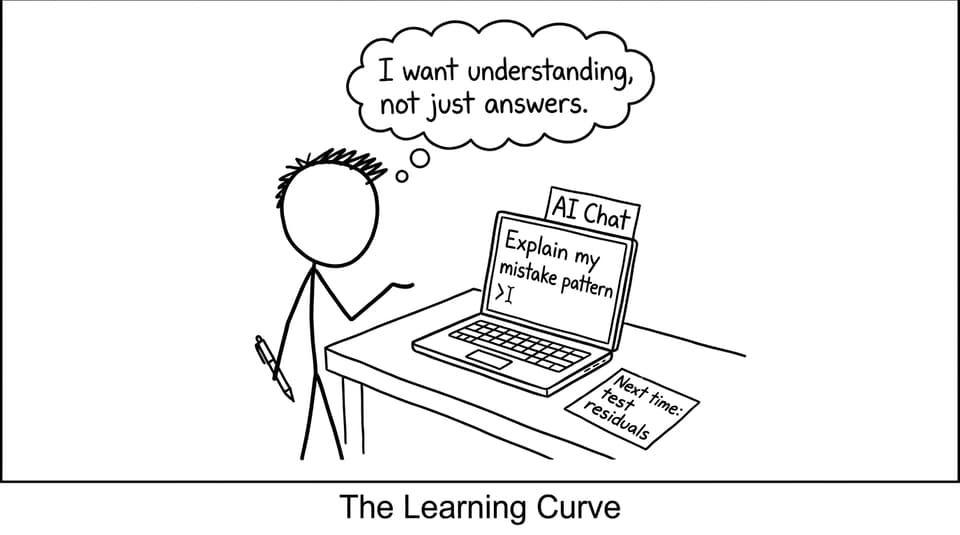
RevisionDojo’s AI Chat is useful here when you ask for explanation and checking rather than solutions. You can describe that process honestly: “I used AI Chat to clarify why my residual plot implied non-linearity, then I verified the conclusion by testing a different model.” That’s reflection as learning.
A clean ending: connect your IB reflection to growth
Your final lines should do two jobs: close the investigation and show growth.
Try this structure:
-
One sentence on the biggest mathematical insight.
-
One sentence on the most important limitation.
-
One sentence on the most realistic extension.
It reads like intellectual honesty, which is exactly what IB wants.
If you want to see how top students shape that tone, study complete models in Using IA/EE Exemplars to Improve Your IB Math IA. Seeing the full arc helps you write your own reflection section with restraint and confidence.
Conclusion: turn your IB reflection into your strongest page
In IB, the reflection section is where your IA stops being a document of work and becomes evidence of thought. It’s where you show that you can evaluate mathematics like a person, not a machine.
If you want the fastest path from “I’m not sure what to say” to a clear, criteria-aligned reflection, use RevisionDojo as your home base: the Coursework Library for exemplars and guides, Study Notes for quick concept clarity, Flashcards for precise language, AI Chat for targeted explanations, and Grading tools to see how marks are awarded. Then keep your exam prep moving with Mock Exams and Predicted Papers, and patch weak skills using the Questionbank. When you need a human set of eyes, RevisionDojo Tutors can help you refine your reflection section without losing your voice.
Write your reflection like it matters, because in IB, it often decides whether your IA feels finished.