


Mathematical modelling is the moment your IA stops being a report and becomes a prediction.
You can feel it when it happens: you stop listing numbers and start telling a story about why the numbers move, and what they might do next. That shift is exactly what many IB examiners reward. Not because they want fortune-telling, but because prediction forces you to be honest about assumptions, precision, and limits.
This guide shows you how to use mathematical modelling to predict outcomes in your IB Math IA in a way that feels rigorous, readable, and genuinely yours.
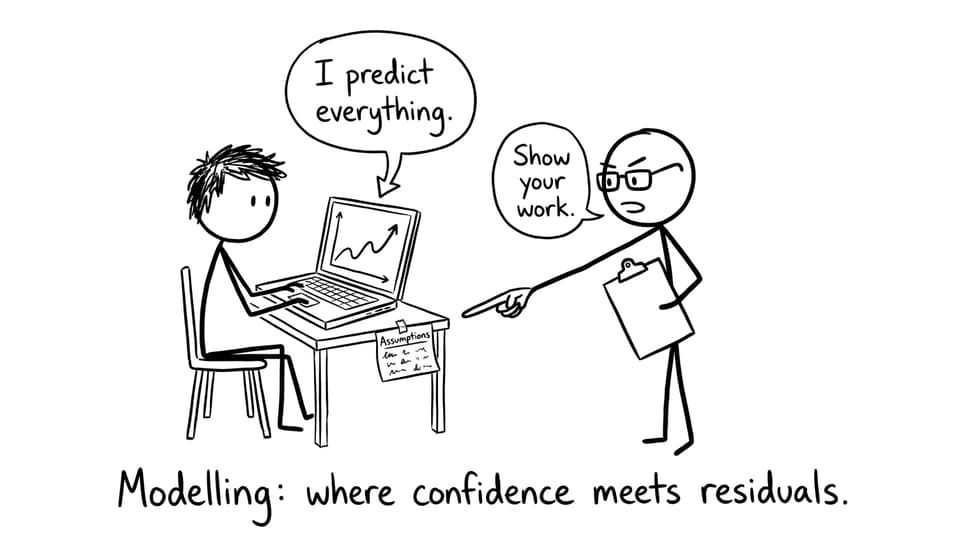
A quick IB modelling checklist (save this)
Use this before you write a single paragraph. It prevents the classic IB Math IA problem: a beautiful equation with no explanation.
-
Define a focused aim (one sentence) and a measurable outcome to predict.
-
Specify variables with units, domain, and how you measured or sourced data.
-
Make an early scatterplot (it tells you what models are plausible).
-
Choose one main model and (optionally) one comparison model.
-
Fit parameters and interpret them in context.
-
Validate with residuals and at least one numerical accuracy measure.
-
Predict within a sensible domain and quantify uncertainty.
-
Reflect on assumptions and propose realistic improvements.
If you need a full modelling roadmap, pair this post with How to Build Mathematical Models for the IB Math IA.
Start with a question that actually allows prediction
A predictive IB Math IA begins with a question that has a future value you can compute.
Good prediction-friendly prompts include:
-
How long until something reaches a threshold? (cooling time, decay, saturation)
-
What value will something have at time (t)? (growth, demand, performance trends)
-
What input produces the “best” outcome? (optimization, projectile range, cost minimization)
If you’re still choosing, browse IB Math IA Ideas for 2025 and Beyond and look specifically for topics where the dependent variable naturally extends forward.
Define variables like an IB examiner is checking every symbol
Prediction collapses if your variable definitions are vague.
In your IB Math IA, define:
-
Independent variable: what you control or index (often time).
-
Dependent variable: what you are predicting.
-
Parameters: constants you estimate (rates, carrying capacity, intercepts).
Write definitions with units and domain. For example:
-
(t) = time in minutes, (0 \le t \le 25)
-
(T(t)) = temperature in (^\circ)C
This is not “extra formatting.” It is mathematical communication, and it makes later evaluation much easier.
Choose a model that fits the story in your data
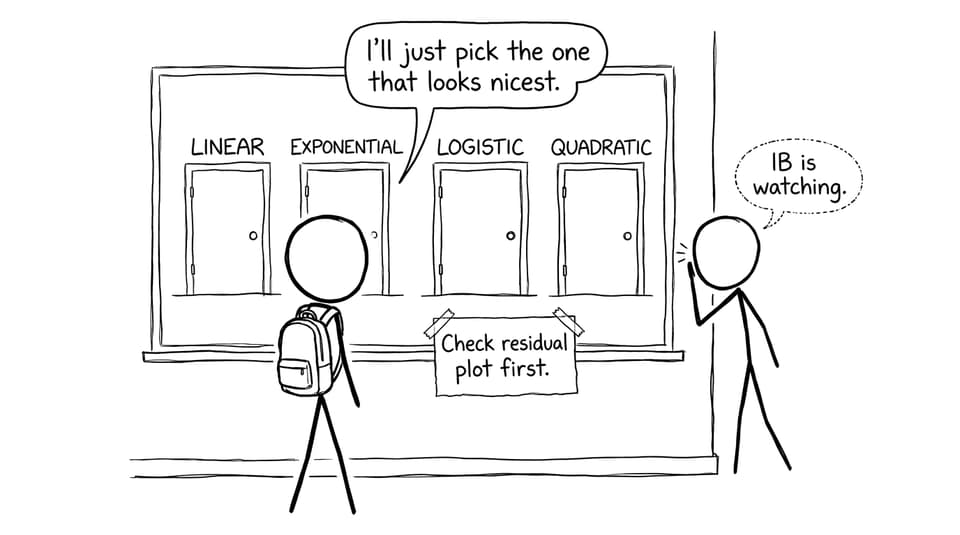
Most IB students pick a model because it’s familiar. Strong IAs pick a model because the context demands it.
Here’s a useful decision map:
-
Linear: constant change per unit time.
-
Quadratic: a single turning point (projectiles, maxima/minima).
-
Exponential: multiplicative change (growth/decay).
-
Logistic: growth that slows toward a limit (saturation).
-
Trigonometric: periodic patterns (day/night cycles, waves).
A smart move: build a “candidate models” paragraph and justify why two models are plausible, then test them.
For more help selecting and explaining models clearly, see How to Develop Mathematical Models from Real Data in the IB Math IA.
Fit the model, then interpret parameters (don’t skip this)
Fitting a model is the easy part. The IB marks come from what you say about the fitted parameters.
Example (cooling-style exponential form):
Interpretation you should include:
-
(a): the long-run temperature your system approaches (often ambient).
-
(b): the initial gap between starting temperature and the long-run level.
-
(k): the rate constant controlling how fast the change happens.
When you interpret parameters, you show ownership of the mathematics. That is the difference between “calculator output” and a real IB exploration.
If you want a clean structure for writing this up, use How to Structure the IB Math IA for Maximum Clarity.
Validate with residuals before you trust any prediction
A predictive model is only as strong as its errors.
Two evaluation tools that work well in an IB Math IA:
-
Residual plot: should look random around zero. Patterns mean the model is missing structure.
-
Accuracy measures: use (R^2) (when appropriate), mean absolute error, or percent error on a test subset.
The easiest way to sound like you know what you’re doing is to connect the evaluation to meaning:
-
“Residuals grow with (t), so my model underestimates later values.”
-
“The curve misses the early points, suggesting different behaviour in the initial phase.”
For a deeper walkthrough, read How to Evaluate Model Fit Using Statistical Tools.
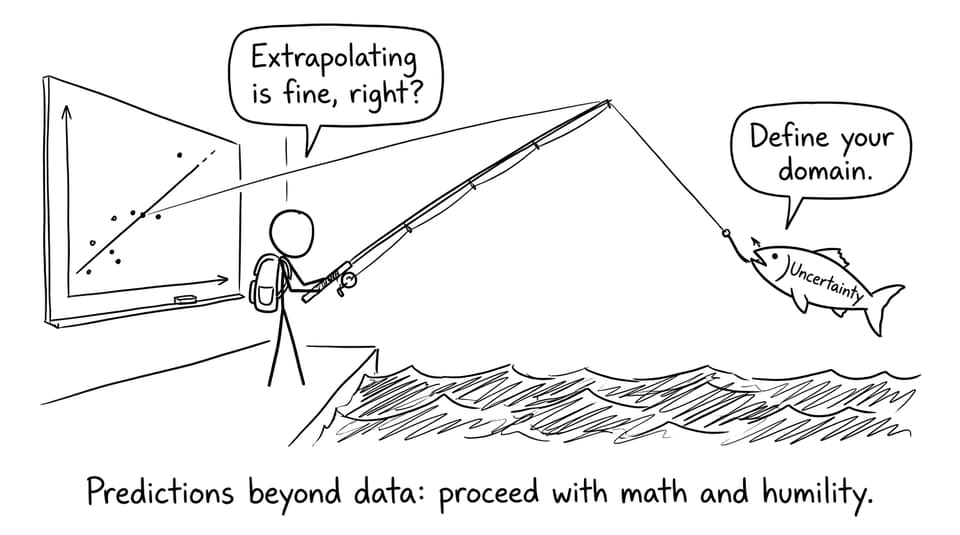
Predict outcomes carefully (and show uncertainty)
Now you earn the title “predictive.” But do it with discipline.
In your IB Math IA, predictions should be:
-
Within domain (or clearly labelled extrapolation)
-
Computed transparently (show substitution and steps)
-
Reported with a sensible precision (don’t give 12 decimal places)
-
Accompanied by uncertainty (an error bound, or discussion based on residual size)
A simple uncertainty method: use the typical residual magnitude as a rough error range. For example, “most residuals fall within (\pm 1.8), so predicted values are likely within about (\pm 2) units.” It’s not perfect, but it’s honest, and honesty reads as sophistication.
Make it examiner-ready with RevisionDojo tools (without losing your voice)
A calm way to keep your IB Math IA strong is to treat RevisionDojo like a workbench:
-
Use the Study Notes to refresh modelling and regression ideas quickly via the IB Mathematics Analysis and Approaches resources.
-
Drill the underlying skills (functions, regression, interpretation) in the Questionbank, like the Functions questionbank or Math AA calculus questionbank.
-
Use Flashcards to tighten definitions and wording, starting with How to Use Flashcards to Learn IB Math Definitions.
-
Ask AI Chat to check if your parameter interpretations match your context (then rewrite in your own words).
-
Run your draft through Grading tools, including the IB Maths AI IA Grader, to spot rubric gaps early.
And when you’re practicing under pressure for exams, RevisionDojo’s Mock Exams and Predicted Papers style practice (without relying on forbidden shortcuts) helps you carry the same modelling habits into timed conditions.
Closing: the IB reward is not the equation, it’s your judgement
A predictive model in an IB Math IA isn’t impressive because it produces a number. It’s impressive because it forces you to think like a mathematician: define, test, doubt, refine, then predict.
If you want the fastest path to a confident draft, use RevisionDojo as your loop: Study Notes for methods, Questionbank for skill fluency, Flashcards for precision, AI Chat for clarity, and Grading tools to stay aligned with the IB rubric. When your model finally predicts something real, you’ll know you earned it.