
In IB Theatre, the hardest moment often isn’t opening night. It’s the quiet one: you’re holding a script that feels complete, yet the room is empty, and you’re expected to turn ink into impact.
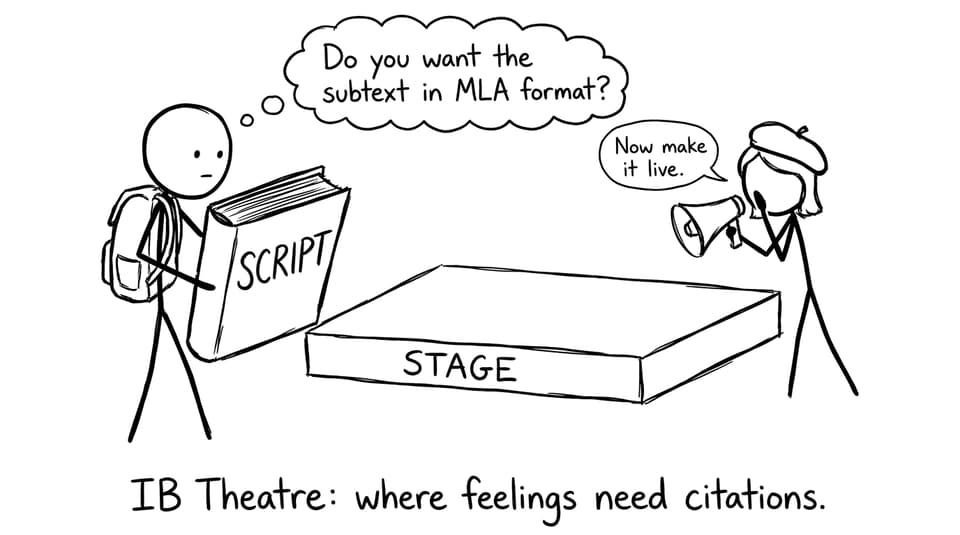
That gap is where most marks live. Because IB Theatre doesn’t reward “good acting” in isolation. It rewards intentional performance, choices you can explain, test, refine, and evaluate. If you’ve ever felt torn between following the text too literally or changing everything just to look creative, this guide gives you a calmer middle path.
Quick checklist: script to performance (IB Theatre)
Use this as your pre-rehearsal routine for IB Theatre:
-
Read the script twice: story first, subtext second
-
Write a one-sentence artistic intention (your “why”)
-
Choose 2-3 moments to transform (not the whole play at once)
-
Run at least 3 rehearsal experiments per moment (blocking, pace, proxemics, voice)
-
Add one clear practitioner lens you can show onstage
-
Track production elements as meaning-makers (light, sound, costume, set)
-
Reflect after every session: intention, impact, next step
If you want the bigger assessment picture, keep this syllabus map nearby: Dive into the World of IB Theatre: An In-Depth Syllabus Overview.
Why script-to-performance is a scoring skill in IB Theatre
A script is not a performance. It’s a set of possibilities.
In IB Theatre, examiners consistently look for the process that turns possibility into evidence: inquiry (what the text suggests), development (how you tested ideas), presentation (what you chose to show), and evaluation (what worked and why). That’s why a smart rehearsal log can be as valuable as a strong run-through.
A useful mindset shift: treat rehearsal like a lab. Your job isn’t to “get it right” immediately. Your job is to prove you earned the final choices.
To see this idea applied specifically to staging, pair this article with How to Approach Staging Play Texts in IB Theatre Coursework.
Analyze the script like a director (not a reader)
The fastest way to level up in IB Theatre is to stop asking, “What does this line mean?” and start asking, “What does this line do to the space, the relationship, and the audience?”
Three lenses that create performance ideas
-
Tension lens: where does pressure rise, shift, or break?
-
Objective lens: what does each character want right now, and what blocks it?
-
Image lens: what recurring ideas keep returning (silence, doors, food, time, power)?
Mark the “odd” lines too: unfinished sentences, repetitions, pauses, jokes that land strangely. These are often the best transformation points.
For a deeper method you can copy, use Best Ways to Analyze a Play Text for Performance Intentions.
Turn analysis into rehearsal experiments (IB Theatre method)
Once you’ve chosen a moment, run experiments that change only one variable at a time. This keeps your reflection sharp, which is essential in IB Theatre.
High-value experiments to try
-
Blocking swap: keep the same lines but reverse who owns the space
-
Tempo shift: perform once too fast, once too slow, then choose a precise middle
-
Status change: play it as if one character is winning, then as if they’re losing
-
Silence test: extend pauses and see what the audience reads into them
Document each attempt with a sentence that starts: “When we changed X, the audience might interpret Y because…” That phrasing trains you for examiner-style evaluation.
Add practitioner influence without forcing it
In IB Theatre, practitioner influence works best when it’s visible and specific. Choose a lens that naturally strengthens your intention, not one you picked because it sounds impressive.
Examples of grounded practitioner choices
-
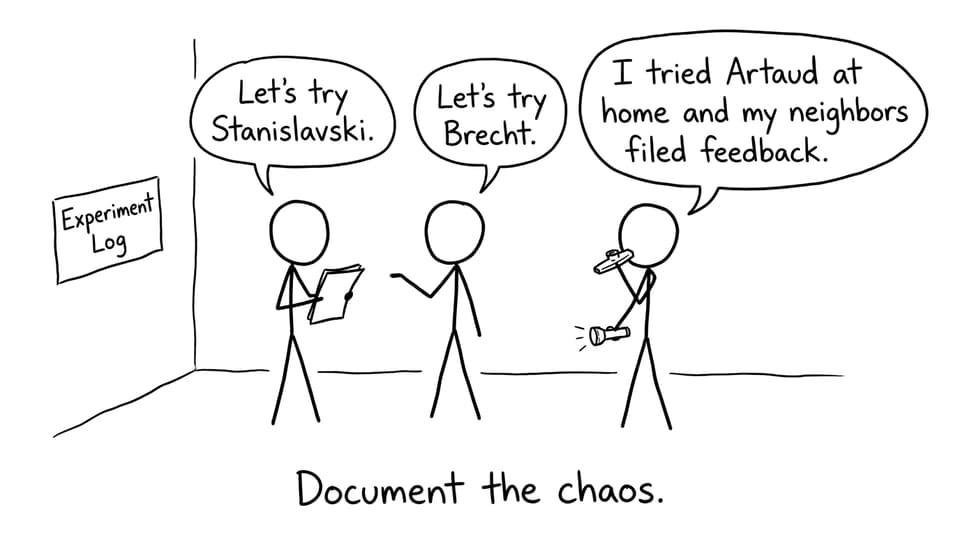
Stanislavski-inspired realism: clearer objectives, playable actions, truthful inner life
-
Brecht-inspired choices: direct address, visible stagecraft, moments that invite judgment not immersion
-
Artaud-inspired intensity: sensory impact through sound, rhythm, physicality, discomfort
The key is justification: “I used this convention because it helped the audience notice X.”
If you’re building a solo piece, this connects closely with How to Aim for a Level 7 in the IB Theatre Solo Theatre Piece.
Use production elements as meaning, not decoration
Even minimal design choices can carry major meaning in IB Theatre if they’re intentional.
Try choosing one “design rule” per scene, such as:
-
Light isolates power shifts (who is visible when the truth lands?)
-
Sound signals internal change (heartbeat, static, silence, repetitive motif)
-
Costume shows status (tight vs loose, clean vs worn, uniform vs individuality)
The best design notes read like arguments, not shopping lists.
Reflection: the step that turns creativity into marks
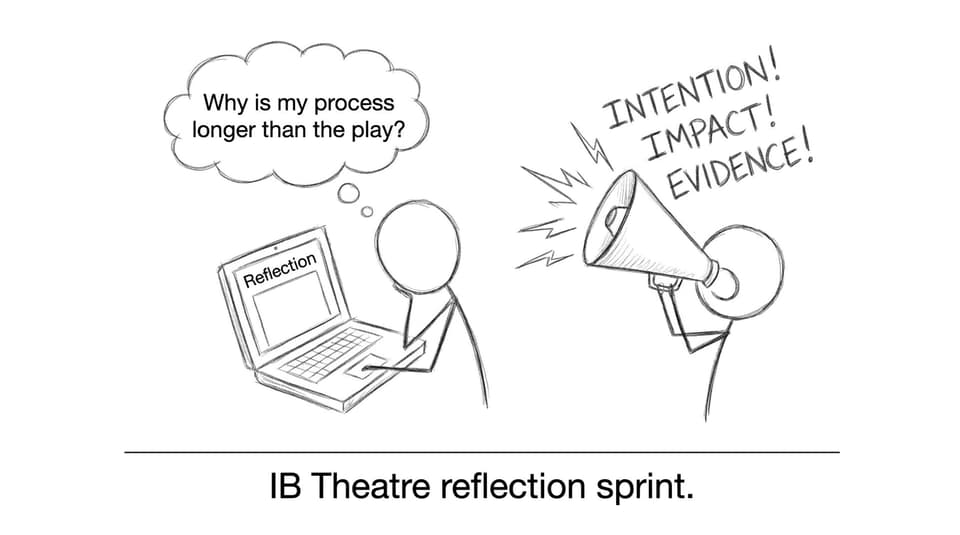
A performance can be brilliant and still score lower if the reflection is vague.
After each rehearsal, write six lines:
-
What was my intention?
-
What did we try?
-
What changed?
-
What did the audience likely read?
-
What limitation appeared?
-
What will we test next?
This is where RevisionDojo becomes a practical advantage: you can consolidate your insights into Study Notes, turn recurring problems into Flashcards, and use AI Chat to pressure-test your justification language. If you’re preparing across the course, Best Study Strategies for IB Theatre Students (SL & HL) is a strong routine to borrow.
Common mistakes that weaken IB Theatre script work
-
Performing the text “as written” without showing transformation
-
Changing things without explaining why they help the audience
-
Mentioning a practitioner but not demonstrating conventions
-
Writing reflection as a diary instead of analysis
-
Forgetting culture and context when they shape meaning
If your work includes research, you’ll likely benefit from Connecting Culture and Context in IB Theatre Research.
Final thought: make the script earn its place onstage
In IB Theatre, transformation isn’t about being flashy. It’s about being able to say, with calm confidence: “Here is what the script suggested, here is what we tested, and here is why the final performance communicates meaning.”
If you want a single home base while you build that process, RevisionDojo gives you the full loop: Questionbank for terminology and concept checks, Study Notes for practitioner and staging theory, Flashcards for retention, AI Chat for refining justifications, Grading tools for criteria-level feedback, plus Mock Exams and a Coursework Library to stay organized. When you’re ready for more personal guidance, Tutors can help you turn rehearsals into evidence efficiently.
Keep your next rehearsal simple: pick one moment, run three experiments, and write six lines of reflection. That’s how IB Theatre stops being intimidating and starts feeling like craft.