

Your IA can be beautifully written and still feel strangely hard to finish. Not because you are lazy. Not because you are “bad at IB.” But because your research question is quietly draining the marks out of your effort.
A weak IA research question is like trying to build a bridge while the river keeps moving. You can keep adding planks, but the structure never feels stable. The good news is that weak questions are predictable. They leave the same footprints every time. If you spot them early, you can fix your IA without rewriting your whole life.
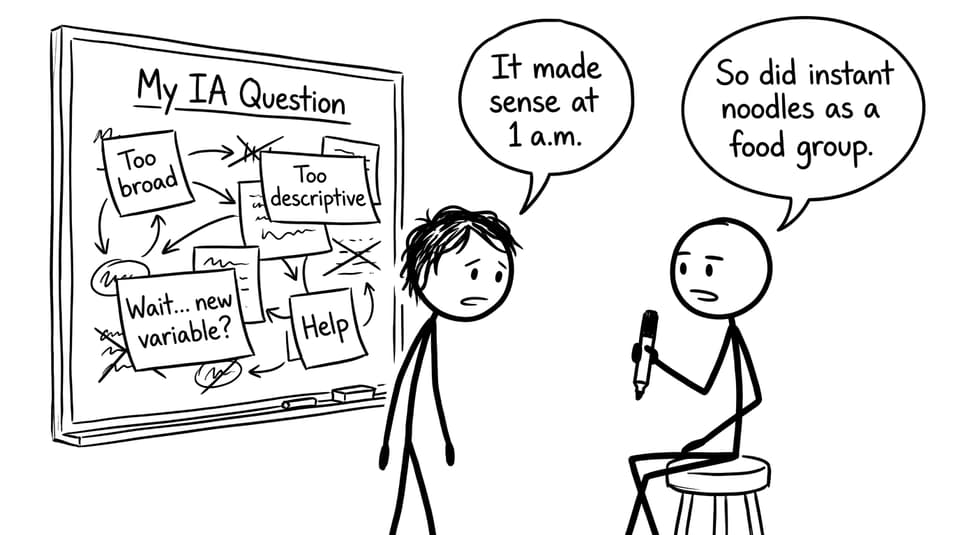
A quick IA research question self-check
Before you write another paragraph, run your IA question through this checklist:
-
Can you answer it with analysis, not just explanation?
-
Can you stay focused on one clear relationship or debate?
-
Do you know exactly what evidence matters most?
-
Does evaluation feel like a natural conclusion, not a forced add-on?
-
Can you realistically do it within time, resources, and word/page limits?
If two or more feel shaky, your IA question is probably weak. That is not a disaster. It is a design problem.
Sign your IA question is weak: it invites description, not analysis
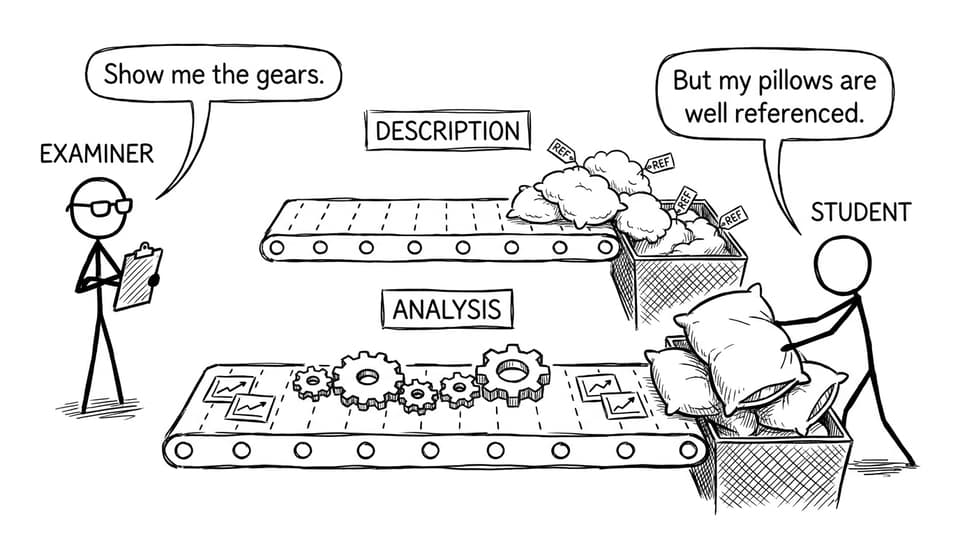
If your IA mostly becomes a “what is” or “what happened” report, the research question is usually the reason. Description is safe. It feels productive. It also rarely reaches the top bands.
A stronger IA question creates pressure to interpret. It nudges you to compare, justify, measure, argue, or evaluate.
If you are unsure what “analytical” looks like in practice, reading a few models can recalibrate your instincts. Start with RevisionDojo’s How to Write a Strong IA Research Question and then skim the Sample IB Biology IA step-by-step example for what analysis actually looks like on the page.
Sign your IA question is weak: your focus keeps shifting
A strong IA question acts like a compass. You can still explore, but you do not drift.
A weak IA question creates “scope creep.” You keep adding angles to rescue it. You tweak wording every session. You collect extra data “just in case.” The IA starts to feel like a folder of unrelated work rather than one controlled investigation.
If this sounds familiar, the fix is usually narrowing, not adding. RevisionDojo’s guide on Why Most IA Research Questions Are Too Broad is a fast way to see the pattern and reverse it.
Sign your IA question is weak: evaluation feels forced
Evaluation should feel earned, like the last step of a clear chain:
method -> evidence -> analysis -> judgment
When your IA question is weak, the chain breaks. You end up repeating generic limitations (“small sample size,” “human error”) and writing conclusions that could fit almost any topic.
A useful test: if your evaluation section could be copy-pasted into a different IA with minimal edits, your research question is not giving you enough specificity to judge anything meaningful.
For subject-specific structure, RevisionDojo’s IB IA Guides hub helps you see what each rubric actually rewards, so your IA question is built to earn marks rather than simply sound interesting.
Sign your IA question is weak: you do not know what evidence matters
Strong IA questions make evidence selection easier. Weak IA questions make everything feel equally relevant.
If you are hoarding screenshots, articles, trials, or quotes because you cannot tell what will “count,” that is a focus problem. The research question is not acting as a filter.
One practical rescue move is to plan your visuals early. If you cannot imagine the two or three graphs/tables that would answer your IA question, it is probably too vague. Use RevisionDojo’s Tips for Organizing Graphs and Tables in Your IA to sanity-check what your evidence should look like.
Sign your IA question is weak: it tries to do too much
Many students think a complex IA question sounds impressive. In reality, examiners reward precision.
Watch for these “too much” signals:
-
Too many variables
-
Too long a time period
-
Too many concepts in one sentence
-
A question that needs three separate methods to answer
If you want examples of what focused looks like in a real subject, the 10 expert tips for History IA research questions show how top questions stay narrow while still being deep.
How to strengthen a weak IA question without starting over
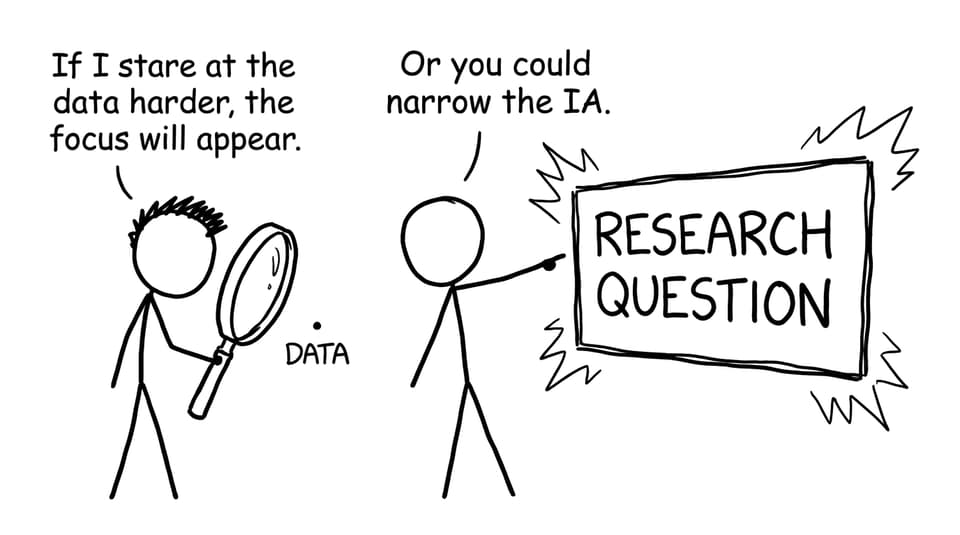
You rarely need to abandon your IA. You usually need to redesign the question.
Try this three-step fix:
Reduce the scope
Shrink the context, timeframe, or dataset until you can answer in one clear line. If needed, use RevisionDojo’s How to Refine Your IA Research Question for Clarity and Focus.
Make the relationship explicit
Name what you are comparing or measuring. “How does X affect Y?” is often stronger than “Explore X.”
Build in evaluation
Add language that requires judgment: “to what extent,” “how significant,” “which model best explains.”
Closing: make your IA question do the heavy lifting
When your IA research question is strong, everything downstream gets calmer: your structure, your evidence, your evaluation, even your motivation. When your IA research question is weak, the work expands to fill every evening you have.
If you want a focused way to strengthen your IA fast, start with RevisionDojo: use the Coursework Library to model what high-scoring focus looks like, AI Chat to test whether your IA is analytical, and Grading tools to check rubric alignment early. Then keep exam momentum with Study Notes, Flashcards, the Questionbank, Mock Exams, Predicted Papers, and Tutors--so your IA improves without hijacking exam season.