


If you have ever opened an IB Math question, stared at it for 40 seconds, and then suddenly found yourself reorganising your pencil case like it is a life mission, you are not alone.
IB revision doesn’t usually fail because you are lazy. It fails because the work feels endless, the feedback feels fuzzy, and your brain can’t “see” progress quickly enough to keep paying attention.
Motivation is not a personality trait. In IB Math, motivation is often just a side effect of evidence: proof that today’s effort made tomorrow’s questions slightly less scary. The good news is that you can design your study so that evidence shows up more often.
A quick checklist for IB Math motivation
Use this as your reset button when your IB energy dips:
-
Pick one tiny target (one subtopic, one skill, one question type).
-
Set a timer for 10-25 minutes and start before you feel ready.
-
Get fast feedback (solutions, marking, or a quick explanation).
-
Log one takeaway: “What mistake pattern did I just find?”
-
End while you still have a little fuel left.
RevisionDojo is built to support this loop with the Questionbank, Study Notes, Flashcards, AI Chat, Grading tools, Predicted Papers, Mock Exams, a Coursework Library, and Tutors when you need a human-level reset.
Why motivation disappears in IB Math
In IB, most students try to “feel motivated” first and then study. But motivation usually comes after you start, not before. It fades fastest when:
-
You cannot tell if you are improving.
-
The task is too big to begin honestly ("revise calculus" is not a task).
-
You only practice in one mode (only notes, or only questions).
-
You confuse time spent with marks gained.
The fix is to create smaller feedback loops. That is why targeted practice with clear tracking tends to revive IB motivation faster than another long study session.
A useful place to start is building a repeatable practice system using RevisionDojo’s Questionbank and a topic hub like IB Mathematics Analysis and Approaches resources.
Make IB motivation measurable (instead of emotional)
One of the quiet frustrations of IB Math is that effort can feel invisible. You do a lot, but you can’t tell if it worked until a test arrives.
Instead, make progress visible weekly:
-
Track accuracy by topic (not just overall).
-
Track which errors repeat (concept vs method vs time pressure).
-
Track consistency (how often you show up, even briefly).
If you want a practical framework for this, the guide on how to use the Questionbank for targeted math revision shows how to focus practice so each session produces a result you can actually see.
Use the “start tiny” rule to beat procrastination
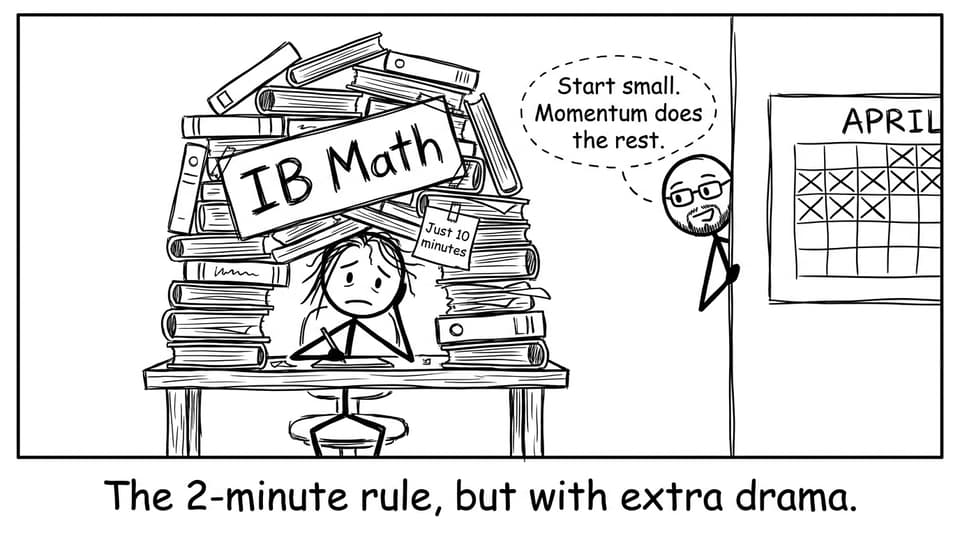
When IB Math feels heavy, the hardest part is opening the first question. Your brain treats starting as risk: “What if I don’t understand it again?”
So reduce the stakes.
Commit to a ridiculously small entry point:
-
One flashcard round.
-
One worked example.
-
One Questionbank set of 5 questions.
Once you start, momentum often carries you past the first two minutes. The goal is not to force a perfect session. The goal is to lower friction.
To make starting easier, keep your tools one click away: IB Flashcards with spaced repetition are designed for short bursts that still count as real IB revision.
Break IB Math goals into micro-wins that compound
A goal like “get a 7 in IB Math” is inspiring, but it is not actionable on a Wednesday.
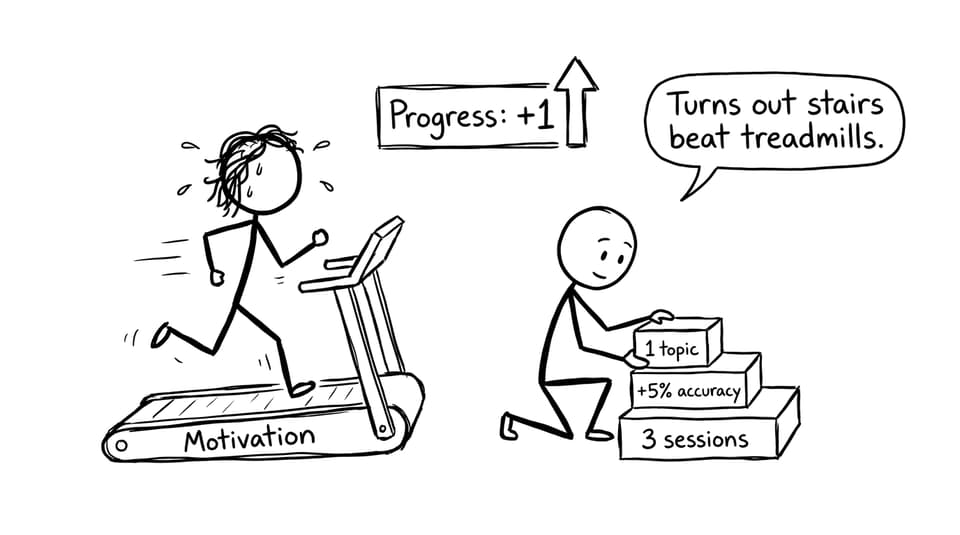
Micro-wins are actionable. They also create reliable motivation because they produce frequent proof of progress.
Examples of IB micro-wins:
-
“Raise differentiation accuracy from 60% to 70%.”
-
“Finish one functions subtopic and retake it 48 hours later.”
-
“Do three short timed sets this week.”
RevisionDojo supports micro-wins naturally because you can switch between understanding and application without changing platforms: study a point in notes, practise it immediately, then review mistakes.
Helpful companions:
Make sessions shorter, but more consistent
In IB season, long marathons are tempting. They also backfire. They create burnout, and then burnout creates avoidance.
A better approach is consistent, contained sessions:
-
25 minutes of focused practice
-
5 minutes break
-
10 minutes review + error log
This is how you build motivation that survives real life: you stop promising yourself heroic evenings and start building a routine you can repeat.
If you want that “one place, one workflow” feeling, RevisionDojo App: the smarter way to prep for IB exams explains how students combine Notes, Flashcards, Questionbank, AI Chat, and timed practice without juggling tabs.
Use feedback loops, not vibes
A lot of IB Math discouragement is just delayed feedback. You practise, but you do not know what to fix.
That is why strong students build an error loop:
-
Attempt a question
-
Check what the mark scheme rewards
-
Identify the pattern
-
Fix one thing
-
Retake soon
If you are stuck conceptually, AI Chat can help you ask the right kind of question: not “explain calculus,” but “why does my method fail at this step?” And when you want rubric-aligned clarity in writing-heavy IB tasks, the Grading tools matter too, because they turn vague effort into specific edits.
This broader feedback mindset is covered well in You’re not lazy: your IB study method is broken.
Add timed practice early to protect motivation later
Motivation often collapses close to exams because timed conditions feel unfamiliar. You start thinking, “I know this, but I can’t do it fast enough.”
You can prevent that by adding low-stakes timed rehearsal early:
-
One short timed block per week.
-
Review longer than you attempt.
-
Use the results to choose next week’s micro-goal.
RevisionDojo supports this with Mock Exams and IB Predicted Papers so your practice matches the pressure you will face, without turning every session into a crisis.
If you prefer studying with accountability, Collaborative IB mock exams: study with friends online offers a practical structure that stays serious (and avoids chaotic group calls).
Protect your energy: IB motivation is partly recovery
IB students often treat rest like a reward. It is not. It is maintenance.
If you are exhausted, motivation will look like a moral failure, even when it is just fatigue.
Try:
-
One full recovery block per week.
-
A hard stop time for math.
-
A “minimum viable session” on bad days (10 minutes still counts).
RevisionDojo’s structure helps here because you can do meaningful IB work in short bursts: a Flashcards session, a small Questionbank set, or a quick check of Study Notes. You stay connected to the subject without needing a perfect evening.
Closing: build IB motivation like a system
The students who look “motivated” in IB are often just students with a cleaner loop: small starts, fast feedback, micro-wins, and enough recovery to keep going.
If you want motivation that lasts through IB Math season, stop asking for more willpower and start asking for more evidence. Let each session produce something measurable: a fixed mistake pattern, a higher accuracy in one topic, a timed block that felt a little easier than last week.
RevisionDojo is built to make that kind of IB progress visible and repeatable, with Study Notes, Flashcards, Questionbank practice, AI Chat for getting unstuck, Grading tools, Predicted Papers, Mock Exams, a Coursework Library, and Tutors when you want a human to sharpen the plan.
Open one topic, do one small set, and let the next session be easier because of what you did today.