
A tiny word can cost you two marks
In IB Math, the hardest part of a question is sometimes not the calculus, the algebra, or the probability. It’s the sentence.
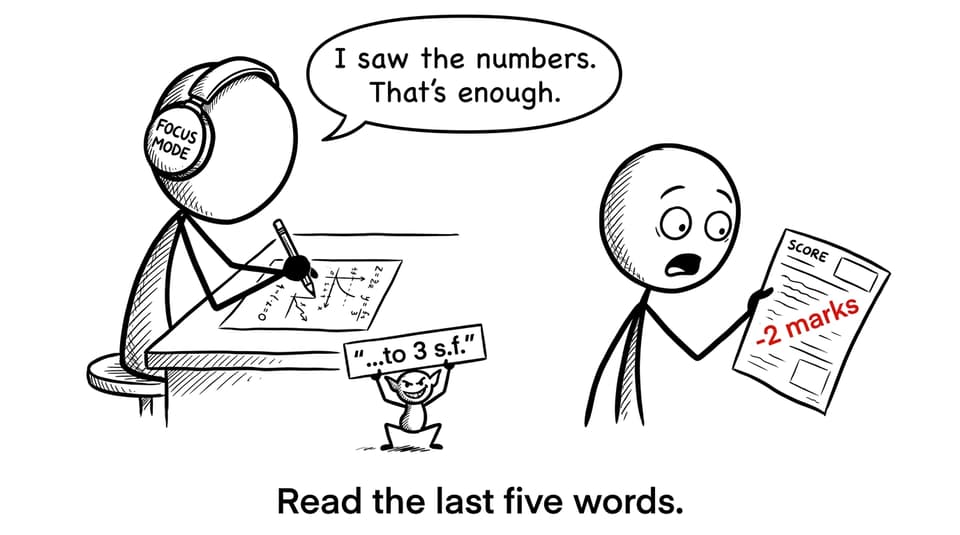
Most students don’t lose marks because they can’t do the math. They lose marks because they did the wrong math -- beautifully, confidently, and at full speed.
You’ve probably felt it: you finish a question, you check the solution, and the method is familiar. Yet the answer is “wrong” because you rounded too early, ignored a domain restriction, or answered part (b) like it was its own universe instead of “hence.” That is an IB reading mistake, not a math mistake.
This post gives you a practical way to read IB math questions carefully, avoid the classic traps, and train the habit under exam pressure with RevisionDojo.
A quick checklist you can use today
Before you solve any IB math question, run this short routine:
-
Read the whole question once without writing anything.
-
Read it again and circle the command term (state, show that, hence, determine, etc.).
-
Underline constraints: domain, interval, “for x ≥ 0,” “in terms of,” “to 3 s.f.,” units, mode (degrees/radians).
-
Write a 7-word summary of the task in the margin.
-
Only then start the working.
If you want structured practice for this, start with RevisionDojo’s Math AA resources and filters: IB Mathematics Analysis and Approaches Resources.
Why IB Math questions feel “tricky” (even when they aren’t)
The IB doesn’t usually hide content. It hides requirements. And requirements live in small words.
A question can be the same topic and the same numbers, but a different command term changes what earns marks. “State” is not “show that.” “Hence” is not “otherwise.” “Give your answer to 3 significant figures” is not “exact.” When you misread, you don’t just risk one mark; you often lose method marks because your solution is no longer aligned with what the examiner asked.
This is why repetition matters. The more IB questions you see, the more you recognize the phrasing patterns that trigger traps. That’s also why practising with a targeted bank helps: IB Mathematics AA Geometry and Trigonometry Questionbank and IB Mathematics AA Calculus Questionbank are perfect for drilling “read-first” habits with exam-style wording.
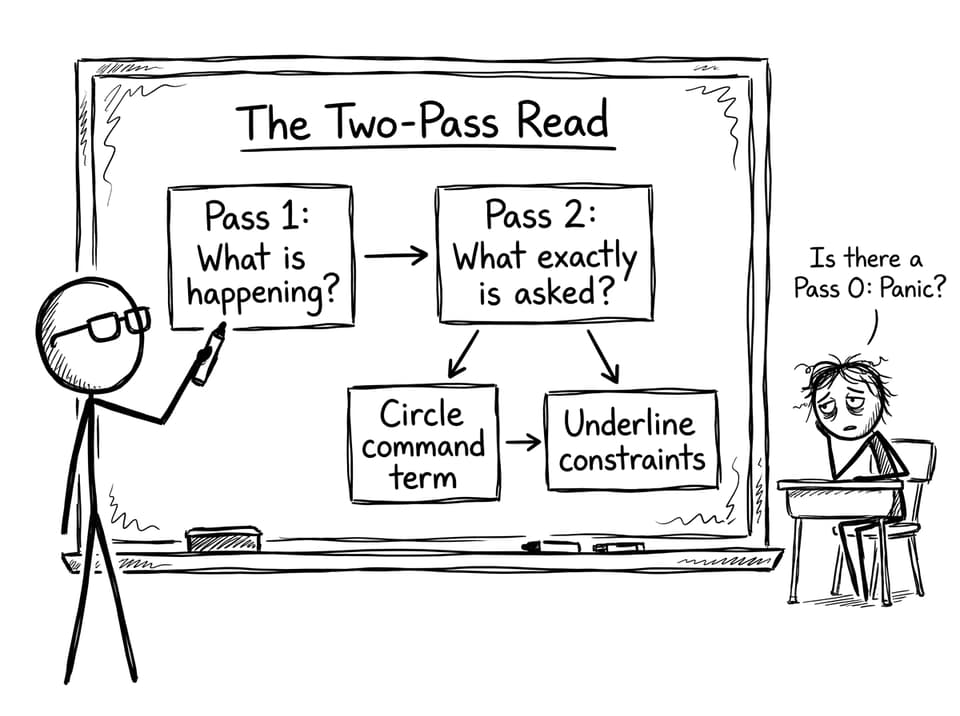
Use the two-pass read (and make it automatic)
The goal isn’t to read slowly. The goal is to read twice.
Pass 1: build a mental movie
Ask: What is happening?
-
Is this a model?
-
Is it asking about a function’s behavior?
-
Are we in geometry, trig, or stats?
-
What is given vs what is unknown?
You are not solving yet. You’re building context so your brain doesn’t latch onto the first obvious calculation.
Pass 2: extract the deliverable
Ask: What exactly must I produce?
-
A value? An equation? A proof? A sketch? An interpretation?
-
What form: exact, decimal, 3 s.f., in terms of (\pi), “show that …”?
-
What restrictions: domain, interval, conditions like (x \ge 0)?
This is where you circle the command term and underline constraints.
If command terms are your weak spot, keep a single reference page and practise weekly with: How to Decode IB Math Command Terms. The more fluent you are in the IB verbs, the fewer “wrong-task” solutions you’ll write.
The five most common IB Math reading traps (and how to disarm them)
Domain and range restrictions
These are quiet marks thieves. “Defined for (x \ge 0)” changes inverses, transformations, and even which solutions are valid.
Disarm it by circling any inequality or interval and writing “VALID SOLUTIONS ONLY” beside your working. Then, at the end, quickly check: did I accidentally include an extraneous root?
“Hence” and “given that”
In IB Math, “hence” is a signpost: the examiner wants you to use the previous result. Starting from scratch can still work, but it often becomes messy, slower, and easier to derail.
Disarm it by writing a one-line bridge: “Using (a), …” This keeps your logic aligned with the marking method.
Rounding, exact values, and premature approximation
If the question says 3 s.f., you keep full precision until the final line. If it wants an exact value, you stop turning (\pi) into 3.14 out of habit.
Disarm it by boxing your final answer only after you re-check the required form.
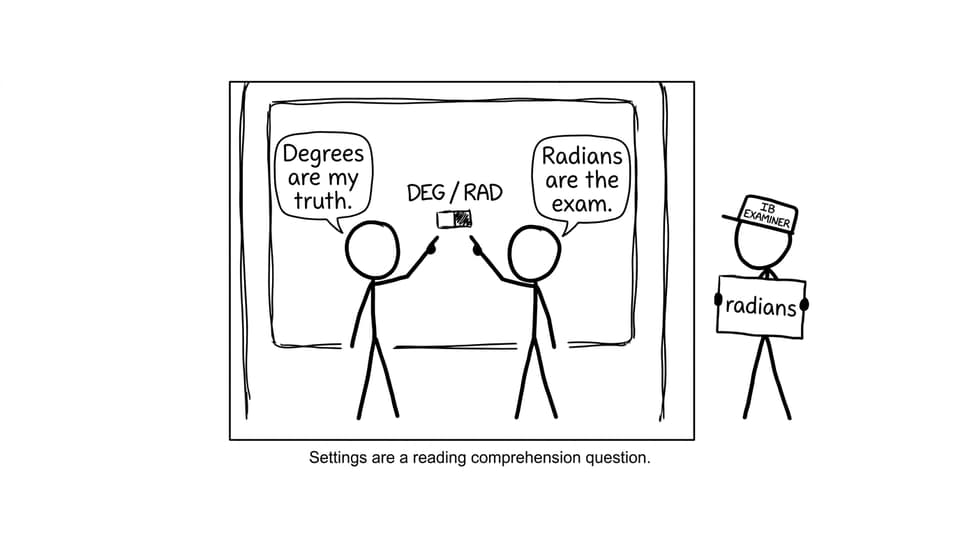
Degree vs radian mode
This is the most painful trap because you can do everything “right” and still be wrong.
Disarm it by making “mode check” part of Pass 2, especially for trig, calculus with trig, and anything involving (\sin), (\cos), (\tan).
“In terms of” and required variables
“In terms of (a) and (b)” means your final expression must not contain anything else. These phrases are easy to skim past when you’re chasing a result.
Disarm it by underlining “in terms of” and writing the allowed symbols in the margin.
To drill these traps with feedback loops, use topic-filtered practice. For Math AI students, this page is useful for structured question sets: Functions Questionbank (Math AI).
Break multi-part questions into micro-tasks
A multi-part IB question is usually designed like steps on a trail.
-
(a) introduces the object or method.
-
(b) uses the result, often with “hence.”
-
(c) extends to a new context or interpretation.
When you treat it as one big problem, you miss the built-in hints and lose easy marks. Instead, after reading, write tiny labels:
-
“What do I need to produce in (a)?”
-
“What result from (a) is supposed to help (b)?”
-
“What is the new requirement in (c)?”
Then practise this structure under time pressure using RevisionDojo’s exam-focused workflows and analytics, especially if you’re building a consistent routine: The Ultimate IB Math Study Routine for Busy Students.
Train careful reading like a speed skill
Careful reading sounds slow, but in IB exams it’s the opposite: it prevents rework.
Here’s a simple training drill you can run in 12 minutes:
-
Pick 6 exam-style questions from the Questionbank.
-
Spend 60 seconds each doing only:
-
circle command term
-
underline constraints
-
write a 7-word “deliverable” summary
-
-
Then solve only 2 of them fully, timed.
-
Review: were your summaries correct?
If you want to practise with huge variety and build pattern recognition, the strategy in How to Use the Questionbank for Targeted Math Revision pairs perfectly with this drill.
RevisionDojo supports the whole loop: Study Notes to clarify concepts, Flashcards to lock in definitions and command terms, AI Chat to question your interpretation, and Grading tools to check whether your final form matches what the IB asked.
Closing: treat reading as part of the math
In IB Math, reading carefully isn’t a soft skill. It’s a scoring skill.
When you circle the command term, underline constraints, and run a two-pass read, you’re doing the real work the exam rewards: aligning your method to the examiner’s requirement. And once you train that habit, your accuracy rises without adding extra study hours.
If you want a system that builds this automatically, use RevisionDojo as your practice loop: Questionbank for exam-style wording, Study Notes for fast clarity, Flashcards for command terms and definitions, AI Chat for quick interpretation checks, Mock Exams and Predicted Papers for timed realism, plus Grading tools, a Coursework Library, and Tutors when you want expert feedback.
Your next mark jump might not come from learning new math. It might come from reading the math you already know -- the way the IB expects.
