



A hook before rehearsal starts
In IB Theatre, the Solo Theatre Piece can feel like standing alone under a hot light, holding a single idea, hoping it somehow carries the weight of “theatre history” without collapsing into a lecture. You rehearse the beats, polish the transitions, time the breath. Then the doubt arrives: How do I prove this is more than one theorist and one performance?
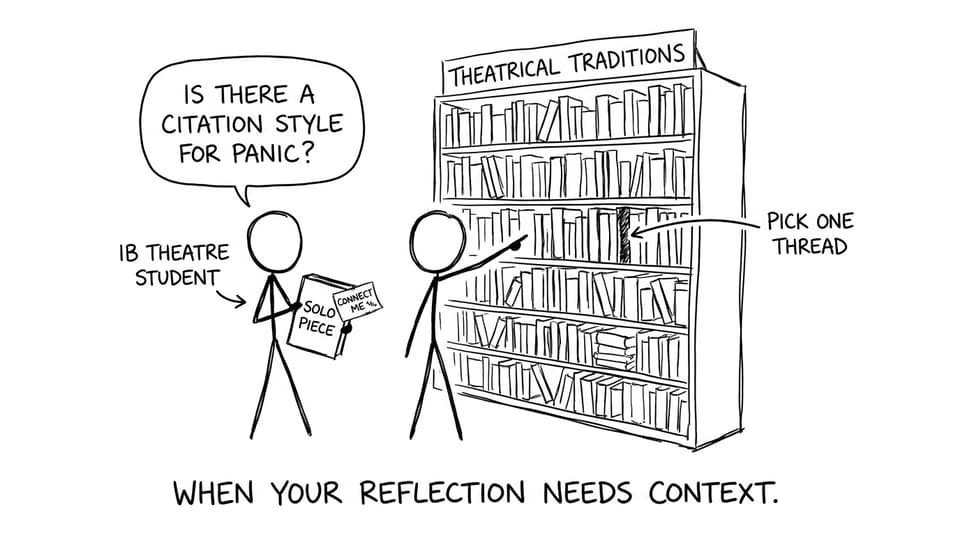
The good news is that connecting your Solo Theatre Piece to wider theatrical traditions is not about cramming in extra names. In IB Theatre, it’s about showing you understand where your theorist came from, what they pushed against, and what your own performance choices are in conversation with.
Quick checklist (keep it on one page)
Use this mini workflow for IB Theatre so your wider connections stay focused:
-
Identify your theorist’s context (time, place, problem they were solving).
-
Choose one or two wider traditions to explore (influence or contrast).
-
Compare using specific conventions (space, audience, gesture, voice, design, structure).
-
Translate the comparison into observable performance choices.
-
Write reflections that link research → rehearsal experiment → decision.
If you need an overview of what IB expects across tasks, revisit Dive into the World of IB Theatre: An In-Depth Syllabus Overview.
Why wider traditions matter in IB Theatre
Examiners are watching for range of understanding, not range of references. In IB Theatre, wider theatrical traditions help you do three things:
-
Deepen your theorist: their techniques stop looking like isolated “tricks” and start looking like responses to real artistic and social pressures.
-
Strengthen reflection: you can explain not only what you did, but why this approach communicates meaning.
-
Show global awareness: theatre isn’t one timeline; it’s many parallel conversations across cultures.
If your revision plan feels scattered, build a steadier routine with Best Study Strategies for IB Theatre Students (SL & HL).
Start with context: what shaped your theorist?
A useful IB Theatre move is to write one sentence that begins: “My theorist developed these ideas because…” and then force yourself to finish it.
Examples (as direction, not a script):
-
Brecht’s methods make more sense when you see the political urgency behind them.
-
Stanislavski becomes clearer when you understand what he wanted to replace: showy performance habits that didn’t feel psychologically truthful.
-
Artaud’s intensity reads differently when you treat it as an attempt to break theatre’s polite distance from the audience.
Once you have context, you can choose wider traditions in a disciplined way: either influence (what fed the theorist) or contrast (what your theorist rejects).
Choose two traditions: one influence, one contrast
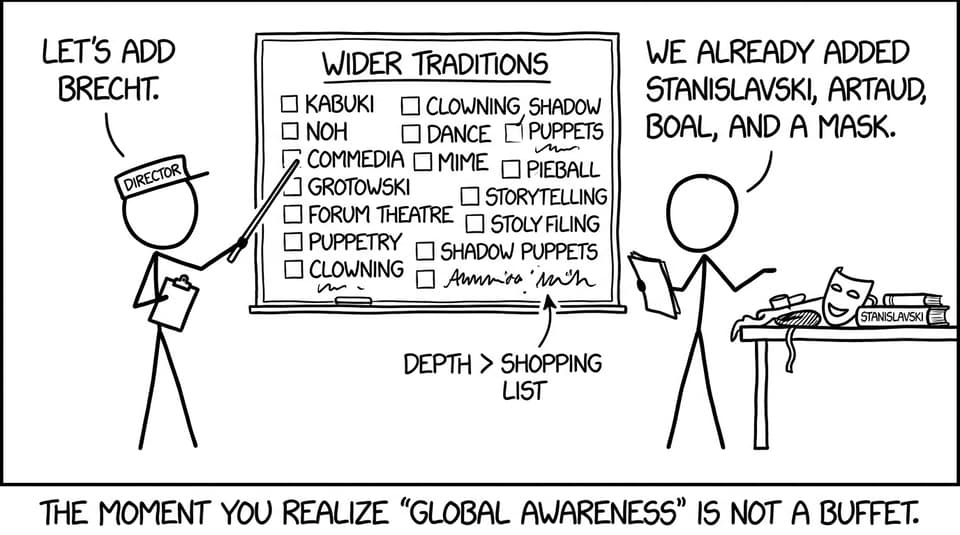
Many students in IB Theatre accidentally write a “shopping list” of traditions. A better strategy: pick two that create a clean triangle between tradition -- theorist -- your solo choices.
A practical pairing method
-
Influence tradition: something your theorist borrows from or echoes (ritual, mask, chorus, music, physical score, audience relationship).
-
Contrast tradition: something your theorist resists (naturalism vs distancing, text-led vs image-led, empathy vs critique).
Need help finding traditions worth researching? Use Best World Theatre Traditions to Research for IB Theatre Assessments to shortlist options with clear conventions.
Compare using conventions, not labels
In IB Theatre, the strongest connections happen when you compare how theatre works, not just what it’s called. Create a simple comparison table in your notes using these headings:
-
Performer’s body (gesture, tempo, tension, stillness)
-
Voice and text (speech rhythm, narration, chant, silence)
-
Space and audience (fourth wall, direct address, proximity)
-
Design and objects (mask, costume symbolism, minimalism, soundscape)
-
Meaning-making (empathy, critique, ritual impact, sensory overload)
Then write one line that starts: “This matters in my Solo Theatre Piece because…”
If physical conventions are your bridge, you’ll likely find practical exercises in How to Apply Physical Exploration in World Theatre Studies.
Turn research into rehearsal experiments (the examiner can see)
A wider tradition only “counts” in IB Theatre when it changes what happens on stage.
Try this three-step loop:
Test one convention at a time
Pick one convention (for example: direct address, ritual repetition, mask-work, stylized walk) and run a 10-minute experiment.
Record what changed
Not “it was cool” -- but what shifted in:
-
audience relationship
-
clarity of intention
-
emotional tone
-
pace and focus
Decide and justify
Keep it, adapt it, or reject it. Any of the three can score well in IB Theatre if your reasoning is sharp.
To keep your theory/practice balance clean, borrow the structure from How to Balance Creativity and Theory in the Solo Theatre Piece and pair it with rehearsal routines from Best Rehearsal Strategies for the IB Theatre Solo Piece.
Portfolio writing: the sentence frames that save time
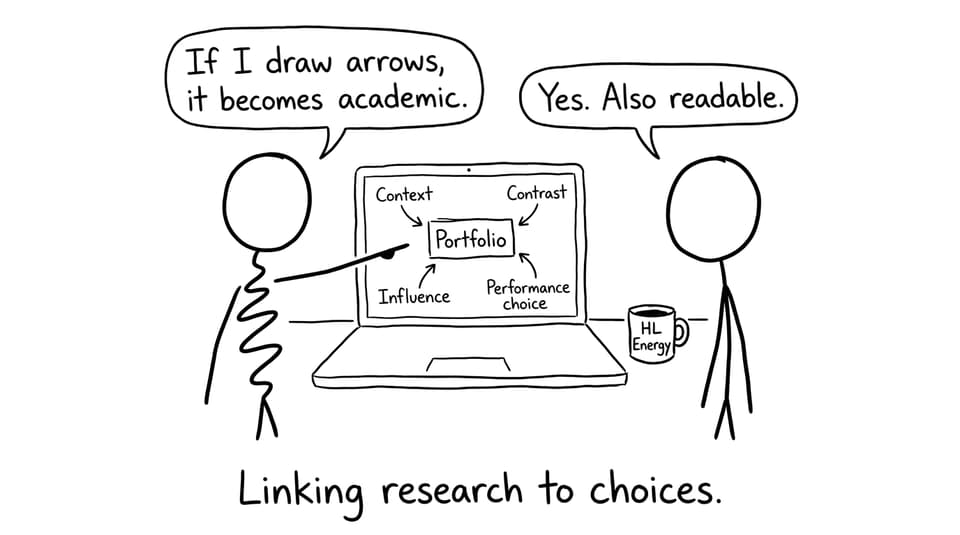
When students struggle in IB Theatre, it’s rarely because they didn’t research enough. It’s because they didn’t connect research to choices.
Use these sentence starters:
-
“I explored ___ (tradition) because it clarifies my theorist’s aim to ___.”
-
“In rehearsal, I tested ___ by ___; the impact was ___.”
-
“This contrasts with ___ because in that tradition the audience is expected to ___.”
-
“I adapted the convention by ___ to suit my piece’s intention of ___.”
When you want rubric-aligned feedback, run your draft through the IB Solo theatre piece Grader to spot where your reflection is descriptive versus analytical.
Closing: make your solo feel larger than one person
Your Solo Theatre Piece is personal by design. But in IB Theatre, it shouldn’t be isolated. When you connect your work to wider theatrical traditions, you’re telling the examiner: I know what I’m borrowing, what I’m resisting, and why my choices belong on stage.
If you want the fastest path from research to examiner-ready reflection, build your workflow on RevisionDojo: use Study Notes to anchor theory, Flashcards to keep conventions sharp, AI Chat to clarify concepts in rehearsal language, Grading tools to tighten your portfolio, and Mock Exams plus Predicted Papers to stay calm as deadlines close in. In IB Theatre, the performance is the proof -- but your connections are the meaning.