


A staging problem every IB Theatre student meets
The first time you try to stage a play text, it feels like the script is staring back at you.
On the page, everything looks certain: entrances, exits, pauses, stage directions, neat dialogue. In rehearsal, nothing stays neat for long. Someone crosses too early. A line lands flat. The “dramatic beat” you underlined doesn’t happen. And suddenly IB Theatre stops being about what the text says and becomes about what you can prove through theatrical choices.
That’s the heart of staging play texts in IB Theatre coursework: not just producing a scene, but building an argument through space, rhythm, design, and reflection.
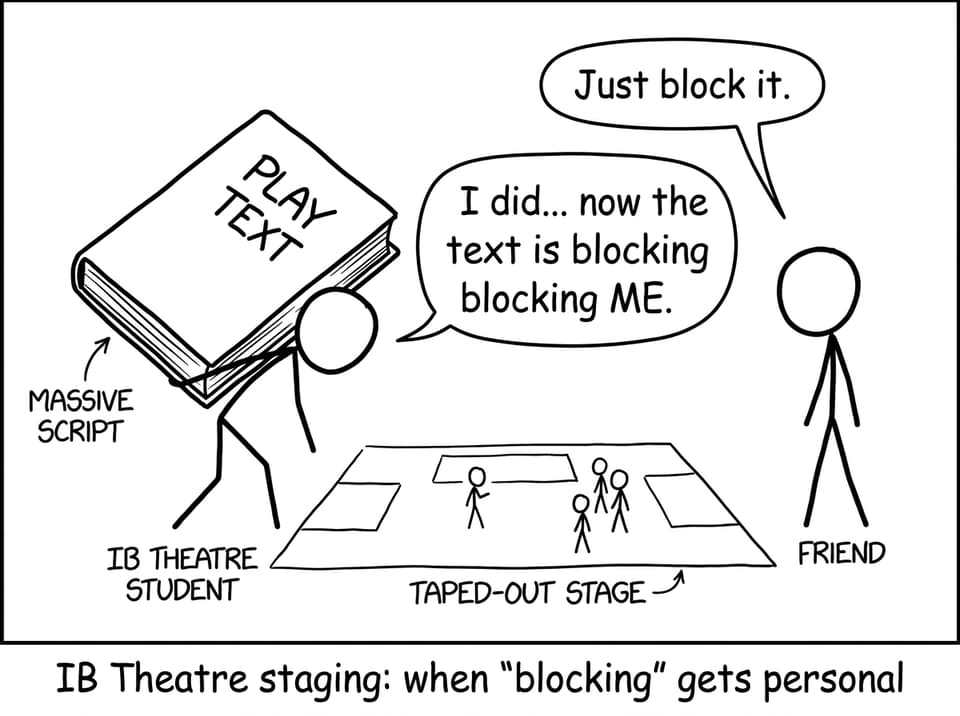
Quick staging checklist (use this before every rehearsal)
If you’re short on time, run this checklist like a pre-flight routine:
-
Read the play text twice: once for story, once for subtext.
-
Write one sentence of directorial intention (your “why”).
-
Choose one practitioner lens (or a clear blend you can justify).
-
Block the scene with power dynamics in mind (who owns space?).
-
Choose 2-3 purposeful production elements (not decoration).
-
Record evidence: annotated script, staging sketches, rehearsal reflections.
For broader exam alignment, keep the bigger course picture in view with How to Score a Level 7 in IB Theatre: Complete Guide.
Why staging play texts matters in IB Theatre coursework
In IB Theatre, staging is where analysis becomes visible. Examiners aren’t only interested in whether your scene is “good.” They want to see intentionality:
-
You can interpret the play text with cultural and historical awareness.
-
You can transform meaning using staging, blocking, and mise-en-scène.
-
You can connect choices to theory, practitioners, and traditions.
-
You can reflect honestly on what worked, what didn’t, and why.
If you want a dependable way to sharpen that reflective habit, borrow study routines from Best Study Strategies for IB Theatre Students (SL & HL).
Analyze the play text like a director, not a reader
A strong IB Theatre staging process starts with a close reading that’s aggressively practical. Instead of asking “What does this mean?”, ask:
-
What does the character want in this beat?
-
What changes between this line and the next?
-
Where is tension stored: in silence, movement, distance, pace?
-
What does the text allow me to show physically?
Here’s a simple tactic: underline lines that contain a shift (a new idea, a new threat, a new vulnerability). Then stage those shifts with a physical change: levels, proximity, pacing, or focus.
Write your directorial intention in one sentence
In IB Theatre, your intention is your anchor. It prevents random choices and makes reflection easier because everything can be evaluated against the same aim.
Try this format:
“I want the audience to feel/realize ______ by emphasizing ______ through ______.”
Example:
“I want the audience to feel watched and complicit by emphasizing surveillance through rigid proxemics, isolated lighting, and repeated stillness.”
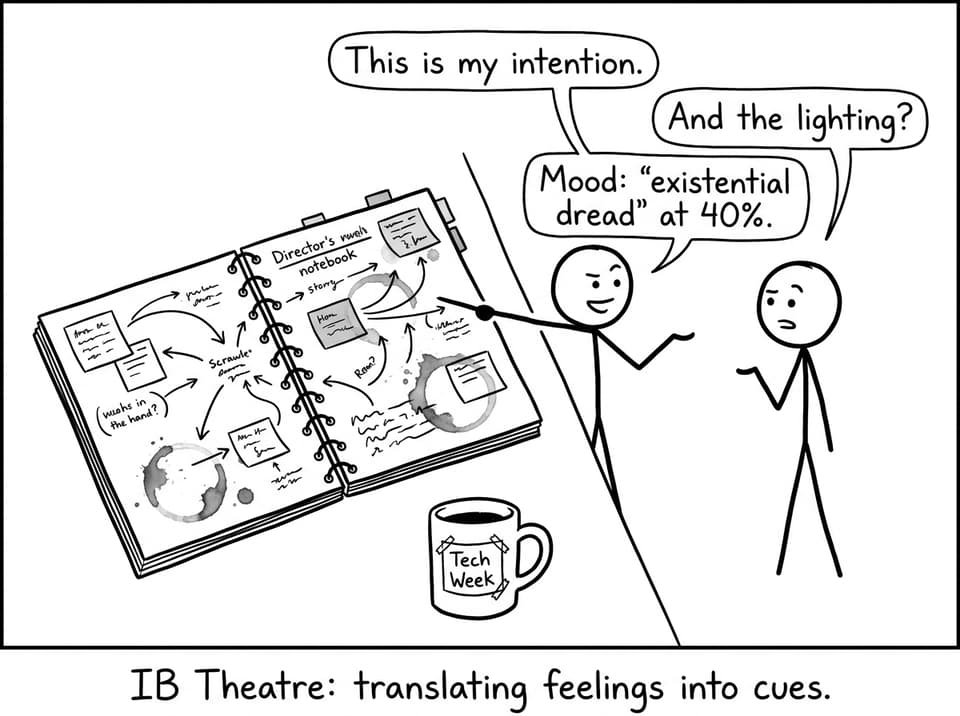
That one sentence should appear in your notebook, your rehearsal notes, and near every design decision. It’s the thread that makes coursework feel coherent.
Use practitioner influence without turning it into cosplay
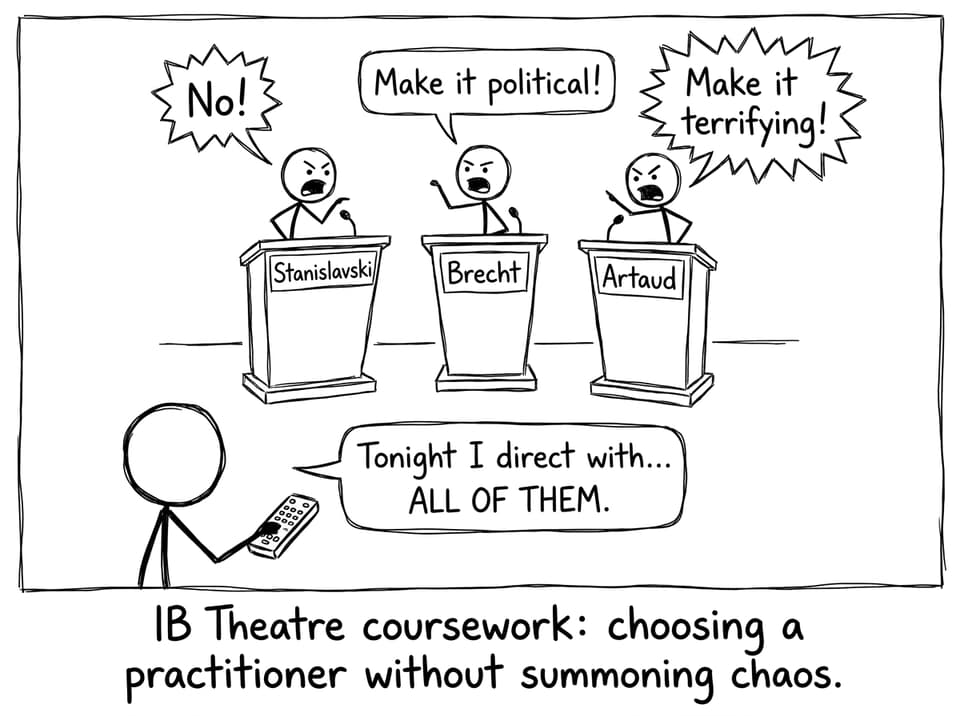
A common IB Theatre mistake is dropping a practitioner name like it’s a password. The better move is to use a practitioner as a tool, then adapt.
-
Stanislavski can sharpen objectives and playable actions.
-
Brecht can help you control audience distance and critical thinking.
-
Artaud can push sensory choices and discomfort with purpose.
But your reflection must answer: why this approach for this play text, now?
If you need reminders on organizing research and turning it into usable rehearsal experiments, see Best Ways to Organize Your Research for the IB Theatre Research Presentation.
Block for meaning: power, pace, and the audience’s eye
Blocking in IB Theatre is not traffic control. It’s meaning-making.
Start with three “director questions”:
-
Who holds power at the start, middle, and end?
-
Where should the audience look, and how do you force that focus?
-
What changes physically when the emotional temperature changes?
Practical tip: rehearse the scene once with no lines. If the story becomes unclear, your staging is relying too much on dialogue. In IB Theatre coursework, silent clarity is a superpower.
Mise-en-scène: fewer choices, stronger symbolism
Design elements should behave like evidence. One chair can say more than a full set if it’s chosen with intent.
Build your mise-en-scène using a short list:
-
One dominant visual metaphor (e.g., confinement, decay, repetition).
-
A controlled color palette.
-
A lighting rule (isolated specials, harsh top light, or warm naturalism).
-
A sound logic (diegetic vs non-diegetic, when silence matters).
For deeper guidance, use Using Mise-en-Scène Effectively When Staging Play Texts.
Document like it’s part of the performance (because it is)
In IB Theatre, your strongest moments can disappear if you don’t capture them. Keep a director’s notebook that includes:
-
Annotated script pages (cuts, beats, intentions).
-
Ground plans and blocking sketches.
-
Production notes (lighting states, costume logic, prop symbolism).
-
Post-rehearsal reflections: one win, one problem, one next step.
If you want a clean starting place for coursework organization across subjects, browse Coursework Guides.
RevisionDojo workflow for IB Theatre exam prep
When exams are close, staging can still help you revise IB Theatre faster, because it forces you to think in criteria-friendly language.
On RevisionDojo, students typically combine:
-
Study Notes to lock in vocabulary and practitioner theory: Study Notes
-
Flashcards to remember key terms and evaluation phrasing
-
AI Chat to test interpretations and tighten intentions
-
Grading tools to self-check reflection quality (and reduce vague writing)
-
Mock Exams and Predicted Papers to rehearse timed analysis habits
-
The Coursework Library for models and structure
-
Tutors when you need fast feedback on clarity and evidence
For a wider view of how RevisionDojo supports exam-mode practice, see RevisionDojo App: The Smarter Way to Prep for IB Exams.
Closing: treat staging as your clearest form of analysis
Staging a play text in IB Theatre is a quiet kind of courage. You read a script written for someone else’s stage, then you decide what must be seen, what can be altered, and what the audience should carry home.
If you want that process to feel simpler and more exam-ready, use RevisionDojo to turn your rehearsal thinking into marks: study with the Questionbank, refine with AI Chat, consolidate with Study Notes and Flashcards, and pressure-test your writing with Grading tools and Mock Exams. IB Theatre rewards students who can create boldly and explain clearly, and that’s exactly the skill set RevisionDojo is built to support.
For more Theatre-specific support, explore All IB Theatre Posts and tighten your revision with IB Theatre SL Grade Boundaries 2025.