

In the middle of an IB week, it rarely feels like you are studying a “curriculum.” It feels more like you are carrying six different languages in your head and being asked to translate them at speed.
You finish a Biology practice set. You start a History essay plan. Your TOK teacher asks for a real-life example that connects to what you just learned. Your EE supervisor wants a sharper research question. And somewhere underneath all that is a quiet fear: I understand each piece, but I cannot see how the pieces belong together.
That is exactly where RevisionDojo becomes more than an exam platform. For IB students, it can function like a connective tissue: helping TOK and EE habits show up inside your everyday subjects, so the “core” stops feeling like an extra subject and starts feeling like a way of thinking.
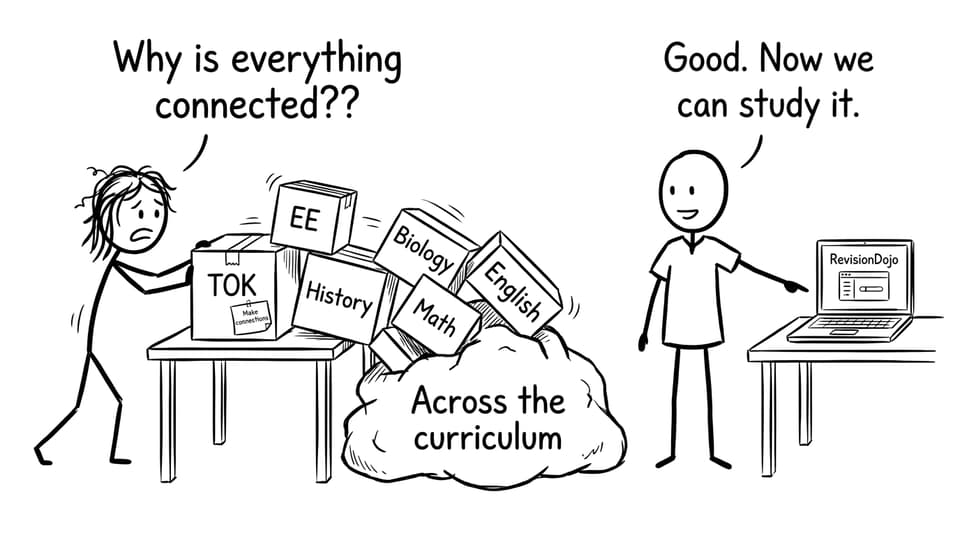
The fast checklist: how IB students can use RevisionDojo for TOK and EE
If you want the practical version first, here is a simple loop you can run weekly. It is designed for IB reality: limited time, lots of subjects, constant deadlines.
-
Use Study Notes to clarify a concept you will actually apply (not reread).
-
Do a short Questionbank set in that same topic to expose what you do not know.
-
Write one TOK-style reflection question about your mistakes: “What did I assume?” or “What counted as evidence?”
-
Move one insight into your EE research log (even if your EE is months away).
-
Draft a paragraph or section and run it through Grading tools for criterion-level feedback.
-
Use AI Chat to ask one precise question that improves the next draft.
-
Once a week, simulate pressure with Mock Exams or Predicted Papers to keep exam stamina alive.
This is not about doing more. It is about making your IB work point in one direction.
Why TOK and EE matter across the IB (even when exams feel louder)
In the IB, TOK and the EE are often described as the intellectual heart of the programme. That sounds poetic, but it is also practical.
TOK trains you to notice the “invisible moves” behind knowledge: assumptions, language, perspective, and the limits of methods. Those moves appear everywhere: in a lab conclusion, in a historical source evaluation, in a math modeling decision, in a literary interpretation.
The EE trains you to build something longer than a homework task: a question you can live with, a method you can defend, and an argument you can refine without collapsing into panic.
When TOK and EE are treated like isolated projects, many IB students learn them late. They try to become reflective thinkers in a single unit, or they try to learn academic writing only after they have already chosen an EE topic. RevisionDojo supports the opposite approach: small, repeated moments of inquiry and reflection embedded across subjects.
How RevisionDojo builds TOK thinking into everyday IB subjects
TOK is not just a course. In a strong IB experience, it becomes a habit: the habit of asking “How do we know?” before you rush to “What is the answer?”
Reflection that actually changes your next attempt
A lot of reflection in school becomes decorative. You write something like “I need to manage time better,” and nothing changes.
RevisionDojo is built for reflection that points to action. After you practice with the Questionbank or do a timed section, you can create short prompts for yourself that mirror TOK thinking:
-
What assumption did I import from my own worldview?
-
What would count as stronger evidence in this subject?
-
Where did language make my claim vague?
-
Which perspective is missing from my conclusion?
Then you use that reflection immediately, because the platform connects it back to what you will do next: a new set, a new draft, a new attempt. That is a very TOK-friendly rhythm for IB students: question, test, revise, repeat.
For TOK-specific guidance and examples, keep the hub open: IB Theory of Knowledge (TOK) Resources.
Seeing TOK patterns across your subjects
One reason TOK feels difficult in the IB is that it can sound abstract. It gets easier when you recognize it inside other subjects.
A few examples you can deliberately watch for:
-
In sciences, what are the limits of empirical evidence and measurement?
-
In history, how do power and selection shape sources?
-
In literature, how does language manipulate interpretation?
-
In math, when does a model become a belief rather than a tool?
RevisionDojo supports this cross-subject awareness because your work is stored as a system: your practice, your feedback, your weak areas, your drafts. The platform encourages you to notice recurring mistakes and recurring thinking traps across the IB.
If you want a TOK skills reset that translates well into essay writing, read: TOK Thinking and Skills: How to Succeed in IB TOK.
Ethical and perspective-aware thinking, without performative “balance”
A common TOK trap for IB students is fake balance: “On the one hand… on the other hand…” with no real evaluation.
RevisionDojo helps you practice useful perspective-taking by tightening the feedback loop. When you draft an argument (in English, History, Global Politics, even a TOK commentary), you can use AI Chat to test the strength of your counterclaim, or to identify where your example is descriptive rather than analytical.
This matters because perspective is not just a TOK concept. It is the difference between a mid-level response and a high-level response in many IB mark schemes.
How RevisionDojo supports your IB Extended Essay from the first idea to the final polish
The EE is rarely ruined by intelligence. It is usually ruined by drift: a question that keeps changing, research that piles up without direction, drafting that starts too late, feedback that is too vague to use.
RevisionDojo supports EE development across the curriculum by making the process feel like a series of smaller, manageable decisions.
Building research skills early, inside your subjects
If you wait until your EE officially starts, you are already behind the best version of yourself.
Instead, use normal subject learning as EE training:
-
In History, practice writing mini source evaluations that could become part of your EE voice.
-
In sciences, practice explaining why your method is valid, not just what you did.
-
In English, practice turning a theme into a debatable claim.
RevisionDojo’s Study Notes help you learn the concepts quickly, but the deeper EE value comes from how you apply them through practice and writing. When you can explain why something is true, and what would make it false, you are doing EE-level thinking in regular IB study time.
Start with the main hub: IB Extended Essay Guide: Structure, Research Question, ....
Turning feedback into a drafting system (not a mood)
The most underrated skill in the IB is not writing. It is rewriting with direction.
RevisionDojo’s IB Coursework Grader supports this by giving criterion-aligned feedback you can act on. Instead of hearing “be more analytical,” you get a clearer picture of what the rubric wants and where your draft is currently landing.
That changes your EE process. You stop doing random edits and start doing targeted passes.
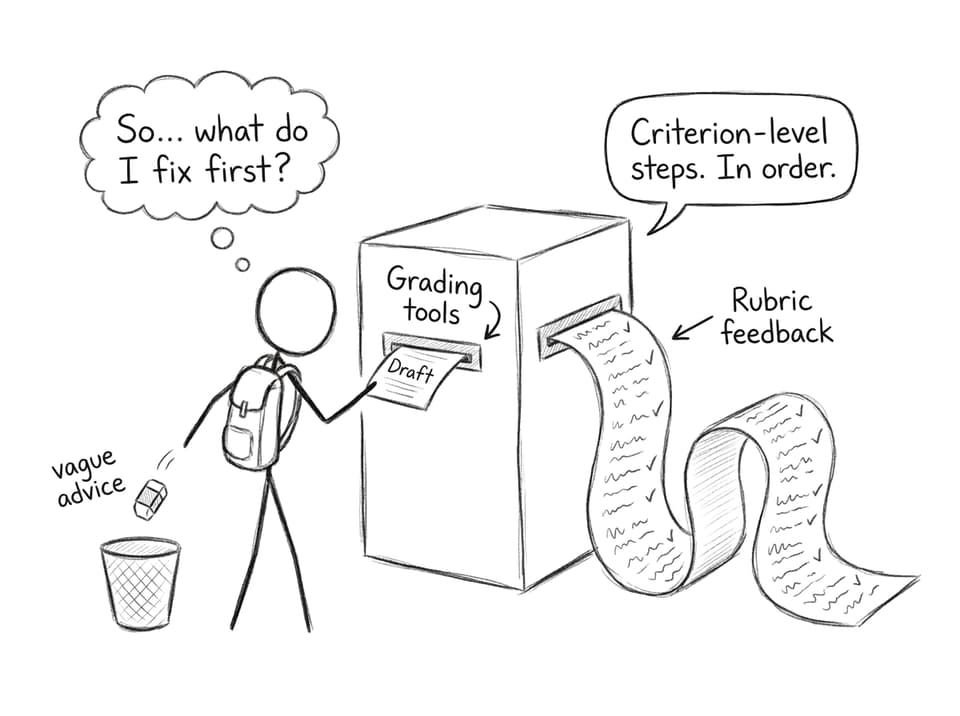
If you want a focused approach to improving with feedback, this article helps: IB EE Feedback Tool: Improve Your Extended Essay Score.
Using TOK to make your EE more critical (and more convincing)
One of the easiest ways to raise EE quality in the IB is to use TOK habits without turning your EE into TOK.
Practical move: take your EE research question and write a “shadow question” behind it:
-
What counts as convincing evidence in this field?
-
To what extent can we trust this method?
-
How does language or measurement shape conclusions?
That shadow question helps you evaluate sources, explain limitations, and justify choices. In other words, it makes you sound like a serious researcher instead of a collector of quotes.
To see this approach clearly, read: How to Use TOK to Enhance Your Extended Essay.
Keeping exam prep alive while your EE grows
The EE can quietly consume your time if you let it. RevisionDojo is useful here because it holds your whole IB routine in one place.
You can keep your exam engine running with:
-
Questionbank sets for daily application practice
-
Flashcards for spaced repetition (definitions, quotes, key steps)
-
Mock Exams for pacing and stamina
-
Predicted Papers for realistic full-paper rehearsal
And when your brain is tired, AI Chat helps you unblock one concept without losing an hour to searching.
If you want the full platform workflow for exam season, use: RevisionDojo App: The Smarter Way to Prep for IB Exams.
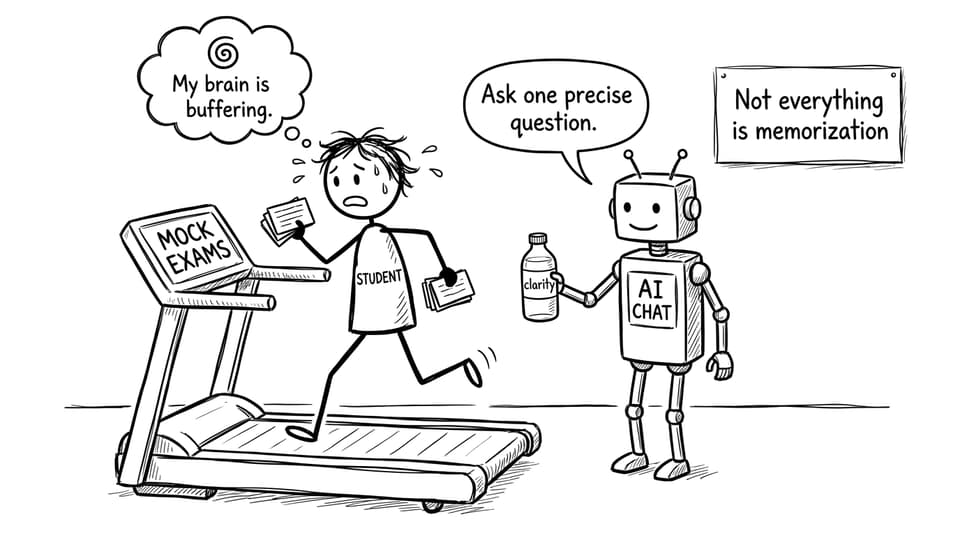
The cross-curricular advantage: how IB stops feeling like six separate lives
The best IB students are not the ones who “do everything.” They are the ones who reuse thinking.
A strong TOK reflection becomes a sharper History evaluation paragraph.
A well-structured English argument becomes a cleaner EE line of reasoning.
A careful science limitation becomes a more honest conclusion.
RevisionDojo supports this cross-curricular development because it is not just a library. It is a system that connects practice, feedback, and improvement across your entire IB workload: Study Notes, Flashcards, Questionbank, AI Chat, Grading tools, Predicted Papers, Mock Exams, a Coursework Library, and Tutors when you want a human second set of eyes.
If you want a broader routine that keeps everything coordinated, read: IB Revision Made Easy With RevisionDojo All-in-One.
For the wider set of tools that keep you stable near exams, this helps too: Best Resources for IB Exam Preparation.
Closing: a calmer way to do IB thinking
A lot of IB stress comes from feeling like you are constantly starting over: new topic, new subject, new rubric, new expectations.
RevisionDojo supports TOK and EE development across the curriculum by helping you keep one set of habits running everywhere: practice that exposes gaps, reflection that changes your next attempt, feedback that points to criteria, and a study loop you can repeat even when you are tired.
If you want one home base for the whole programme--exam prep, coursework drafting, and cross-curricular thinking--start with RevisionDojo for Schools to see how the platform supports consistent IB development at scale, and keep the student workflow pages open as you build your routine.
Because the best version of the IB is not six separate lives. It is one mind learning to connect what it already knows.