When you walk into two different classes in the same IB subject and hear two different definitions of “what matters most,” it’s not usually because one teacher is right and the other is wrong.
It’s because revision planning quietly becomes personal.
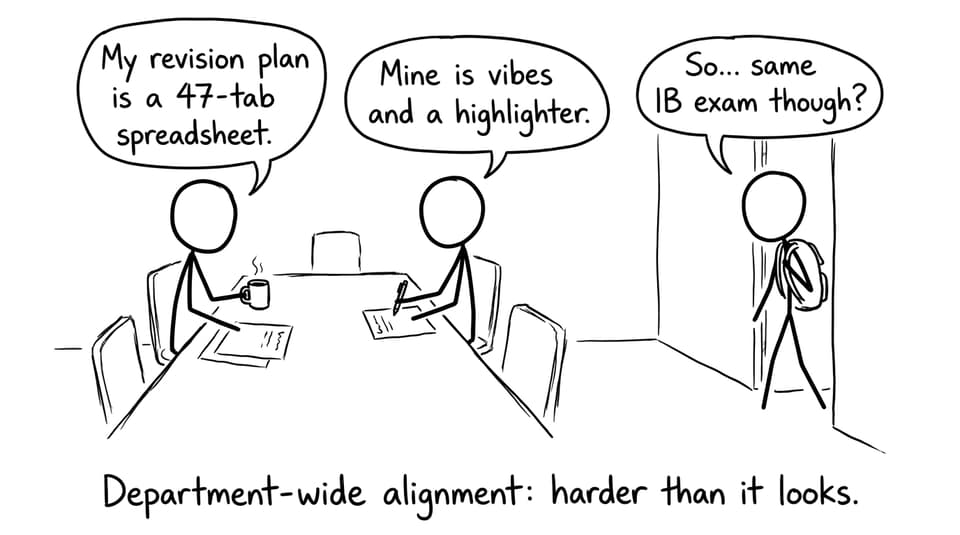
A teacher builds a sequence that fits their style, their class, and their calendar. Another teacher does the same. Both are trying to help. But the student experience can start to feel like luck: you either land in the class that happened to rehearse the exact skills your exam will reward, or you spend the last month scrambling to fill gaps.
Department-wide alignment is how schools remove that luck. And for IB students preparing for exams, it’s one of the biggest hidden advantages a department can give you.
The student problem department planning is actually solving
In the IB, consistency matters because the exam is the same for everyone, but teaching paths vary.
When departments plan revision together, students benefit in three practical ways:
-
Coverage becomes reliable: fewer “we never really revised that” surprises.
-
Practice becomes comparable: you can talk to friends in other classes and still be practicing the same skills.
-
Feedback becomes predictable: marking and improvement advice stop depending on who happened to grade it.
RevisionDojo was built to make that consistency easier to build and maintain at scale, without turning teachers into robots.
If you’re curious what coordinated planning looks like behind the scenes, this guide is a useful companion: Streamlining collaborative planning with teacher tools.
Quick checklist for department-wide IB revision planning
If your department is trying to simplify revision planning, the fastest path is to standardize the skeleton while leaving freedom in the muscle.
Here’s a clean setup most IB departments can start within a week:
-
Agree on a shared revision map by topic and week
-
Use one shared resource spine (so every class learns from the same core materials)
-
Align on common question types and command terms to practise
-
Build one shared data loop (what students missed, what gets retaught)
-
Reduce duplication by assigning ownership: one teacher builds, everyone benefits
For students, this often shows up as calmer revision. Less hunting. More doing.
Why IB departments drift into “silo revision”
Most silos are accidental. They happen because the IB is content-heavy, time is tight, and planning meetings get eaten by admin.
Different pacing creates invisible gaps
Two teachers can “finish the syllabus” but land in different places for revision season. One class repeats weak topics three times. Another touches them once and moves on. Students then compare notes and realize they prepared for different exams even though the exam is identical.
Resources multiply faster than quality control
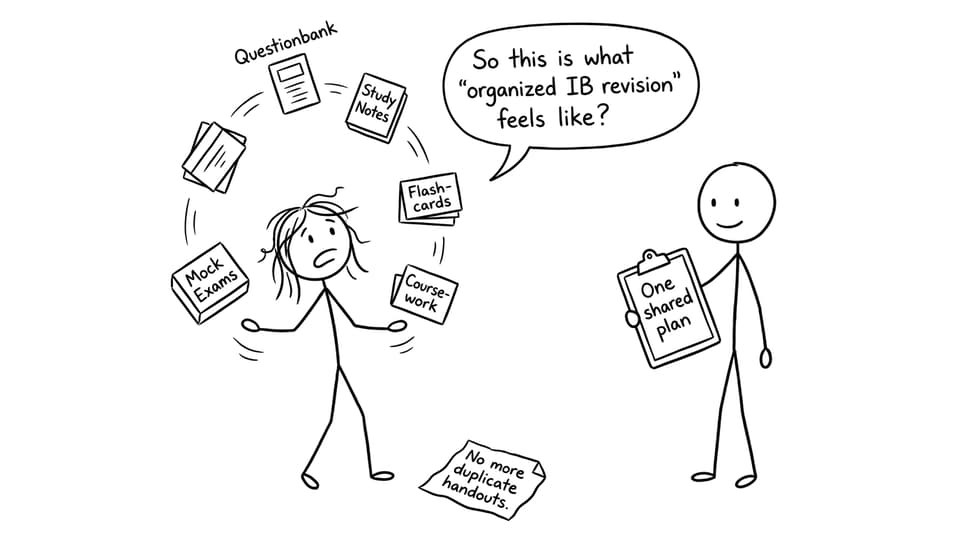
Handouts, slide decks, old packets, shared drives, random PDFs. Everyone has something. Not everything is equally updated or exam-aligned.
A central hub helps here. RevisionDojo’s Study Notes give departments an IB-aligned baseline, and students can use them as the same reference point no matter which class they’re in. For a deeper look at building retention from notes, see: Use RevisionDojo Notes to boost IB retention.
Assessment styles vary unless you actively moderate
One teacher marks generously. Another marks tightly. If you don’t reconcile that difference, students end up training for inconsistent expectations.
This is where RevisionDojo’s Grading tools and shared rubrics help departments calibrate, while still letting teachers give feedback in their own voice.
How RevisionDojo makes department-wide IB revision simpler
RevisionDojo works best when it becomes the department’s “single source of truth” for revision planning and exam practice.
One shared content spine (without locking teachers in)
Departments can align around one set of syllabus-organised materials, then let teachers customise delivery. That balance matters in the IB: students need consistency, teachers need flexibility.
Students feel this as clarity: fewer competing checklists, fewer conflicting “most important topics,” and a stronger sense of what to do next.
You can explore the broader platform here: RevisionDojo for IB.
Question practice that’s consistent across classes
When a department uses a shared question system, practice stops being random. RevisionDojo’s Questionbank lets teachers assign targeted sets by topic and difficulty, while students get feedback that’s tied to how marks are actually awarded.
If you want to understand how to use it effectively as a student, this is worth saving: IB Question Bank: how to use it effectively.
A shared “data truth” that makes reteaching faster
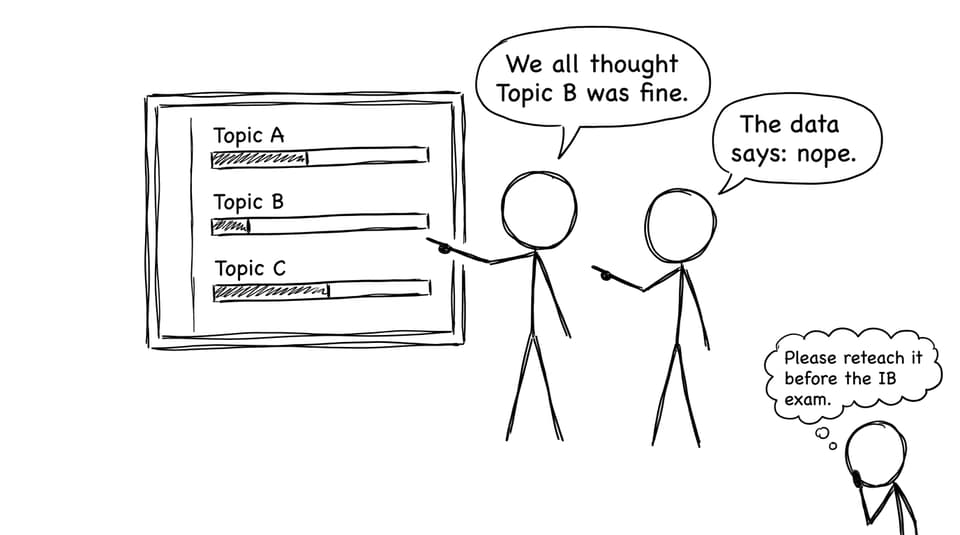
In most schools, the hard part isn’t noticing a problem. It’s proving it across classes quickly enough to fix it.
RevisionDojo’s analytics make patterns visible so departments can say: “Topic B is the issue,” and then do something about it this week, not next term.
Revision that includes timing, stamina, and exam-mode habits
A department-wide plan should include not just content revision, but exam behaviour: pacing, endurance, and decision-making.
That’s where RevisionDojo’s Mock Exams and Predicted Papers fit naturally into a shared schedule: one class doesn’t do “three full papers,” while another does none. Everyone trains the same skills.
For students trying to raise performance through realistic practice, this is helpful: IB grade predictions: improve them with practice papers.
And if you’re unsure how predicted sets should be used, read: IB predicted vs specimen papers: what they mean.
Support beyond the classroom
Sometimes the biggest revision bottleneck isn’t motivation. It’s confusion that lingers for days.
RevisionDojo’s AI Chat helps students get unstuck quickly, the Flashcards system supports daily spaced repetition, the Coursework Library reduces background stress, and Tutors provide human diagnosis when you need more than hints.
If you want to see how all those pieces fit into one routine, start here: RevisionDojo app: the smarter way to prep for IB exams.
What this looks like in real student life
When a department aligns its IB revision plan, students start to talk differently.
Not “What did your teacher say will be on the exam?”
But “Which topic are you drilling this week?”
That shift matters because it moves revision from rumours to routines. A shared plan turns group chats into accountability, not panic.
FAQ
How does department-wide planning help IB students preparing for exams?
Department-wide planning helps IB students by making revision predictable. You stop losing time to mismatched priorities between classes, because everyone is revising the same topics in roughly the same window. It also improves fairness: students across different teachers receive similar practice and similar feedback standards. When departments align, the revision workload tends to spread out more evenly, reducing last-minute cramming. It becomes easier to form study groups across classes because you’re working on the same skills. Over time, that consistency compounds into confidence, because you can measure progress against a shared benchmark.
What should students do if their department is not aligned yet?
First, don’t wait for perfect coordination to begin your IB revision. Build your own “single source of truth” using a platform that’s syllabus-aligned, then practise with targeted questions and timed sessions. RevisionDojo makes this practical because your Study Notes, Flashcards, and Questionbank can connect into one weekly loop. Second, compare notes with classmates in other sets and look for gaps rather than gossip. If you notice a topic your class hasn’t covered in revision, raise it early and specifically: “Can we schedule one session on X and practise Y question type?” Finally, use analytics from your own practice to guide what you revisit, so your revision is driven by evidence, not anxiety.
How can teachers align revision without adding more meetings?
Alignment doesn’t have to mean more time. It usually means better reuse. In the IB, departments can start by agreeing on a shared revision map and a shared resource spine, then letting teachers adapt delivery. Platforms like RevisionDojo reduce admin by keeping materials and performance insights in one place, so collaboration can happen asynchronously. Teachers can share question sets, flashcard decks, and revision sequences without rebuilding them each year. Department heads can use shared analytics to focus discussions on the few topics that actually need reteaching. Over time, the system becomes lighter because each cohort improves the department’s library instead of starting from zero.
A final note for IB students
You can’t control whether your department is perfectly aligned. But you can choose a revision system that rewards consistency.
If your school is building department-wide revision planning, ask to make RevisionDojo part of the routine: shared Study Notes, a common Questionbank, daily Flashcards, and scheduled Mock Exams and Predicted Papers. When everyone practises with the same structure, the IB stops feeling like a moving target.
If you’re a coordinator or teacher looking to standardise revision across classes, start here: RevisionDojo for Schools.

