


If you’re an IB student, you can feel it when exam season arrives.
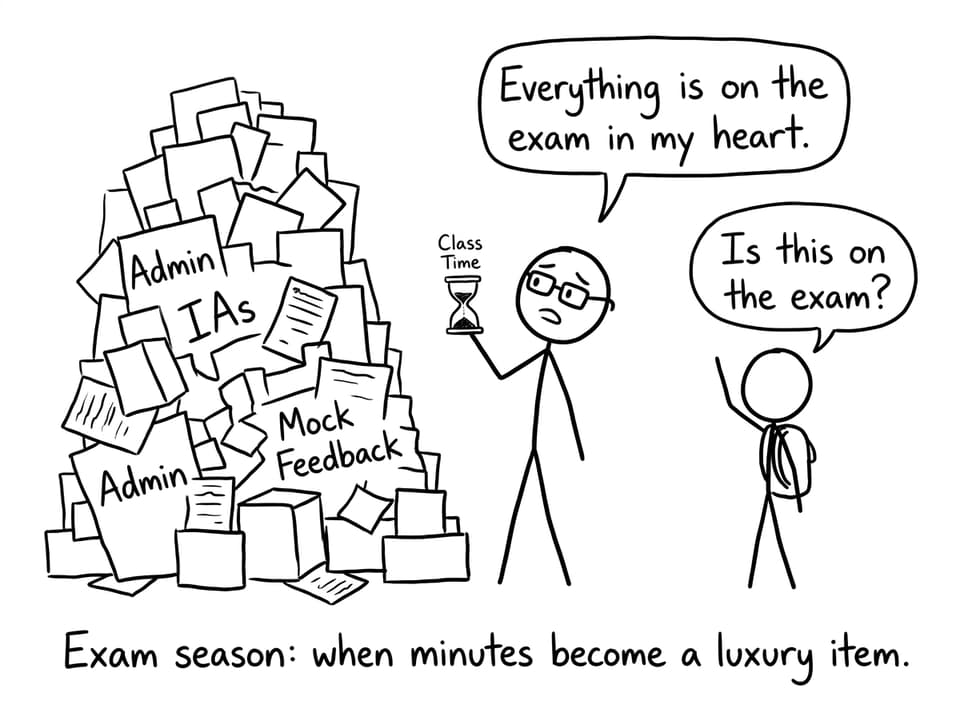
Lessons get tighter. Questions get sharper. Teachers start making choices that look ruthless from the back row: skipping a “nice-to-know” detail, cutting an activity short, assigning more independent work. It can feel like the class is moving too fast. But most of the time, it’s not panic; it’s triage.
Your teacher isn’t trying to do less. They’re trying to protect the few minutes that still matter.
Below is how great IB teachers manage limited class time during exam season (and how you can match their system at home so you get twice the benefit).
A quick student checklist for protecting IB class time
Use this list before your next lesson. It helps you arrive ready, which saves class time for the hard parts.
-
Show up with one clear question (not a vague “I don’t get anything”).
-
Bring a mistake you want fixed (a wrong method, weak paragraph, or missed command term).
-
Pre-read one topic summary so class becomes practice, not first exposure.
-
Do 10-15 minutes of targeted questions the night before.
-
Decide what you’ll do immediately after class (a short set, flashcards, or a timed section).
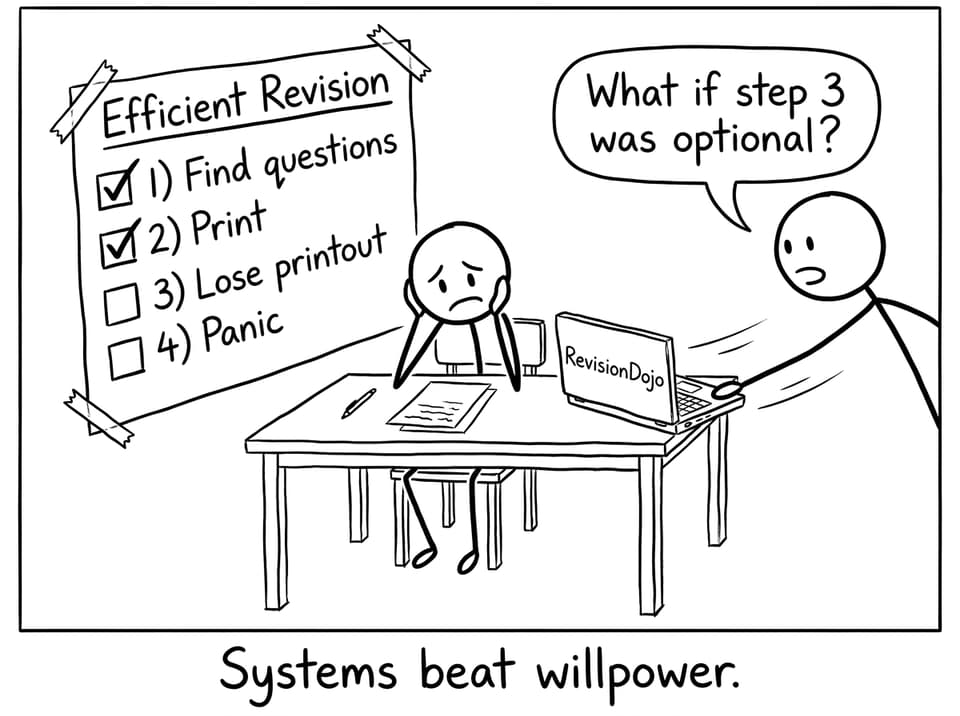
For quick topic clarity, start with RevisionDojo for IB so you’re revising the way IB exams actually test.
Why IB class time disappears in exam season
In the final stretch, your teacher’s job quietly splits into three jobs:
Coverage vs mastery (the unfair trade)
The IB syllabus is wide, and exam season punishes indecision. Teachers have to choose: revisit everything lightly, or revisit the highest-yield material properly. The best teachers pick mastery on the most tested skills, because that’s what moves grades.
Feedback demand explodes
Mock feedback, draft questions, and last-minute “Can you check this?” requests multiply. Every minute spent doing admin is a minute not spent helping you think.
Classes are uneven by May
One group is confident. Another is behind. The teacher has to differentiate, which is hard when the clock is loud.
This is where a shared platform can make the whole room faster: RevisionDojo for Schools is designed to reduce prep and feedback friction while keeping IB practice consistent.
What smart IB teachers do with limited time (and how you can mirror it)
They flip content delivery so class becomes practice
When teachers push core explanation outside class, it’s not “giving up.” It’s making space for the highest-value activity: guided correction.
You can support that by using syllabus-aligned notes and arriving ready to apply them. For example, IB Subject Note Collections: Comprehensive Study Materials helps you preview the exact subtopics your teacher is likely to drill.
They replace long review with short exam-style sets
In exam season, teachers often choose 10 focused questions over a 45-minute recap. That’s because IB marks are earned by performance, not familiarity.
If you want to match this at home, use an IB question bank routine that is small enough to repeat daily. This guide makes it concrete: IB Question Bank | How to Use It Effectively.
They prioritise “mistake patterns” over “more content”
Great teachers don’t chase every topic equally. They look for recurring errors:
-
Misread command terms (describe vs explain vs evaluate)
-
Weak structure (especially in essays/data responses)
-
Formula slips and unit mistakes
-
Shallow application to context
That’s also why RevisionDojo’s Questionbank, Study Notes, Flashcards, AI Chat, and Grading tools work best as a loop: clarify, practise, get feedback, repeat.
If you’re building your own resources, this overview is useful: Comprehensive IB Question Bank: Thousands of Practice Questions.
They run timed rehearsal earlier than students expect
Timed work isn’t just about speed. It’s about decision-making under pressure, which is a core IB skill.
If your class time can’t fit full papers, teachers often assign timed sections or mini-mocks. You can do the same with RevisionDojo’s Mock Exams and Predicted Papers.
Start here: IB Predicted Papers and (for the strategy behind them) IB Predicted vs Specimen Papers: What They Mean.
They protect energy, not just minutes
During IB exam season, exhaustion quietly ruins efficiency. The best teachers build short breaks and reset rituals into the pace.
If your motivation is collapsing, you’re not broken; you’re overloaded. These two articles help you keep your revision realistic:
A simple “teacher-friendly” IB lesson structure you can prepare for
If you want to make your teacher’s limited time work for you, assume the lesson will follow this pattern:
-
5 minutes: quick diagnostic (what you know vs what you miss)
-
25 minutes: exam-style practice (questions, data response, short essay plans)
-
10 minutes: feedback + common mistakes
-
5 minutes: next-step assignment (targeted)
Your job: arrive with the diagnostic already started. That means you’ve done a small set, found your mistakes, and can ask precise questions.
FAQ
How can I help my IB teacher use class time better?
Start by reducing “warm-up time.” In IB exam season, the biggest waste is a slow start where everyone is re-opening notes, remembering the topic, and getting organised. Do a 10-minute preview at home using reliable study notes, then come to class ready to practise. Bring one specific question you want answered and one mistake you want corrected, because teachers can fix concrete errors quickly. If your teacher assigns targeted homework, do it in full and on time, because it tells them the class can handle more practice next lesson. Finally, use a consistent system like RevisionDojo so you aren’t reinventing your workflow every night.
What should teachers prioritise when there isn’t enough time for full IB revision?
They should prioritise what reliably converts into marks: command terms, exam-style practice, and feedback on recurring mistakes. In the IB, knowing content is only step one; the assessment rewards how you apply it under specific question constraints. That’s why short, targeted question sets often beat broad re-teaching. Teachers should also prioritise topics that unlock other topics (core models, foundational methods, key definitions). Another high-value priority is timed practice, even if it’s only a section, because it teaches pacing and reduces exam shock. The goal isn’t to cover everything perfectly; it’s to maximise performance on the papers students will actually sit.
How does RevisionDojo save time for both IB students and teachers?
RevisionDojo saves time by turning revision into a repeatable loop: learn quickly with Study Notes, retain with Flashcards, practise with the Questionbank, and get unstuck with AI Chat. For teachers, the Grading tools and analytics reduce repetitive marking and help identify class-wide gaps faster, so lessons can target what matters. For students, it removes the hidden time drain of searching for the right questions and wondering what to do next. Predicted Papers and Mock Exams add realistic rehearsal without teachers having to build full practice sets from scratch. The Coursework Library and Tutors also help when coursework pressure competes with exam prep, which is common in IB exam season. The result is fewer wasted minutes and more deliberate practice.
Closing: make limited IB class time count twice
Here’s the quiet truth about IB exam season: the students who improve fastest aren’t always the ones who study the longest. They’re the ones whose class time and home time fit together like two halves of the same system.
If your teacher is moving quickly, meet them halfway. Preview with Study Notes, practise with the Questionbank, lock in recall with Flashcards, use AI Chat when you’re stuck, and pressure-test with Predicted Papers and Mock Exams. When you do that, limited class time stops feeling like a loss and starts feeling like coaching.
To see how your school or class can run this more smoothly, explore RevisionDojo for Schools and build a calmer, sharper IB exam season.