

If you picture an examiner reading your IA like a novel, slowly, lovingly, one page at a time, you’re not alone.
But the real scene is closer to this: a professional marker, a timer, a checklist, and a stack that never seems to shrink. They’re not trying to “catch you out.” They’re trying to award marks consistently, at speed. And that reality changes everything about how you should write your IA.
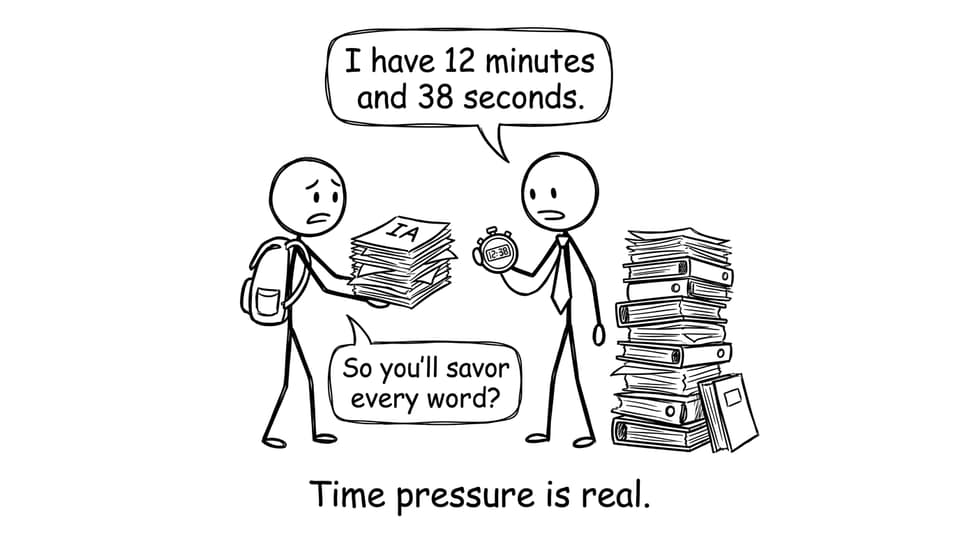
The examiner’s first minute with your IA
In the opening minute, your IA is already sending signals. Not about whether you’re “smart,” but about whether your work is markable.
Examiners tend to notice three things almost immediately:
-
Clarity of focus: Is the research question/aim obvious without hunting?
-
Navigation: Do headings and signposts let them find analysis and evaluation fast?
-
Control: Does it feel like a planned investigation or a document that grew randomly?
A practical move: compare your first page to the first page of a top example in RevisionDojo’s IB Internal Assessment Guides. You’ll see how quickly strong IAs declare purpose.
A quick checklist to make your IA easy to reward
Before you edit a single paragraph, run this checklist:
-
My IA research question/aim is visible within the first 5-7 lines.
-
Every section answers: “So what?” not just “What happened?”
-
Description, analysis, and evaluation are clearly separated.
-
Tables/graphs are labeled, referenced, and used (not just displayed).
-
The conclusion directly answers the research question/aim.
If you’re still shaping the question itself, use the framework in How to Write a Strong IA Research Question to tighten it before polishing anything else.
What examiners notice first: purpose, not length
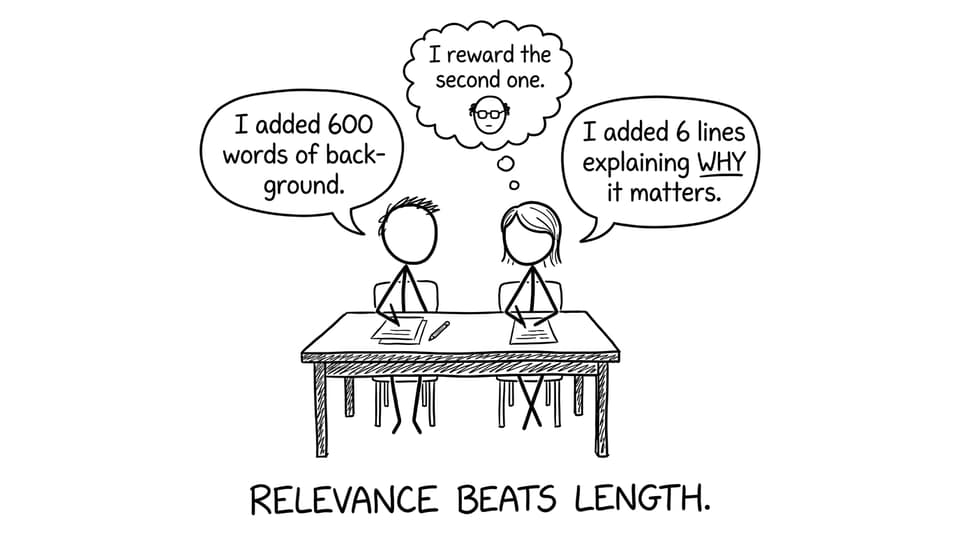
Students often treat length like safety: more background, more pages, more screenshots.
Examiners treat length like friction. In a high-volume marking workflow, extra text is only helpful if it earns marks. So the first question in an examiner’s head is rarely “How much did they write?” and often “Why is this section here?”
In a strong IA, each paragraph has a job:
-
justify a method choice
-
interpret a result
-
compare findings to theory
-
evaluate limitations with evidence
If you’re unsure whether your sources are doing real work (or just decorating the bibliography), the post How Many Sources Should an IA Have? is a useful reality check.
Structure is a marking shortcut (use it)
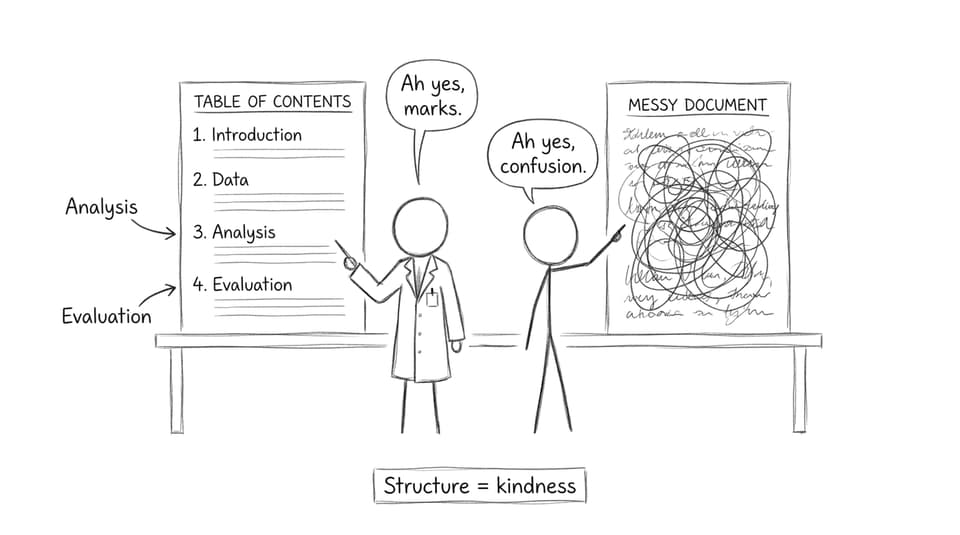
A great IA is not only good; it’s easy to locate marks inside.
That’s why structure matters so much. When headings and sequencing are clear, an examiner can quickly identify:
-
where the analysis begins
-
where evidence supports claims
-
where evaluation is actually happening
When structure is messy, the examiner must interpret your intent. That’s dangerous, because under time pressure, unclear work doesn’t get the benefit of long investigation.
If you want a simple way to build “markable” structure, start with RevisionDojo’s broader Coursework Guides and adapt the template to your subject.
Analysis is spotted fast (and description is capped)
Examiners are trained to separate description from analysis quickly.
-
Description says what you did or what you found.
-
Analysis explains what it means, why it happened, and what it implies for your research question.
A simple test: highlight one results paragraph in your IA. Count how many sentences start with “This suggests…,” “This indicates…,” “This may be because…,” or “Compared with…” If it’s close to zero, you probably have a description-heavy section.
For science students, statistical treatment is one of the clearest “analysis signals” when it’s explained properly. See Using Statistical Analysis Effectively in an IB Science IA for ways to make numbers translate into meaning.
Evaluation stands out when it’s specific
Evaluation is where many IAs sound confident but score modestly.
Strong evaluation is concrete:
-
limitations linked to method/design choices
-
impact on results explained (direction and magnitude where possible)
-
realistic improvements that would change data quality, not just “be more careful”
Weak evaluation reads like vibes: broad claims about “human error,” “accuracy,” or “reliability” without tracing consequences.
If you want targeted practice on evaluator-style thinking (the kind examiners reward), RevisionDojo’s Questionbank helps you drill command terms like “evaluate” and “discuss,” while IB Flashcards keep key terminology sharp when you’re tired.
Closing: write your IA for the reader you actually have
Your IA is not rewarded for being long, fancy, or dramatic. It’s rewarded for being clear, focused, analytical, and easy to assess.
If you want to make that process simpler, build your workflow inside RevisionDojo: use the IA Guides and Coursework Guides to structure the draft, the Questionbank to train criteria-style thinking, Flashcards to keep definitions precise, AI Chat to unblock confusion fast, and Grading tools plus Tutors when you need higher-stakes feedback. Your IA becomes easier to mark, and that’s often where the extra marks quietly appear.