


A small change that quietly wins the exam
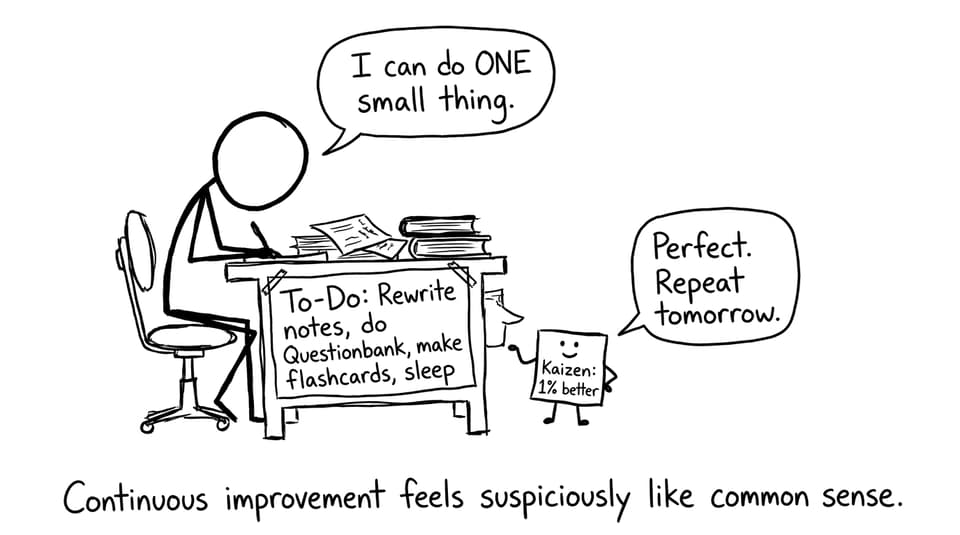
The night before a mock, most IB Business Management students don’t fail because they “don’t know Kaizen.” They fail because revision becomes a dramatic, all-or-nothing event: rewrite everything, memorize everything, fix everything. Kaizen offers a calmer truth: the biggest gains often come from the smallest changes, repeated with discipline.
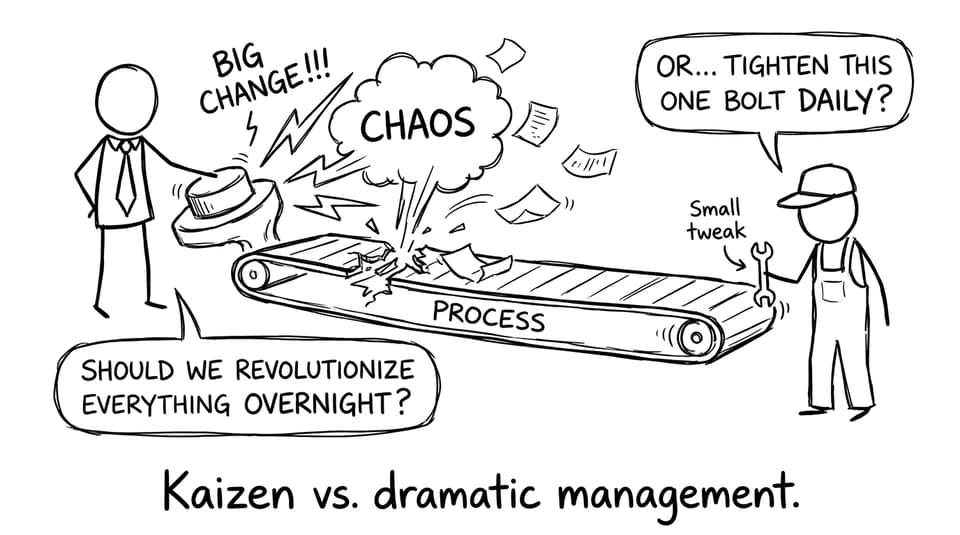
In operations, Kaizen is a lean philosophy built on continuous, gradual improvement. In exam prep, it’s the same mindset: identify friction, remove one tiny obstacle, and do it again tomorrow. That’s how efficiency grows without burnout.
Kaizen in one exam-ready checklist
Use this quick Kaizen checklist (and phrase it like an examiner would expect in IB Business Management):
-
Spot waste in a process (time, movement, defects, waiting)
-
Propose a small improvement (low cost, low disruption)
-
Involve employees (ideas from people closest to the work)
-
Standardize what works (make the “new way” the normal way)
-
Repeat (continuous improvement, not a one-off project)
For the syllabus framing, revise Kaizen inside Methods of Lean Production and connect it to broader operations in Unit 5: Operations Management.
How Kaizen improves efficiency (the marks are in the mechanism)
In IB Business Management, “efficiency” is not a vibe. It’s a mechanism: outputs rise, costs fall, time reduces, and quality stabilizes.
Kaizen improves efficiency by eliminating waste
Kaizen starts with noticing waste: unnecessary steps, delays, excess movement, rework, or overprocessing. A factory might rearrange tools to cut motion. A service business might remove a duplicate approval step. Small change, measurable time saved.
Link this directly to lean theory using Features of Lean Production. In exam responses, name the waste, show how Kaizen reduces it, then state the efficiency outcome (lower unit costs, faster throughput, higher capacity).
Kaizen improves efficiency through employee involvement
A hidden advantage of Kaizen is where ideas come from. Instead of relying on top management “breakthrough innovation,” Kaizen invites suggestions from everyone. Employees feel ownership, which reduces resistance and increases practical problem-solving. And practical beats perfect in operations.
For precise terminology, reinforce your definitions in the IB Business Management Glossary. When you can define Kaizen cleanly, your analysis becomes clearer and faster under timed conditions.
Kaizen improves efficiency by strengthening teamwork and flow
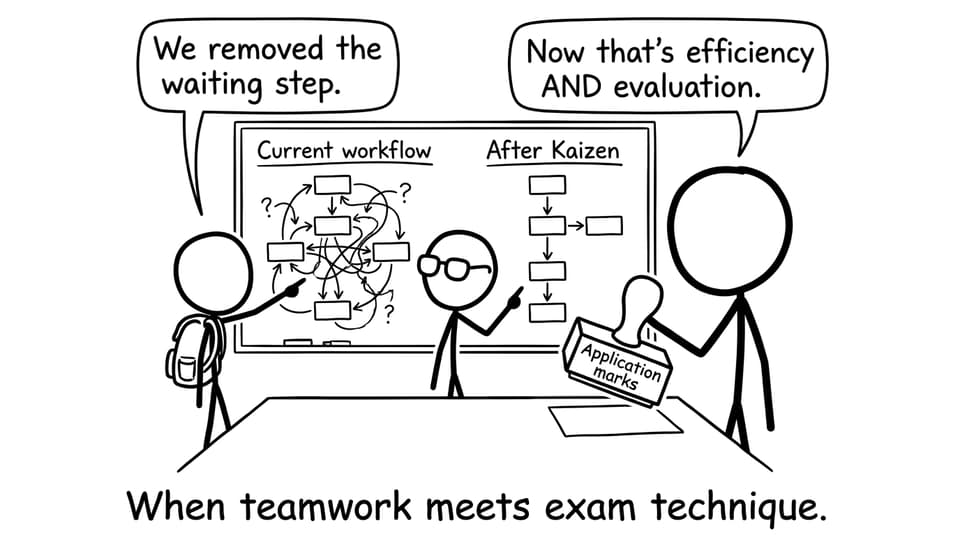
Kaizen often happens in group discussions, quick feedback loops, and shared targets. That improves communication and reduces process “blind spots” between departments. In IB Business Management, this matters because smooth flow reduces waiting time and defects.
A good extension is to compare efficiency-focused lean thinking with quality-focused systems like TQM. See Impact of Lean Production and TQM on an Organization to build evaluation points.
Kaizen supports continuous improvement by preventing quality problems
Kaizen doesn’t just speed things up. It supports continuous improvement by catching small quality issues early, before they scale into expensive rework or reputational damage. That’s why Kaizen pairs naturally with quality assurance systems.
If you’re revising quality, connect Kaizen to Quality Control vs. Quality Assurance and to wider standardization in National and International Quality Standards.
How to use Kaizen to revise IB Business Management (without rewriting your life)
Try a Kaizen loop for your next study session:
-
Do 10 minutes on one subtopic in the 5.3 Lean Production and Quality Management notes
-
Answer 2 timed questions from the 5.3 Questionbank
-
Use AI Chat to test your definition and evaluation
-
Turn one weak point into Flashcards
-
Repeat tomorrow, 1% better
This is where RevisionDojo becomes more than content. It’s a system: Study Notes for clarity, Questionbank for exam habits, Flashcards for retention, Mock Exams via exam-builder workflows, Predicted Papers for realistic practice, Grading tools for feedback, a Coursework Library for context, and Tutors when you’re stuck.
Conclusion: Kaizen is the quiet competitive advantage
Kaizen improves efficiency by removing waste, tightening teamwork, and preventing quality problems before they spread. More importantly, it supports continuous improvement by turning progress into a daily habit, not a one-time event.
If you want Kaizen to feel exam-ready, build your routine around IB Business Management practice, not just reading: use RevisionDojo’s notes for clarity, the Questionbank for speed and feedback, Flashcards for retention, AI Chat for explanation drills, and graded tools to refine your exam technique until “small changes” become big results.


