


The moment marketing stops being a guess
You know the feeling: you’re staring at a case study, and every marketing idea sounds equally plausible. “Lower the price.” “Add an influencer.” “Go international.” In IB Business Management, that moment matters, because examiners reward decisions that are grounded in evidence, not vibes.
A SWOT analysis is the simplest way to turn noisy information into a clean marketing direction. It forces a business to look inward (what we can control) and outward (what we can’t), then make marketing choices that actually fit reality.
Quick checklist: what to write in a SWOT for marketing
Use this as your fast Paper 1/Paper 2 plan in IB Business Management:
-
Strengths: What internal advantage can marketing amplify?
-
Weaknesses: What internal limitation makes a strategy risky?
-
Opportunities: What external trend could marketing ride?
-
Threats: What external risk could damage demand or brand?
-
Link: Turn bullets into actions (SO, WO, ST, WT thinking).
If you want a syllabus-aligned refresher before practising, start with the SWOT analysis overview and the deeper SWOT analysis notes.
Strengths and weaknesses: marketing that matches the business
In IB Business Management, strengths and weaknesses are internal factors. That sounds obvious until students start listing “competitors” as a weakness (that’s a threat). Keep it clean.
A strength might be strong brand awareness, a loyal customer base, a patent, strong cash flow, or a skilled sales team. In marketing terms, strengths tell you what to highlight. If the business has a premium brand, your promotion can lean into quality and status. If distribution is excellent, you might prioritise availability and convenience.
Weaknesses are the quiet problems that make big campaigns fail: low finance, weak brand recognition, limited capacity, or poor customer service. A clever decision in IB Business Management often sounds like: “Because the firm has weak distribution, a national launch would be risky; a targeted rollout is more realistic.”
To connect SWOT to the syllabus, keep Unit 4 nearby via the IB Business Management subject hub and revise marketing foundations like the Seven Ps of the marketing mix notes.
Opportunities and threats: the market pushes back
Opportunities and threats are external factors. They explain why a marketing plan that worked last year might flop this year.
An opportunity could be a growing market segment, a lifestyle trend, new technology, or a competitor leaving a gap. Opportunities help businesses adjust segmentation, targeting, and positioning. They can also justify changes to the marketing mix: a trend toward sustainability might support new product features, green branding, or partnerships.
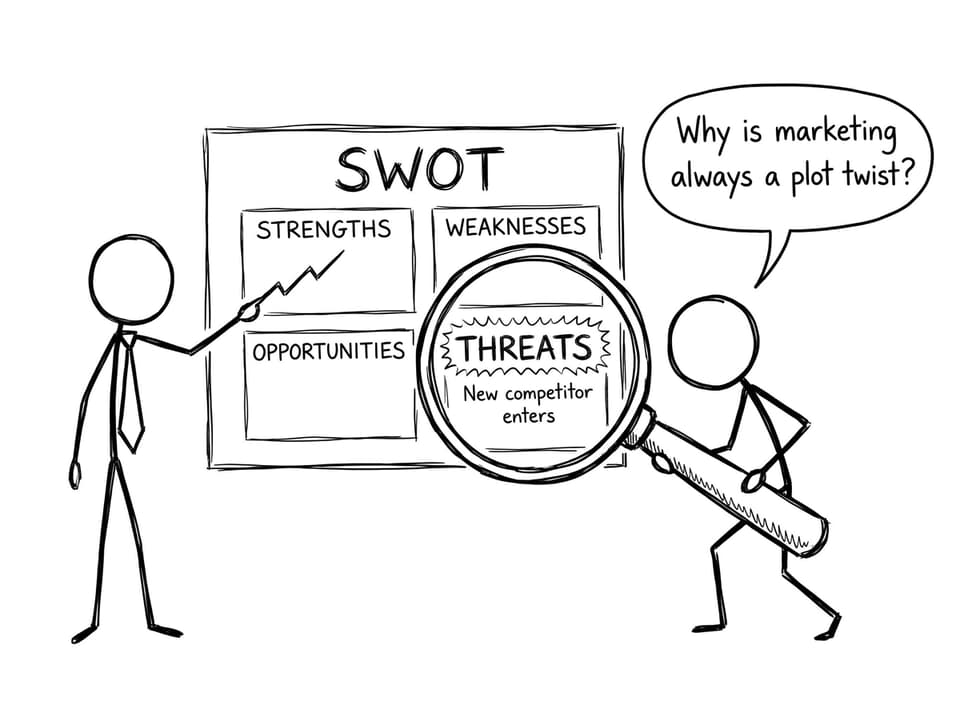
Threats include new entrants, substitute products, changing consumer tastes, economic downturns, or rising input costs that force price increases. In IB Business Management, threats are where evaluation lives: you show you can see what might go wrong and propose a response.
When you practise, build speed by drilling exam-style prompts in RevisionDojo’s Questionbank and then pressure-test your timing with IB Business Management predicted papers and Mock Exams inside the same ecosystem.
The real benefit: SWOT turns bullets into decisions
A SWOT isn’t four separate lists. The value comes from the connections:
-
SO strategies: use strengths to exploit opportunities (e.g., strong R&D + trend toward eco products).
-
WO strategies: fix weaknesses so you can chase an opportunity (e.g., improve online presence before expanding).
-
ST strategies: use strengths to defend against threats (e.g., loyalty program to reduce switching).
-
WT strategies: reduce exposure (e.g., avoid an expensive campaign if cash flow is fragile).
This is why SWOT helps businesses make better marketing decisions: it creates a logic chain from evidence to action, which is exactly what IB Business Management examiners reward.
Final takeaway: make SWOT your marketing compass
When you’re under exam pressure, the best decisions feel calm. SWOT gives you that calm by turning chaos into priorities. If you want to master SWOT the IB Business Management way, combine the BM Toolkit frameworks hub with targeted practice in RevisionDojo’s Questionbank, Study Notes, Flashcards, AI Chat, Grading tools, Predicted Papers, Mock Exams, Coursework Library, and Tutors. The goal isn’t to write more; it’s to decide better.


