


There’s a particular kind of quiet panic that shows up after results day.
Not the loud kind. The quiet kind: you open your score, do the math on your university conditions, and realize you might need an IB retake.
Then a second question lands, almost immediately: Do predicted grades still matter for IB retake candidates? Because if universities still look at predictions, you need a plan. If they don’t, you need a different plan.
This guide breaks down what predicted grades can (and can’t) do for IB Diploma retake candidates, how schools typically handle new predictions, and how to move forward with less guesswork and more evidence.
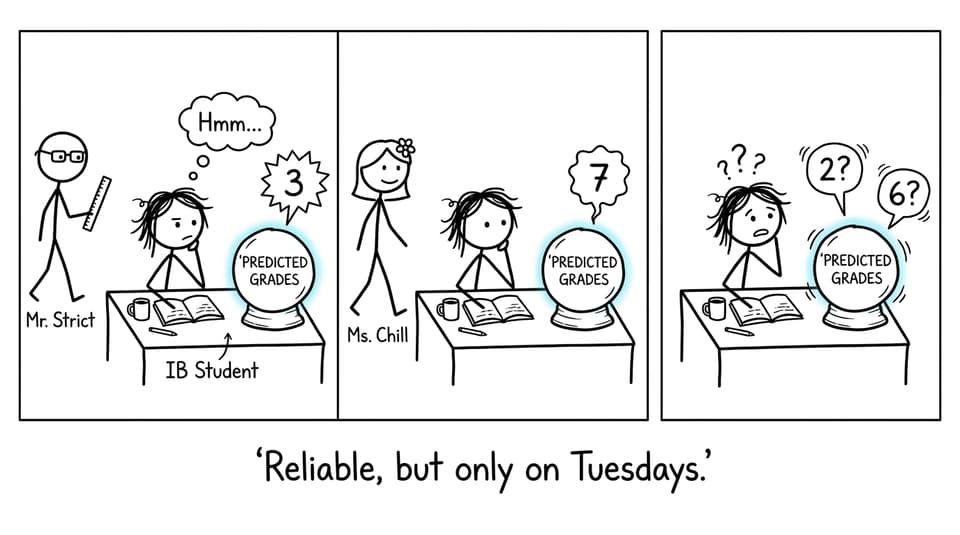
IB retake predicted grades: a quick reality checklist
Use this as your fast filter before you email anyone:
-
Are you reapplying in a new admissions cycle, or just meeting conditions?
-
Does your school still have an active relationship with you as an IB candidate (alumni policies vary)?
-
Is the university asking for updated predicted grades, or only final results?
-
Can you show fresh evidence (mock scores, timed practice, improved coursework) that supports a new prediction?
-
Do you have a revision system that turns effort into results (not just more studying)?
If you need a clean place to run that system, start with RevisionDojo for IB.
What predicted grades mean for IB retake candidates
Predicted grades are teacher-estimated scores used to forecast performance. In the IB, they’re often submitted to universities to support applications and conditional offers.
For retake candidates, predicted grades sit in a strange middle ground.
Some schools will provide updated predictions if you are actively preparing under their supervision and can demonstrate improvement. Other schools won’t issue new predictions for graduates, especially if your original application already used predicted grades from your first sitting.
Either way, predicted grades for an IB retake candidate are less about hope and more about proof. Schools are far more likely to predict up if you can show clear progress through timed practice and marked work.
A practical way to generate that proof is to run weekly exam simulations using IB Predicted Papers and track your score trends.
When predicted grades matter in an IB retake
Predicted grades matter, but only in specific admissions scenarios.
Reapplying in a new admissions cycle
If you’re reapplying, universities may ask for updated predicted grades to judge whether the retake is likely to change your academic profile.
In this case, predicted grades can act like a bridge between your old results and your next attempt. A stronger prediction doesn’t guarantee an offer, but it can make your application feel credible rather than speculative.
To build that credibility, you want performance data, not vibes. Use targeted practice from the Questionbank and then validate your progress under time pressure.
Conditional offers tied to retake performance
Some universities issue conditional offers that depend on your retake results. If they request predicted grades, they’re often looking for reassurance that you can realistically meet those conditions.
This is where your school’s prediction may become part of your story: “Here is what changed, here is the evidence, and here is why the retake outcome should be different.”
A useful support tool here is the IB Grade Calculator, because it helps you translate practice marks into a realistic target.
Internal guidance during your retake prep
Even when universities don’t care, predicted grades can still matter inside your process.
Schools sometimes use predicted grades to structure support: which topics to prioritize, whether you need more feedback on writing-heavy papers, and how to approach any coursework resubmission allowed by policy.
If you’re building a feedback loop independently, RevisionDojo helps by connecting Study Notes to practice, so you can move quickly from “I understand it” to “I can score on it.”
When predicted grades usually don’t matter for an IB retake
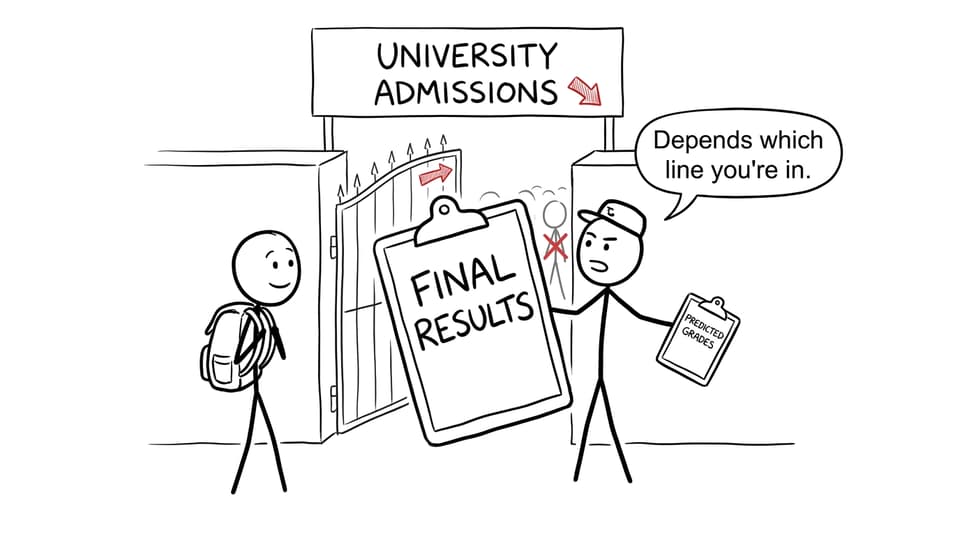
For many IB retake candidates, predicted grades are simply not the main factor.
Predicted grades often matter less when:
-
You’re applying after results are released and the university can evaluate you on final scores.
-
You’ve graduated and are no longer enrolled with your original IB school, so updated predictions aren’t available.
-
You’re applying to systems that prioritize transcripts and final outcomes, where predicted grades may be optional or not requested.
This can actually be a relief. It means your IB retake is judged on what you do, not what someone estimates.
How to request predicted grades as an IB retake candidate
If predicted grades are required, treat your request like a professional update, not a personal plea.
-
Contact your original IB coordinator or counselor.
-
State exactly why you need predicted grades (reapplication, conditional offer, appeal).
-
Provide recent evidence: mock results, timed practice, and any improved drafts if relevant.
-
Ask politely, understanding that schools may not be obligated to issue new predictions.
If you need better evidence quickly, run a tight loop: one topic, one timed set, one review session, repeat. The RevisionDojo App workflow for IB exam prep explains a sustainable structure.
How to improve IB retake results (even without predicted grades)
Predicted grades are paperwork. Results are leverage.
Here’s the retake strategy that tends to move scores:
Build a weekly “timed proof” routine
Once a week, sit a timed paper-style simulation. Then diagnose patterns.
RevisionDojo makes this easier with realistic practice like IB Predicted Papers and exam rehearsal habits explained in Online IB Mock Exams: Practice Anywhere, Anytime.
Turn mistakes into a system
Most retake improvements come from fixing repeat errors: missing command terms, shallow evaluation, weak structure, or timing.
Use Flashcards to lock in common mark-winning moves, and use AI Chat and grading support to shorten your feedback cycle (RevisionDojo’s grading tools and AI features are designed for exactly this kind of iteration).
Keep coursework stress contained
If coursework is still part of your mental load, don’t let it leak into every day.
RevisionDojo’s Coursework Library and Grading tools help you see what strong work looks like and what to fix next, without endless rewriting. When you need a human diagnosis, Tutors can give you a plan that fits your timeline.
Closing: predicted grades matter less than your next proof
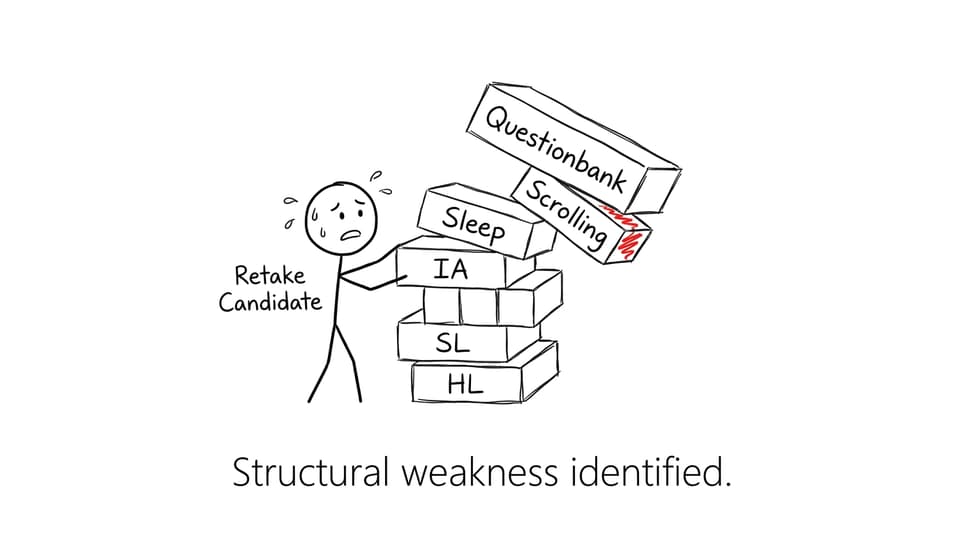
An IB retake is not a reset button. It’s closer to a second draft: the same story, but with sharper choices.
Predicted grades can help in the right admissions situations, but for most IB retake candidates, the win comes from building evidence that you’re different this time. Use RevisionDojo to run that evidence loop with Questionbank practice, Study Notes, Flashcards, AI Chat, Grading tools, Predicted Papers, Mock Exams, the Coursework Library, and Tutors when you need a human strategy reset.
If your goal is a higher score, start today with one timed set, one correction pass, and one next-step decision. That’s how the IB retake stops being stressful in theory and starts becoming measurable in practice.