


If you have ever promised yourself “I’ll revise after one more video”, you already understand the heart of motivation: people rarely move for just one reason. In IB Business Management, that same messiness shows up in three classic theories you are expected to compare: Maslow, Herzberg, and Taylor. They are all trying to answer one question: why do employees work hard?, but they start from completely different assumptions.
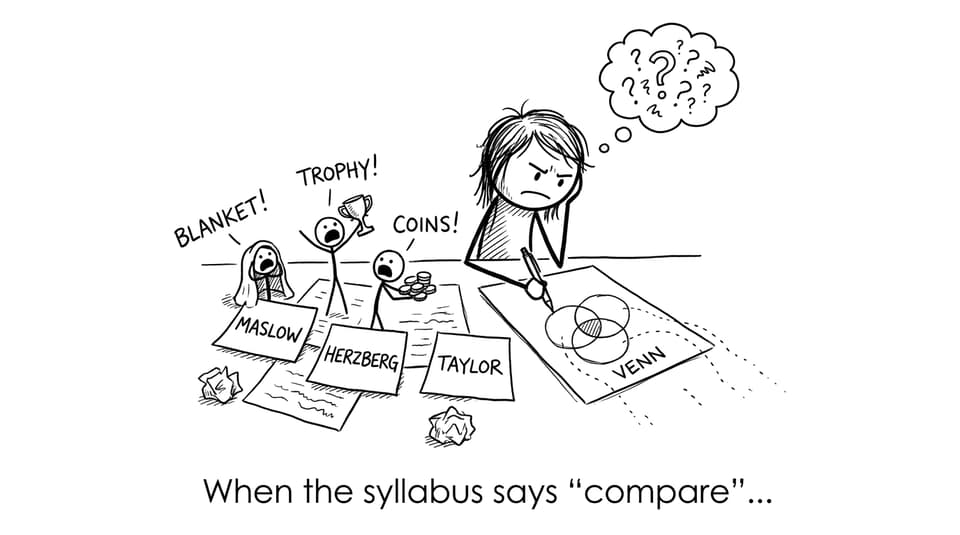
Quick exam checklist for IB Business Management
-
Maslow = motivation comes from progressing needs (from basic to self-fulfillment).
-
Herzberg = satisfaction and dissatisfaction come from different factors (hygiene vs motivators).
-
Taylor = workers are motivated mainly by money and efficiency (scientific management).
-
Best evaluation point: real workplaces blend approaches.
For the full syllabus-aligned summary, keep 2.4.1 Motivation Theories open while you revise.
Maslow in IB Business Management: motivation as a ladder of needs
Maslow argues that employees climb a ladder of needs: physiological, safety, belonging, esteem, and self-actualization. The big idea for IB Business Management essays is sequencing: when lower needs feel threatened, higher needs lose their power.
A simple application: if a worker is worried about layoffs (safety), “innovate and be creative” (self-actualization) can feel like background noise. Maslow is useful for writing about HR strategies that build a supportive culture, not just a pay packet.
Need a fast refresher and examples? Use RevisionDojo’s 2.4.1 Motivation Theories Notes.
Herzberg in IB Business Management: two different engines
Herzberg splits work factors into:
-
Hygiene factors (salary, policies, conditions), andthey prevent dissatisfaction, but do not create long-term drive.
-
Motivators (achievement, recognition, responsibility, growth), andthese create satisfaction.
This is where many students win evaluation marks in IB Business Management: improving pay might stop complaints, but it may not create pride, loyalty, or extra effort. Herzberg fits beautifully with concepts like job enrichment and empowerment.
To connect theory to tools you can actually write about, see 2.4.7 Non-Financial Rewards Notes.

Taylor in IB Business Management: motivation as pay-for-output
Taylor’s scientific management assumes workers are primarily motivated by money. To raise productivity, managers should standardize tasks, use time-and-motion study, and closely supervise, thenthen reward output, often through piece-rate pay.
In exam terms, Taylor is strongest in environments where work is repetitive and efficiency is measurable. Your evaluation can point out the limitation: the approach can reduce creativity and autonomy, and may ignore social and psychological needs.
If you want a modern link, RevisionDojo covers the updated version in 5.9.10 Digital Taylorism.

How to compare them in one strong IB Business Management paragraph
A clean comparison structure:
-
Maslow: broad human needs, motivation depends on unmet needs.
-
Herzberg: job design matters, and “no dissatisfaction” is not the same as “high motivation.”
-
Taylor: financial incentives and efficiency drive effort.
Then evaluate: most firms combine financial rewards (Taylor), fair conditions (Herzberg hygiene), and growth/recognition (Herzberg motivators, Maslow higher needs). That blended conclusion often earns top marks.
To practice writing this comparison under timed conditions, try the 2.4 Motivation and demotivation Questionbank.
Final takeaway (and what to do next)
Motivation is not one switch you flip. In IB Business Management, Maslow teaches you to think in needs, Herzberg teaches you to separate dissatisfaction from true motivation, and Taylor teaches you the power (and limits) of financial incentives and efficiency. When you revise, aim to compare them with context and evaluation, not just definitions.
If you want to turn these theories into exam-ready answers, use RevisionDojo’s Study Notes, Flashcards, and AI Chat to lock in definitions fast, then test yourself with the Questionbank and build timed stamina with Mock Exams and Predicted Papers. Start here: IB Business Management resources and the 2.4.1 Flashcards.