



If you have ever stared at your IB subject choices and felt your brain do that quiet little shutdown, you are not alone. The IB is a juggling act: six subjects, TOK, CAS, the EE, and a calendar that seems to sprint the moment you blink.
And then there is the deceptively simple question many students ask right before the stress really kicks in:
How difficult is IB German Ab Initio compared to other IB subjects?
In the world of IB Languages, German Ab Initio sits in a strange spot. It is designed for beginners, which sounds comforting. But it also asks you to perform in four skills (reading, writing, listening, speaking) under pressure, which can feel like learning to swim while someone is already timing your laps.
This guide will help you judge the difficulty honestly, compare it to other IB subjects, and build a revision plan that actually matches how language learning works.
Quick difficulty checklist (use this in 60 seconds)
Before you label German Ab Initio as “easy” or “hard,” check which boxes describe you:
-
You can commit to short daily practice (10-25 minutes) most days.
-
You do not mind memorising vocabulary in small, repeatable chunks.
-
You can tolerate being imperfect out loud (speaking is messy at first).
-
You prefer steady progress over last-minute cramming.
-
Your other subjects are content-heavy (e.g., sciences or humanities essays).
If most of these are true, IB Languages like German Ab Initio usually feel manageable. If several are false, German can feel harder than students expect, even though it is a beginner course.
What makes IB German Ab Initio genuinely challenging
The difficulty is not usually about “intelligence.” It is about the type of effort the course demands.
German grammar is logical… and still annoying
German often makes sense once you see the pattern, but early on it can feel like rules stacked on rules:
-
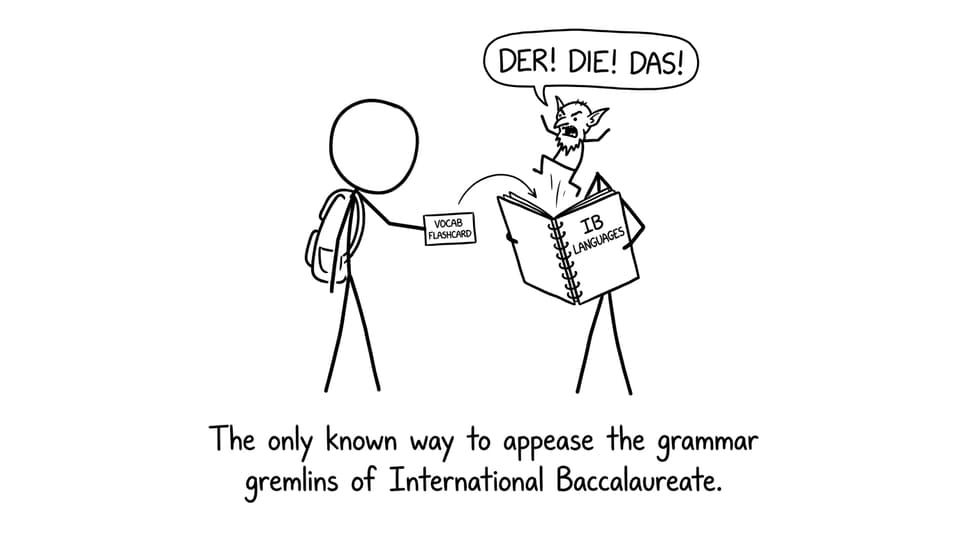
Gendered nouns (der, die, das) that you must learn with the word
-
Cases (nominative, accusative, dative, genitive) changing articles and pronouns
-
Word order shifts, especially with time expressions and subordinate clauses
In other IB subjects, you can sometimes brute-force your way through a unit with intense revision. In IB Languages, grammar errors tend to repeat until you deliberately train them out.
Vocabulary builds fast across the five themes
German Ab Initio is taught through the IB’s five themes (Identities, Experiences, Human Ingenuity, Social Organization, Sharing the Planet). That structure helps, but it also means you need functional vocabulary across multiple life contexts, not just one niche.
A helpful reference point: the course is designed to take most students to roughly A2 level by the end (basic user, everyday communication). If you want to understand what that means in practical terms, see What Level of German Will I Achieve in IB German Ab Initio?.
Speaking and listening are emotional skills as much as academic ones
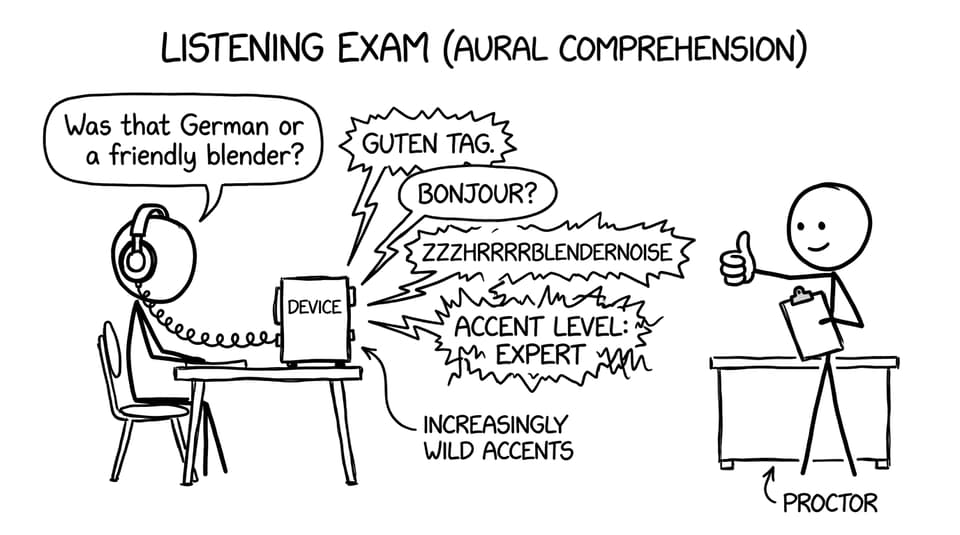
For many students, the hardest part of IB Languages is not writing or reading. It is the moment your brain blanks in a conversation, or an audio track features an accent you did not expect.
The Individual Oral rewards communication, not perfection, but it still triggers nerves. If you want a clear breakdown of how to train it, use How to Succeed in the IB German Ab Initio Oral Exam.
What makes IB German Ab Initio more manageable than it sounds
German Ab Initio exists for a reason: it is meant to be approachable, even if you are starting from zero.
The assessment is balanced across skills
You are not betting everything on one strength. In most IB Languages courses at this level, you are assessed across:
-
Writing
-
Reading
-
Listening
-
Speaking
That balance protects you. If your writing is strong but listening is weaker, you still have a path to a solid grade.
For the exam structure, timings, and what each paper is actually asking you to do, read IB German Ab Initio Exam Format (2025 Guide).
Marking rewards clarity and communication
At Ab Initio level, examiners generally value:
-
understandable messages
-
relevant details
-
basic accuracy that does not block meaning
This is why simple, clean sentences often beat “ambitious” ones that collapse under grammar.
Progress is predictable if your system is predictable
Language learning rewards routines. RevisionDojo is built around that reality: Study Notes for clarity, Flashcards for retention, and a Questionbank for practice loops. When you get stuck, AI Chat can explain an error pattern in plain terms, and Grading tools can help you see exactly what your writing is missing.
If you want an overview of how the platform fits into the full IB workflow, start at the RevisionDojo home page.
Comparing German Ab Initio to other IB subjects (the honest version)
Difficulty comparisons only help if we compare the kind of work each subject demands.
Compared to IB sciences (Biology, Chemistry, Physics)
Sciences often feel difficult because they combine:
-
dense content knowledge
n- application under time pressure -
data handling and lab demands
German Ab Initio is different. The hard part is consistency. If you skip practice, the skill decays faster than a science definition you can relearn from notes.
So, compared to sciences, German Ab Initio is usually:
-
lighter in single-session intensity
-
heavier in daily maintenance
Compared to IB Mathematics
Math difficulty is often about abstraction and multi-step reasoning. German difficulty is about recall plus real-time production.
Students who like “right or wrong” answers sometimes find IB Languages frustrating, because communication can be correct enough even when it is not perfect.
Compared to humanities (History, Geography, Economics)
Humanities difficulty often comes from:
-
long writing
-
evaluation of evidence
-
structured arguments under timed conditions
German Ab Initio writing is shorter, but you cannot rely on sophisticated ideas to compensate for unclear language. The challenge is skill-building, not content depth.
Compared to Language B
This is where IB German Ab Initio looks easier. Language B assumes years of experience and typically aims higher (often B1 to B2 range depending on level).
German Ab Initio is a beginner runway. Language B is more like joining the highway at speed.
If you want a broader strategy guide for IB Languages at the B level (still useful for Ab Initio habits like vocabulary systems and exam technique), see How to Effectively Revise for Language B Exams.
Workload reality: lighter volume, higher frequency
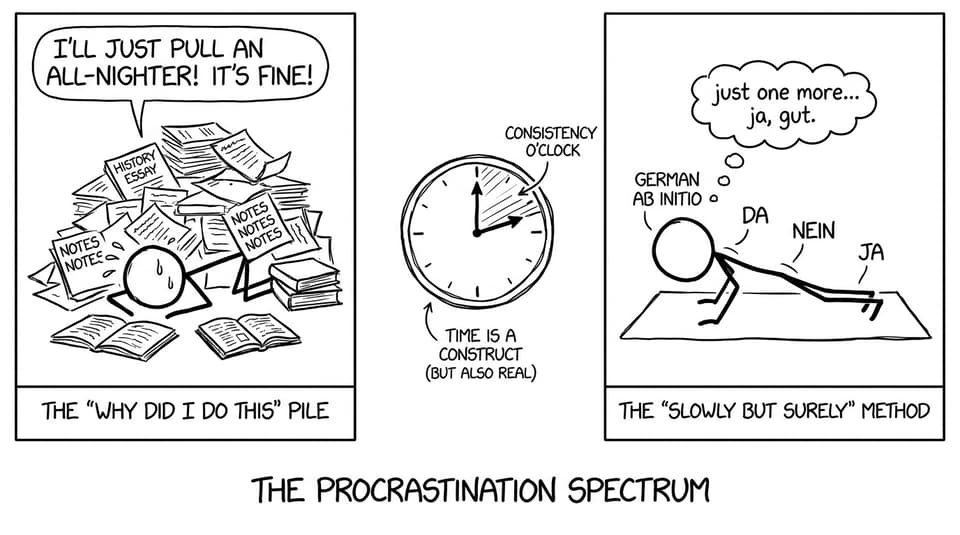
German Ab Initio rarely asks for huge nights of work. Instead, it asks for small reps.
A realistic weekly workload for most students in IB Languages might look like:
-
4-5 days of vocabulary + mini-writing (15-25 min)
-
2 days of listening practice (10-20 min)
-
1 speaking practice session (10 min, recorded is fine)
-
1 timed task every 1-2 weeks as exams approach
If you want a resource hub built around the course itself, use German Ab Initio - IB Resources and the guide on What Is IB German Ab Initio?.
A RevisionDojo-style plan for German Ab Initio (simple, repeatable)
Here is a workflow that fits how IB Languages improve:
-
Study Notes: clarify one grammar point or one theme subtopic
-
Flashcards: lock in 10-20 words or phrases (especially connectors and opinion phrases)
-
Questionbank-style practice: do short comprehension and writing drills, then fix one recurring mistake
-
AI Chat: ask why your sentence is wrong and request 5 corrected variations
-
Mock Exams: run timed practice to train calm and pacing
When you need inspiration for tools and task types that align with IB themes and assessments, see Top Language Learning Tools for IB Students.
If your revision schedule is collapsing under pressure across subjects, the mindset shift in How to Study for IB Exams Without Burning Out is especially useful for language students.

Conclusion: the real comparison you should make
The best way to judge difficulty is not “German vs Physics” or “German vs History.” It is this:
Does your schedule support the kind of effort IB Languages require?
IB German Ab Initio is challenging because it is skill-based, consistent, and public (you have to speak). It is manageable because it is built for beginners, graded fairly, and improves fast with small daily reps.
If you want to make German Ab Initio feel simpler this month, build your system in RevisionDojo: drill with the Questionbank, stabilise grammar with Study Notes, lock vocab with Flashcards, practise confidently with AI Chat, and pressure-test yourself with Mock Exams and Predicted Papers. That is how IB Languages stop feeling like a mystery and start feeling like a routine you can trust.