



Introduction
A university application is a story with footnotes.
Your grades are the headline. Your activities are the colour. But what admissions teams quietly look for is evidence that you can walk into an unfamiliar room, stay calm, and learn fast.
That is exactly what IB Languages often signal. And yes, even beginner courses count.
If you are taking IB German Ab Initio, you are doing something surprisingly rare in a cohort obsessed with optimisation: choosing difficulty that does not immediately “pay off” on day one. In 2025, that choice can be a strength on your application, if you know how to frame it and if you actually build the skills the course is designed to measure.
Quick checklist: what German Ab Initio can add
Here is the short, useful list you can return to when you write your personal statement or activity descriptions:
-
Academic breadth through IB Languages (balance across the Diploma)
-
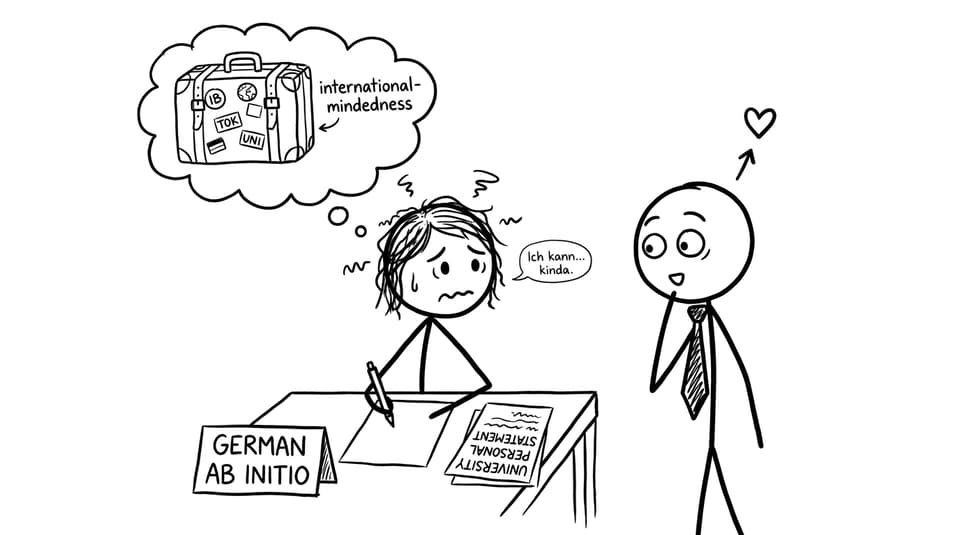
Evidence of resilience: learning “from zero” over two years
-
Transferable communication skills (writing, listening, speaking)
-
Clear global engagement (culture, identity, perspectives)
-
A credible reason for internships, exchanges, or study abroad later
If you want the exam-side structure as well, keep this open: IB German Ab Initio Exam Format (2025 Guide).
Why universities take IB Languages seriously (even Ab Initio)
Universities understand what IB Languages demand: sustained practice, tolerance for embarrassment, and the willingness to be a beginner in public.
German Ab Initio is not “easy German.” It is German taught at a level appropriate for beginners, assessed across the same four skills that matter in university life: reading, listening, writing, and speaking.
That combination maps neatly onto what admissions officers want to predict:
-
Can you handle unfamiliar content?
-
Can you communicate under pressure?
-
Can you think beyond your local context?
If you want a clear overview of what the course actually involves under the 2025-first-assessment curriculum, see: What Is IB German Ab Initio? Complete 2025 Guide.
How IB German Ab Initio strengthens your application narrative
Academic breadth that looks intentional
The IB is built to prevent academic tunnel vision. Taking IB Languages alongside sciences, humanities, or maths shows range.
But range only helps if it looks deliberate. In your application, connect German Ab Initio to the kind of student you are:
-
the engineer who enjoys systems (grammar is a system)
-
the economist who cares about European markets
-
the future medic who values patient communication across cultures
Global engagement that is more than a buzzword
“International-mindedness” is easy to write and hard to prove.
IB Languages provide built-in proof because the themes force you to discuss identity, experiences, social organisation, and global issues through another cultural lens. German matters here not because universities need you fluent tomorrow, but because you showed you can shift perspective.
Transferable skills that show up in every degree
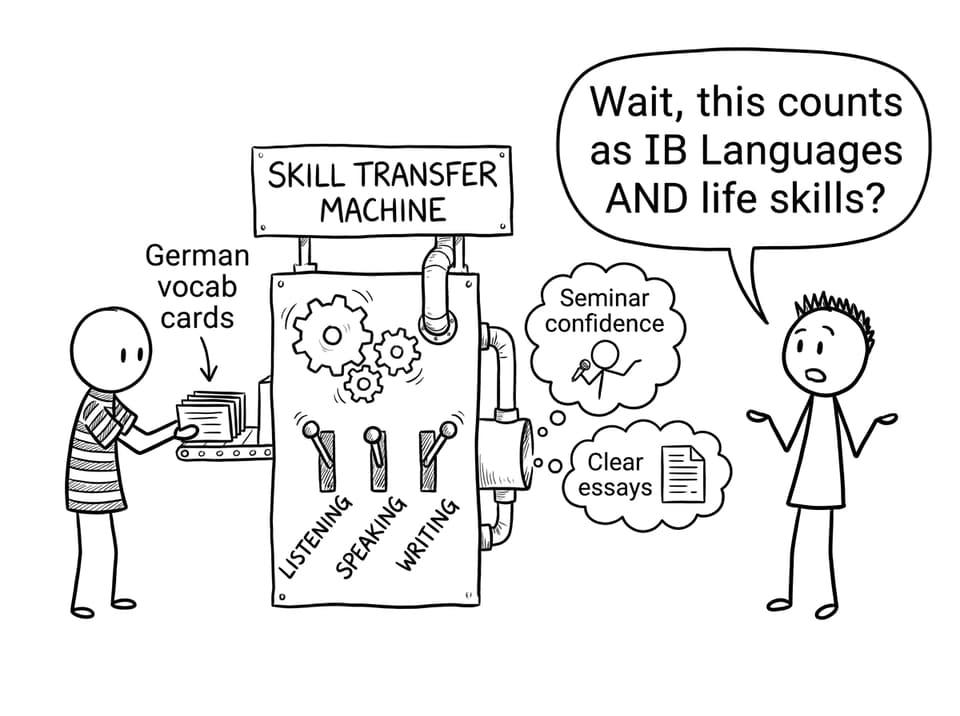
German Ab Initio trains outputs, not just knowledge.
-
Paper 1 writing teaches clarity, register, and structure under time pressure.
-
Paper 2 reading and listening teach extracting meaning without panicking.
-
The oral teaches you to think aloud, recover gracefully, and keep talking.
Those are university seminar skills in disguise.
If you are targeting marks, build your prep around the assessed tasks: How Can I Prepare for IB German Ab Initio Paper 1? (2025 Guide) and How to Succeed in the IB German Ab Initio Oral Exam (2025 Edition).
What to say in your application (without sounding forced)
A strong application line has three parts: action, friction, result.
Here are examples you can adapt:
-
“Taking IB Languages at Ab Initio level taught me how to stay consistent with daily practice; I used the same habit loop to improve my lab write-ups.”
-
“German Ab Initio pushed me to communicate with limited vocabulary; that constraint made my writing clearer and more intentional.”
-
“Through the cultural themes in IB Languages, I became better at discussing identity and community, skills I now use in debate and in my Extended Essay research.”
Keep it specific. Mention a moment when you got stuck, what you changed, and what improved.
How to back up the claim with real preparation (so it stays honest)
Universities can tell the difference between “I took a course” and “I built a skill.”
That is where RevisionDojo becomes practical, not promotional.
-
Use the German ab initio subject hub to keep your revision aligned.
-
Drill weak spots with the Questionbank so your application story matches your exam performance.
-
Consolidate phrases and theme vocabulary with spaced repetition using Flashcards inside RevisionDojo.
-
When you get stuck, use AI Chat to untangle grammar errors quickly, then return to practice.
-
If you want models of what “good” looks like, use the IB German ab initio Exemplars to understand quality standards.
For a resource plan that actually works week-to-week, see: What Study Resources Are Best for IB German Ab Initio?.
Conclusion: make IB Languages part of your “student identity”
In 2025, university applications reward students who can show more than performance, they reward students who can show trajectory.
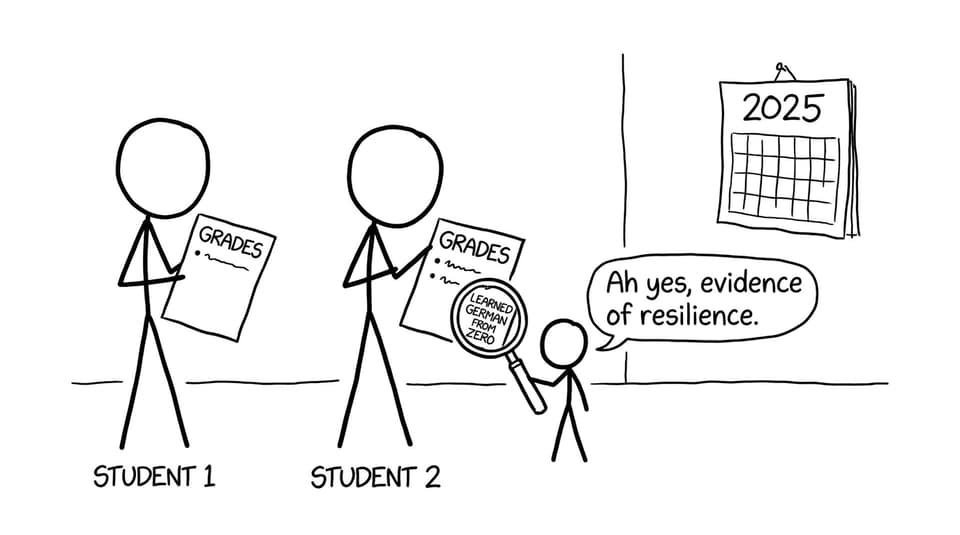
IB Languages, including German Ab Initio, offer a clean narrative: you began at zero, learned consistently, communicated under exam pressure, and widened your perspective along the way.
If you want that narrative to translate into marks and confidence, build a simple loop inside RevisionDojo: Study Notes for clarity, Flashcards for retention, Questionbank for exam skill, AI Chat for quick unblocking, then timed practice with Mock Exams and Predicted Papers when you are ready. And if you want human guidance, Tutors can help you turn feedback into a plan.
Start with your next actionable step: open the German ab initio subject hub and pick one theme to master this week, because the best university applications are built the same way languages are built: one honest session at a time.