

Half-equations feel a bit like opening a group chat where everyone is talking at once. You can tell something important is happening (electrons are moving), but the moment you try to balance the whole thing, the noise wins.
In IB Chemistry, half-equations are the quiet trick: split the chaos into two small stories, make each story consistent, then stitch them back together. Once you can do that, redox stops being scary and starts being predictable. Predictable is what you want on exam day.
Half-equations in IB Chemistry: the quick checklist
Use this mini-checklist whenever IB Chemistry throws a redox equation at you:
-
Identify what’s being oxidized and what’s being reduced (use OIL RIG).
-
Write two half-equations (one oxidation, one reduction).
-
Balance atoms (not H or O first).
-
Balance O with H₂O.
-
Balance H with H⁺ (then convert to OH⁻ if basic).
-
Balance charge with e⁻.
-
Multiply half-equations so electrons cancel.
-
Add them and cancel anything identical on both sides.
If you need a refresher on what “redox” even means in IB Chemistry, start with Redox Reactions Explained for IB Chemistry and What’s a Redox Reaction? IB Chemistry Explained.
What a half-equation actually is (and why IB Chemistry loves them)
A half-equation (half-reaction) is an equation showing either:
-
Oxidation (electrons are lost), or
-
Reduction (electrons are gained)
including the electrons explicitly.
In IB Chemistry, half-equations matter because they make two things visible at once:
-
Mass balance (atoms conserved)
-
Charge balance (total charge conserved)
That second point is where most exam mistakes happen. Students balance atoms, feel confident, and forget the charges. Half-equations force you to respect both.
For quick definitions and common traps, it also helps to read Oxidation and Reduction Explained for IB Chemistry.
OIL RIG, but with exam precision
You already know the mnemonic, but in IB Chemistry you need to use it, not just remember it:
-
Oxidation Is Loss of e⁻
-
Reduction Is Gain of e⁻
A clean way to self-check: if electrons appear on the product side, it’s oxidation. If electrons appear on the reactant side, it’s reduction.
Also remember agents:
-
The reducing agent donates electrons and is oxidized (see Reducing Agents Explained for IB Chemistry).
-
The oxidizing agent accepts electrons and is reduced (see Oxidizing Agents Explained for IB Chemistry).
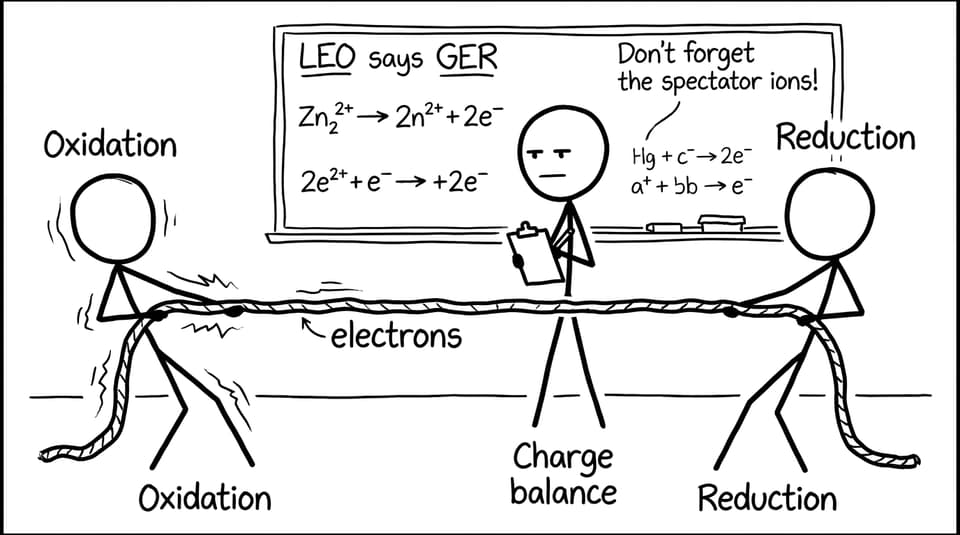
Two starter half-equations (the ones you should recognize instantly)
In IB Chemistry, these are your “hello world” examples:
Oxidation:
Zn(s) → Zn²⁺(aq) + 2e⁻
Reduction:
Cu²⁺(aq) + 2e⁻ → Cu(s)
They pair naturally into the Daniell cell story, which leads directly into electrochemical cells (useful later for E° questions). For that bridge, see Galvanic Cells Explained Simply and the syllabus-aligned note Electrochemical cells: Oxidation and reduction.
How to write half-equations in IB Chemistry (acidic method)
When the reaction is in acidic solution, IB Chemistry expects this sequence because it works reliably.
Balance atoms that aren’t oxygen or hydrogen
Start with the “main” element changing.
Balance oxygen using H₂O
Add H₂O to the side missing oxygen atoms.
Balance hydrogen using H⁺
Add H⁺ to the side missing hydrogen atoms.
Balance charge using electrons
Add e⁻ to the more positive side until charges match.
Final check
Count atoms and total charge on each side. In IB Chemistry, both must match perfectly.
If you want targeted practice on exactly this skill, RevisionDojo’s R3.2.2 Redox half-equations and the broader unit R3.2 Electron transfer reactions are ideal because the questions mirror exam style and the solutions show the balancing logic.
Converting to basic conditions (the OH⁻ “undo” move)
Alkaline half-equations are where IB Chemistry students often panic, but it’s just one extra loop:
-
Balance the half-equation as if it were acidic.
-
Add OH⁻ to both sides to cancel any H⁺.
-
Convert: H⁺ + OH⁻ → H₂O.
-
Cancel any extra H₂O that appears on both sides.
That’s it. Same method, plus a cleanup step.
Combining half-equations without losing your mind
Once each half-equation is balanced, combination is mechanical:
-
Multiply one or both half-equations so the number of electrons is equal.
-
Add the two equations.
-
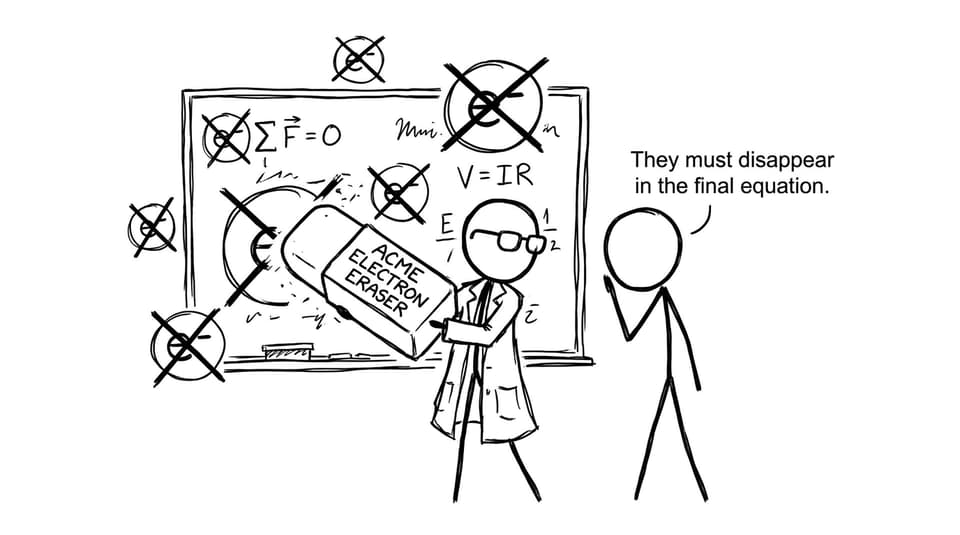
Cancel electrons completely (they must vanish in the final equation).
-
Cancel any species that appear unchanged on both sides.
A classic IB Chemistry example is permanganate oxidizing Fe²⁺ in acidic conditions:
Oxidation:
Fe²⁺ → Fe³⁺ + e⁻
Reduction:
MnO₄⁻ + 8H⁺ + 5e⁻ → Mn²⁺ + 4H₂O
Multiply the iron half-equation by 5, add, and electrons cancel:
5Fe²⁺ + MnO₄⁻ + 8H⁺ → 5Fe³⁺ + Mn²⁺ + 4H₂O
When you can do this calmly, you’re not just “doing redox” in IB Chemistry. You’re building the foundation for E°cell, electrolysis, and titration questions.
Where half-equations show up later in IB Chemistry
Half-equations are not an isolated trick. In IB Chemistry, they show up again when you:
-
Analyze electrolysis reactions (see Electrolysis Explained for IB Chemistry (Fast + Clear)).
-
Use standard electrode potentials to predict feasibility (see Standard Electrode Potential Explained).
-
Decide anode vs cathode correctly (see Electrochemical cells: Oxidation and reduction).
Conclusion: make half-equations your calm advantage in IB Chemistry
A lot of IB Chemistry feels like learning to stay composed when a question looks bigger than it is. Half-equations reward that mindset. Split the reaction, balance atoms, balance charge, cancel electrons, and suddenly the “hard” redox question becomes a sequence of small wins.
If you want to turn this into exam performance, RevisionDojo is built for it: practice with the Questionbank, lock in steps with Study Notes and Flashcards, check your thinking with AI Chat, and sharpen accuracy using Grading tools, Predicted Papers, and Mock Exams. When you’re ready to go deeper, the Coursework Library and Tutors help you close the last gaps.
Half-equations aren’t just a topic in IB Chemistry. They’re a repeatable method you can trust under time pressure.