
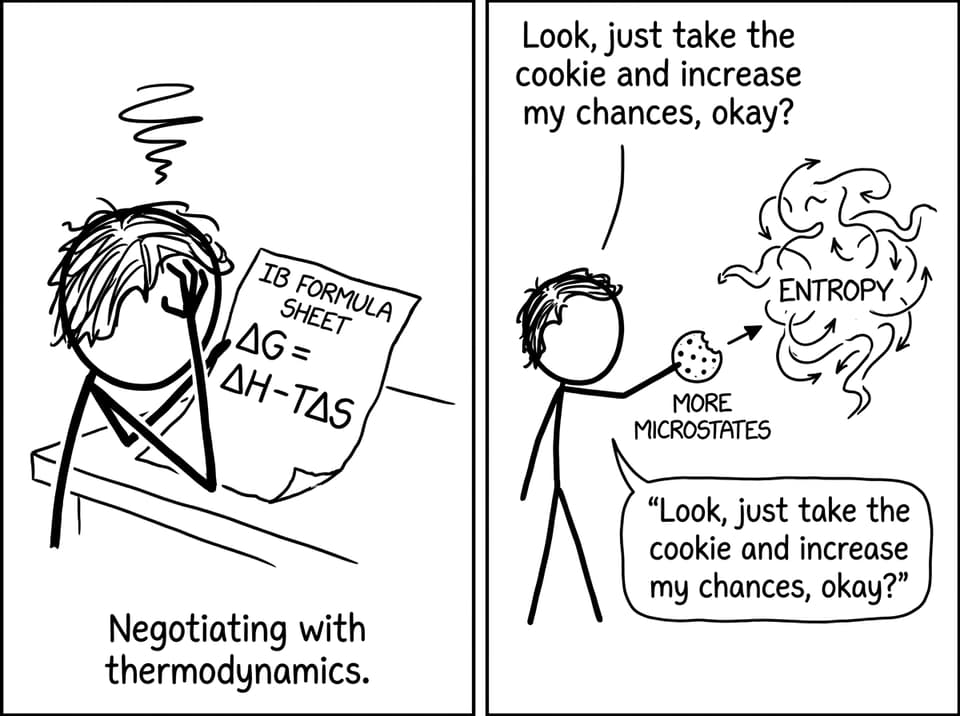
If you have ever stared at ΔG = ΔH - TΔS in IB Chemistry and felt like it is more a warning label than a formula, you are not alone. In exam season, Gibbs free energy can feel like a gatekeeper concept: simple on the surface, but ruthless when units or temperature quietly sabotage your working. The good news is that ΔG is not trying to trick you. It is trying to tell a story about what a reaction wants to do.
This guide explains Gibbs free energy in plain language for IB Chemistry students, with the exact decision rules and exam habits that earn marks.
What Gibbs Free Energy Means in IB Chemistry
In IB Chemistry, Gibbs free energy (G) is the measure of how much energy is available to push a chemical change forward at constant temperature and pressure. What you actually use is ΔG, the change in Gibbs free energy for a reaction.
The sign of ΔG is the whole point:
-
ΔG < 0: the reaction is spontaneous (thermodynamically feasible)
-
ΔG > 0: the reaction is non-spontaneous in the forward direction (but may be spontaneous in reverse)
-
ΔG = 0: the system is at equilibrium
If you want a quick refresher on the ingredients that feed into ΔG, pair this with RevisionDojo’s explanations of entropy and enthalpy change.
The Gibbs Free Energy Equation (the one you must know)
For IB Chemistry, the headline equation is:
ΔG = ΔH - TΔS
Where:
-
ΔG is Gibbs free energy change
-
ΔH is enthalpy change
-
T is temperature in Kelvin
-
ΔS is entropy change
A practical way to remember it: ΔH is the heat story, ΔS is the randomness story, and T decides how loudly entropy gets to speak.
Mini checklist before you calculate
-
Convert °C to K: T(K) = T(°C) + 273.15
-
Watch units: ΔS is often given in J K⁻¹ mol⁻¹ so convert to kJ K⁻¹ mol⁻¹ by dividing by 1000 if ΔH is in kJ
-
Write a sign next to each value before substituting
For syllabus-aligned practice on this exact skill set, use the R1.4 Entropy and spontaneity hub and the R1.4 topic lessons on RevisionDojo.
How ΔH, ΔS, and T control spontaneity
In IB Chemistry, exam questions often test whether you understand the tug-of-war inside the equation.
Enthalpy (ΔH)
-
Negative ΔH (exothermic) tends to make ΔG more negative, which helps spontaneity.
-
Positive ΔH (endothermic) can still be spontaneous, but usually needs help from entropy and temperature.
If exothermic vs endothermic still feels fuzzy under pressure, review exothermic reactions.
Entropy (ΔS)
-
Positive ΔS means increased dispersal of energy / more microstates. This pushes ΔG down (more negative), especially at higher T.
-
Negative ΔS fights spontaneity because it makes the ( -TΔS ) term positive.
Temperature (T)
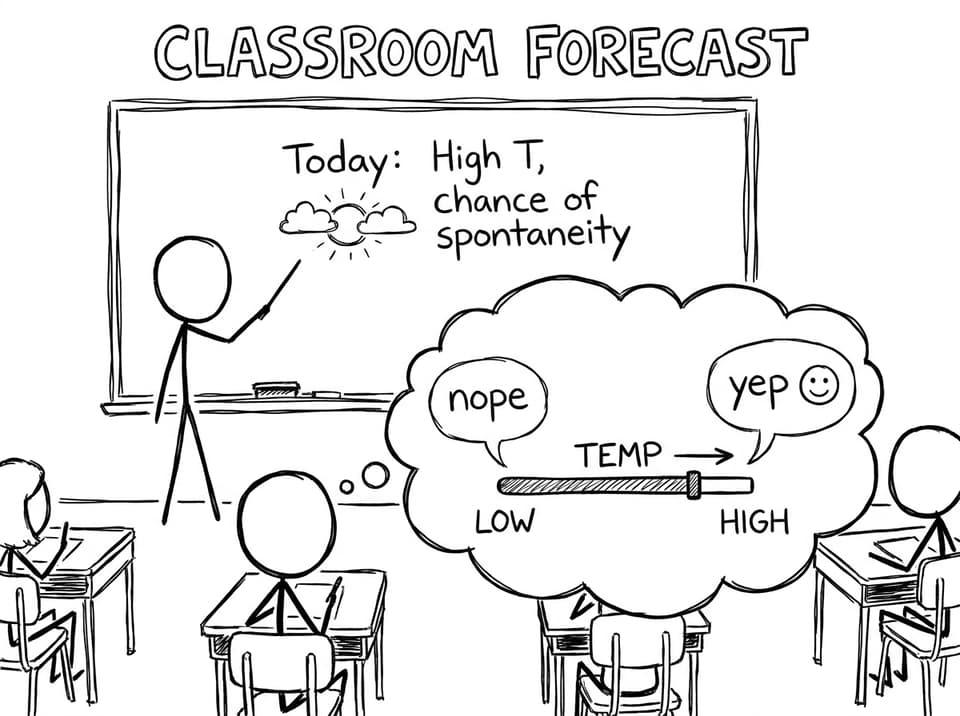
Temperature does not change the sign of ΔH or ΔS, but it changes the weight of the entropy term. High temperature magnifies entropy’s impact.
The four IB Chemistry spontaneity cases (quick decisions)
These combinations appear constantly in IB Chemistry short answers.
ΔH negative, ΔS positive
Always spontaneous (ΔG always negative). Think: many combustion-style reactions.
ΔH positive, ΔS negative
Never spontaneous (ΔG always positive). You are paying an energy cost and becoming more ordered.
ΔH negative, ΔS negative
Spontaneous at low temperature. Enthalpy helps, entropy resists, so keep T small.
ΔH positive, ΔS positive
Spontaneous at high temperature. Entropy can “outvote” enthalpy once T is big enough.
A powerful exam move in IB Chemistry is to state this in one line: “At high T, -TΔS dominates.” Then you justify the sign of ΔG.
Two ways IB Chemistry asks you to calculate ΔG
Using ΔH and ΔS
You substitute into ΔG = ΔH - TΔS. This is where unit slips happen.
Using standard Gibbs free energies of formation
If the data booklet provides ΔGf°, then:
ΔG° = ΣΔGf°(products) - ΣΔGf°(reactants)
This method is fast when values are given directly, and it avoids the entropy unit trap.
To train these question styles with markscheme-level feedback, use RevisionDojo’s Gibbs free energy and equilibrium Questionbank and the matching notes for R2.3.7.
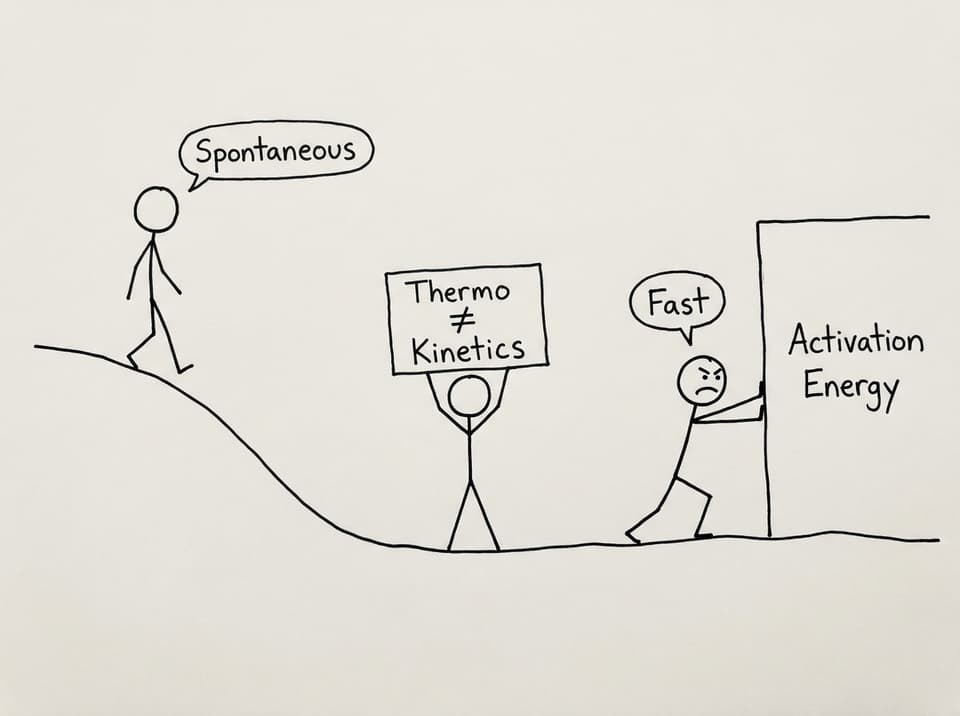
Spontaneous does not mean fast (a classic IB Chemistry trap)
A reaction can have ΔG < 0 and still crawl. Rusting is the emotional proof: it is thermodynamically allowed, but kinetics (activation energy) sets the pace.
When you practise with RevisionDojo’s AI Chat, you can ask it to mark your explanation and check whether you used the right thermodynamics vs kinetics language. That kind of precision is what pushes IB Chemistry responses into top bands.
Quick exam checklist for IB Chemistry ΔG questions
-
Write the equation: ΔG = ΔH - TΔS
-
Convert T to Kelvin
-
Make units consistent (J to kJ when needed)
-
Decide sign of ΔG first, then calculate (or use calculation to confirm)
-
State meaning: spontaneous / non-spontaneous / equilibrium
For a structured revision path, start from IB Chemistry resources and build a plan using RevisionDojo’s Study Notes, Flashcards, Questionbank, Mock Exams, and Grading tools.
Closing: make Gibbs feel predictable
Gibbs free energy is a big deal in IB Chemistry because it turns a messy idea (energy vs disorder) into a clean decision about spontaneity. Once you treat ΔG = ΔH - TΔS like a story with three characters and one referee (temperature), the marks become much more repeatable.
If you want this to feel effortless under timed conditions, revise with RevisionDojo: drill ΔG questions in the Questionbank, lock in definitions with Flashcards, clarify confusion with AI Chat, and pressure-test your understanding using Mock Exams, Predicted Papers, and the Grading tools. That is how IB Chemistry stops being intimidating and starts being manageable.