
If you have ever held a test tube and felt the warmth rise faster than your confidence, you have already met the idea behind IB Chemistry exothermic reactions. They are simple on paper: heat out, ΔH negative, products lower than reactants. But in exams, they become a story about systems, surroundings, and the quiet trap of mixing up temperature with energy. This guide walks you through exothermic reactions the way examiners expect you to think about them in IB Chemistry: one clear definition, one diagram, one explanation at a time.
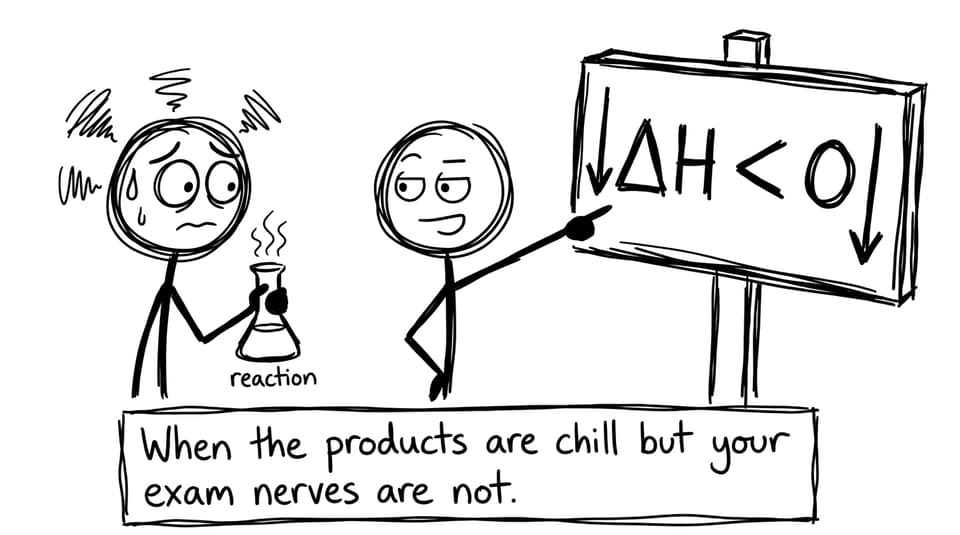
Quick checklist for IB Chemistry exothermic reactions
Use this as your 20-second scan before you attempt any IB Chemistry energetics question:
-
Heat is released from the system to the surroundings.
-
ΔH is negative (ΔH < 0).
-
Products have lower enthalpy than reactants.
-
Surroundings warm up (temperature increases).
-
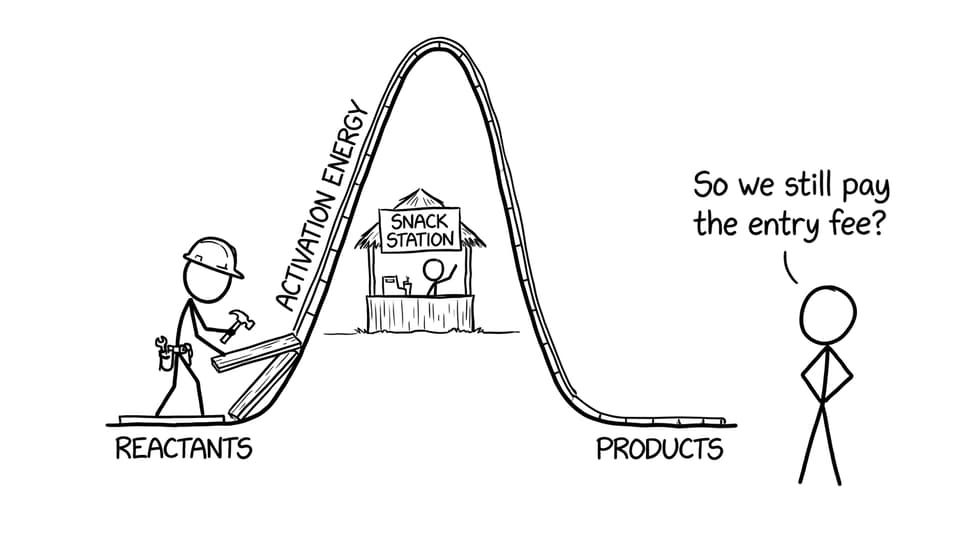
The reaction still needs activation energy (Ea) to start.
If you want a broader energetics foundation, keep the RevisionDojo notes open while you revise: Energetics and Thermochemistry Notes.
What exothermic reactions mean in IB Chemistry
In IB Chemistry, an exothermic reaction is defined by energy transfer: the reaction (the system) releases heat energy to everything around it (the surroundings). At constant pressure, this heat transfer is described using enthalpy change, ΔH.
So the exam definition you are aiming for is:
- Exothermic reaction: a reaction where heat is released to the surroundings, so ΔH is negative.
The deeper reason matters too, because IB questions often ask “explain why energy is released.” The bond-energy storyline is the cleanest:
-
Bond breaking requires energy (endothermic step).
-
Bond forming releases energy (exothermic step).
-
If bond formation releases more energy than bond breaking absorbs, the overall reaction releases energy, making it exothermic.
To sharpen that explanation, pair this article with: Bond Enthalpy Explained for IB Chemistry.
How to recognize exothermic reactions in energy profile diagrams
Energy profile diagrams are a favorite because they test multiple skills at once in IB Chemistry: interpretation, vocabulary, and sign conventions.
For an exothermic reaction, the diagram shows:
-
Reactants start at a higher enthalpy.
-
The curve rises to a peak: this is the transition state.
-
The vertical rise from reactants to the peak is activation energy (Ea).
-
Products finish at a lower enthalpy.
-
The vertical difference from reactants down to products is ΔH, and it is negative.
A common exam sentence that scores well:
The reaction is exothermic because the products have lower enthalpy than the reactants, so energy is released to the surroundings and ΔH is negative.
For more targeted support on the language of ΔH and how it appears in calculations, see: Enthalpy Change Explained for IB Chemistry.
Real-world exothermic reaction examples IB Chemistry loves
Exothermic reactions are everywhere, which is why IB Chemistry uses them as “familiar contexts” for hard questions.
Examples you should be ready to mention (and explain):
-
Combustion of fuels (large negative ΔH, often linked to fuels and energetics).
-
Neutralization reactions (acid + base forming water, typically exothermic).
-
Respiration (biochemical oxidation releasing energy overall).
-
Rusting (slow, but still exothermic overall).
-
Thermite-type redox reactions (dramatic heat release).
When fuels come up, IB questions often shift from “identify” to “compare” and “calculate.” RevisionDojo’s syllabus-aligned pathway helps here: IB Chemistry Resources Hub.
Exothermic vs endothermic in IB Chemistry (the fast distinction)
Exothermic vs endothermic is a small distinction that causes big grade losses in IB Chemistry when rushed.
-
Exothermic: heat released, ΔH < 0, surroundings warm, products lower enthalpy.
-
Endothermic: heat absorbed, ΔH > 0, surroundings cool, products higher enthalpy.
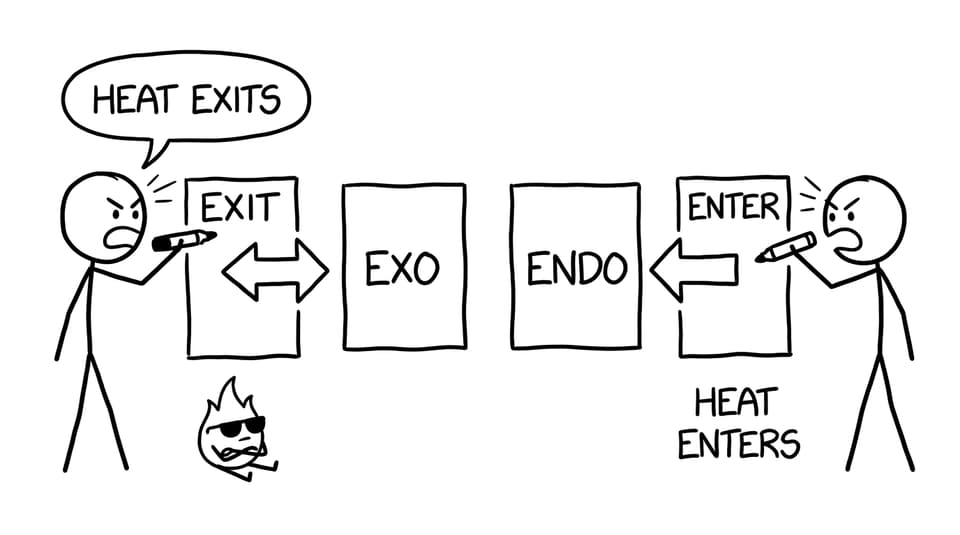
One memory anchor that actually holds up under stress:
-
Exo: heat exits the system.
-
Endo: heat enters the system.
Exam-style explanation template (copy this)
When an IB Chemistry question asks “Explain why the reaction is exothermic,” aim for a two-layer answer: what you observe + why it happens.
Use this structure:
-
State the sign: ΔH is negative.
-
Link to energy levels: products lower enthalpy than reactants.
-
Energy transfer: heat released to surroundings, temperature of surroundings increases.
-
Bond reasoning: more energy released during bond formation than absorbed during bond breaking.
Then practice it in mixed question sets so it becomes automatic. RevisionDojo makes this easier with immediate feedback loops through R1.2 Energy cycles in reactions Questionbank and topic drilling in R1.1 Energy transfer in chemical reactions.
Closing: Turn exothermic reactions into guaranteed marks
Exothermic reactions in IB Chemistry are not just a definition: they are a pattern that repeats across diagrams, calculations, and explanations. If you can consistently say “heat released, ΔH negative, products lower enthalpy, activation energy still required,” you will recognize the question faster and write cleaner answers under time pressure.
To lock it in, use RevisionDojo as your practice engine: build confidence with the Questionbank, reinforce concepts with Study Notes and Flashcards, test yourself with Mock Exams and Predicted Papers, and clean up explanations using AI Chat and Grading tools. If you are stuck, the Tutors and Coursework Library help you connect theory to the way IB actually assesses it. Start with energetics practice here: IB Chemistry Topic R1.1 Measuring Enthalpy Change.