Fuel cells feel like one of those IB Chemistry topics that should be simple… until you’re under exam pressure and suddenly can’t remember which electrode makes water.
Here’s the calming truth: a fuel cell is basically a galvanic cell that refuses to “run out,” because it keeps getting fed reactants. Once you see the story of the electrons, the rest becomes memorisable.
Fuel cells in IB Chemistry (quick definition)
A fuel cell is an electrochemical device that converts the chemical energy of a continuously supplied fuel and oxidant directly into electrical energy via a spontaneous redox reaction.
In IB Chemistry, fuel cells matter because they connect the “diagram-and-half-equations” world of electrochemistry to real technologies (cars, backup power, spacecraft). They’re also a perfect test of whether you truly understand oxidation at the anode, reduction at the cathode, and electron flow.
If you want the syllabus-aligned version before you practise questions, start with RevisionDojo’s R1.3 Energy from fuels topic hub.
Exam checklist: what you must be able to do
Before you leave this topic, make sure you can:
-
Define a fuel cell in IB Chemistry language (continuous reactants, redox, electrical energy).
-
Write the anode and cathode half-equations for a hydrogen-oxygen fuel cell.
-
State the overall equation and identify the only chemical product.
-
Compare fuel cells vs batteries (stored reactants vs supplied reactants).
-
Give at least two advantages and two limitations with realistic context.
To drill the exact spec point, use RevisionDojo’s R1.3.5 Fuel cells Questionbank and then lock in definitions with the matching Fuel cells Flashcards.
What is a fuel cell (and what it is not)
A fuel cell behaves like a galvanic cell: electrons move through an external circuit because the redox reaction is thermodynamically favourable.
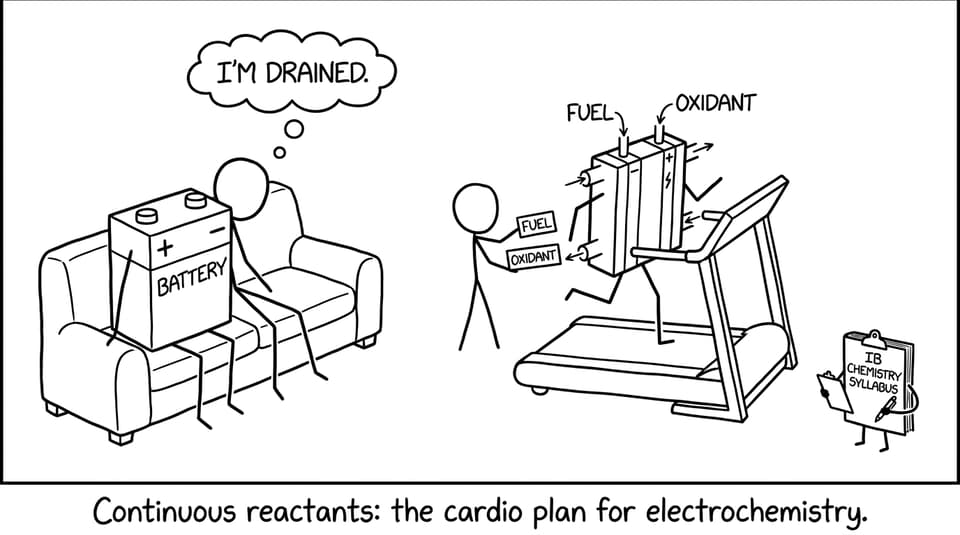
But unlike a typical battery, a fuel cell does not “store” a fixed amount of reactants inside itself. It’s more like a system you keep feeding.
That one distinction solves a lot of common IB Chemistry confusion:
-
A fuel cell doesn’t need “recharging” in the same way a battery does.
-
A fuel cell doesn’t burn fuel; it oxidises it electrochemically.
-
A hydrogen fuel cell doesn’t produce CO₂ at the point of use; it produces water.
For a quick refresher on how electron transfer language works, RevisionDojo’s Redox reactions explained for IB Chemistry is a clean warm-up.
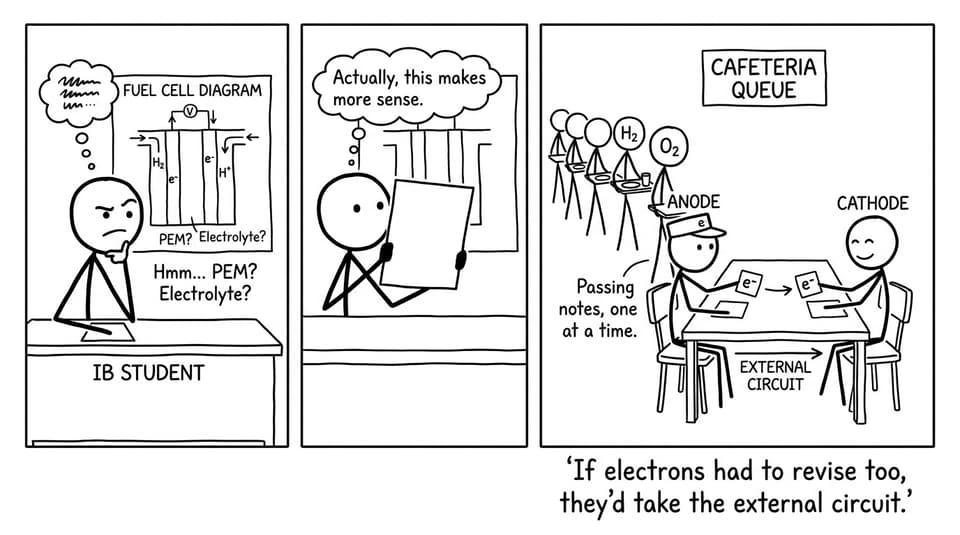
How a hydrogen fuel cell works (step-by-step)
Most IB Chemistry questions focus on the hydrogen-oxygen fuel cell because the half-equations are neat and the products are easy to interpret.
A typical setup includes:
-
Anode (oxidation happens)
-
Cathode (reduction happens)
-
Electrolyte (moves ions, not electrons)
-
Catalyst (often platinum)
-
External circuit (where electrons travel and do useful work)
Oxidation at the anode
Hydrogen is oxidised at the anode:
H₂ → 2H⁺ + 2e⁻
What to picture for IB Chemistry:
-
hydrogen produces protons (which move through the electrolyte)
-
hydrogen produces electrons (which must go through the wire)
If your anode/cathode instincts get shaky, revise the core rule using Oxidation and reduction (electrochemical cells) notes.
Electron flow (this is the electricity)
Those electrons can’t cross the electrolyte, so they take the external path. That movement is the current you can use to power a motor, a phone charger, or a very unimpressed desk fan in your classroom demo.
Reduction at the cathode
Oxygen is reduced at the cathode:
O₂ + 4H⁺ + 4e⁻ → 2H₂O
This is where water forms. Many students try to force water into the anode half-equation because they associate hydrogen with water. In IB Chemistry, you win marks by following the electrons, not your gut feeling.
Overall reaction
Add the half-equations (with electrons cancelled):
2H₂ + O₂ → 2H₂O
This overall reaction is spontaneous, which is why the device is galvanic in nature.
For a broader electrochem foundation (cell structure, electron direction, neutrality), read Galvanic cells explained simply.
Types of fuel cells you should recognise in IB Chemistry
You don’t need to memorise every engineering detail, but you should recognise common categories:
-
PEM (proton exchange membrane) fuel cells: common in vehicles; polymer membrane; moderate temperatures.
-
Alkaline fuel cells (AFCs): alkaline electrolyte (often KOH); used historically in space applications.
-
Solid oxide fuel cells (SOFCs): ceramic electrolyte; high temperature; suitable for steady large-scale power.
-
Molten carbonate fuel cells (MCFCs): very high temperature; industrial contexts.
If you want definitions written in the “exam voice” of IB Chemistry, keep RevisionDojo’s IB Chemistry glossary open while you practise.
Advantages and limitations (how to write them like an examiner)
In IB Chemistry, “advantages and disadvantages” questions reward specificity. Aim for a claim plus a brief reason.
Advantages
-
High efficiency: energy is converted directly from chemical to electrical, without the same heat-loss pathway as combustion.
-
Clean local emissions: hydrogen fuel cells produce water at the point of use.
-
Continuous operation: as long as fuel and oxidant flow in, electricity flows out.
-
Quiet and reliable: few moving parts.
Limitations
-
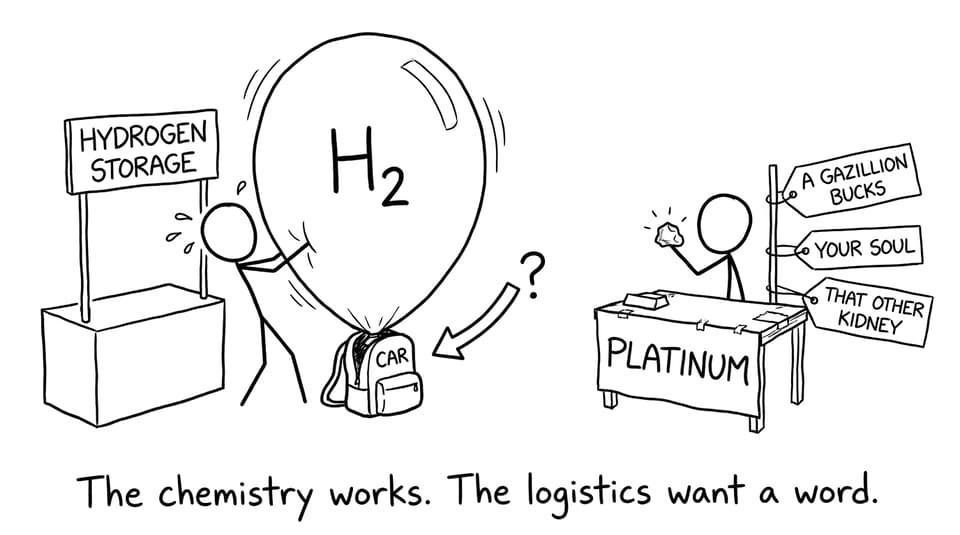
Hydrogen storage/transport: hydrogen often needs compression or liquefaction, which is challenging.
-
Hydrogen source: much hydrogen is still produced using fossil fuels, reducing overall sustainability.
-
Catalyst cost: platinum is expensive.
-
Durability: membranes and catalysts can degrade.
-
Infrastructure: refuelling networks can be limited.
Fuel cells vs batteries (a clean comparison)
A battery carries its reactants inside and delivers electricity until those reactants are used up.
A fuel cell is closer to a system: reactants come from outside, products leave, and the device keeps operating while supplies last.
This is why exam questions in IB Chemistry often phrase it as: “fuel cells do not run down,” which really means “the cell itself isn’t the limiting store of chemicals.”
To practise these comparison-style questions with feedback, combine the R1.3 Energy from fuels Questionbank with RevisionDojo’s AI Chat to interrogate your own explanations until they’re tight.
Bring it home: how to revise fuel cells efficiently
Fuel cells are a small section of IB Chemistry, but they sit on top of big ideas: redox, electrochemical cells, and real-world energy choices. That’s why they show up in short questions, data-based questions, and “evaluate” prompts.
If you want a simple plan: learn the half-equations, practise the comparisons, then test yourself under timed conditions. RevisionDojo makes that loop easy with syllabus-aligned Study Notes, Flashcards, the Questionbank, and Mock Exams (plus AI Chat when you want instant clarification). Start with the R1.3 Energy from fuels notes, then move straight into targeted practice until “IB Chemistry fuel cells” feels like free marks, not free stress.



