
Fractional distillation feels like one of those IB Chemistry ideas that everyone nods at, until a question asks why the column matters and suddenly your brain turns into a beaker on a hot plate. The good news: once you picture what’s happening inside the column, the whole process becomes almost predictable. It’s not magic, it’s just lots of tiny do-overs.
And that’s the secret to most IB Chemistry marks: the examiner isn’t asking for fancy language. They’re asking if you can explain the same simple idea from a few angles.
What fractional distillation is (in one clean definition)
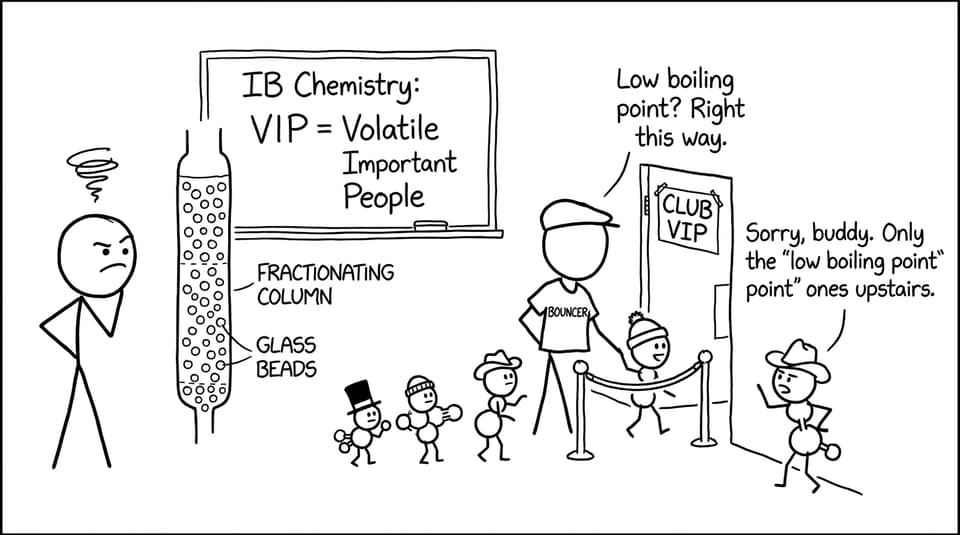
In IB Chemistry, fractional distillation is a separation method used to separate a mixture of liquids by exploiting different boiling points, especially when those boiling points are close together.
Think of it as simple distillation with extra checkpoints. Those checkpoints happen in a fractionating column, where vapour repeatedly condenses and evaporates. That repetition is what improves purity.
If you want a quick refresher on the language examiners like, keep the IB Chemistry Key Definitions open while you revise.
Quick exam checklist (what to include for full marks)
When a fractional distillation question appears, include these points:
-
State it separates miscible liquids with similar boiling points
-
Mention the fractionating column increases surface area (beads/plates)
-
Explain repeated condensation and vaporization (fractionation)
-
Describe the temperature gradient: hot bottom, cool top
-
Say lower boiling point component reaches the top first and is collected first
This structure fits most IB Chemistry short answers without you memorising a paragraph.
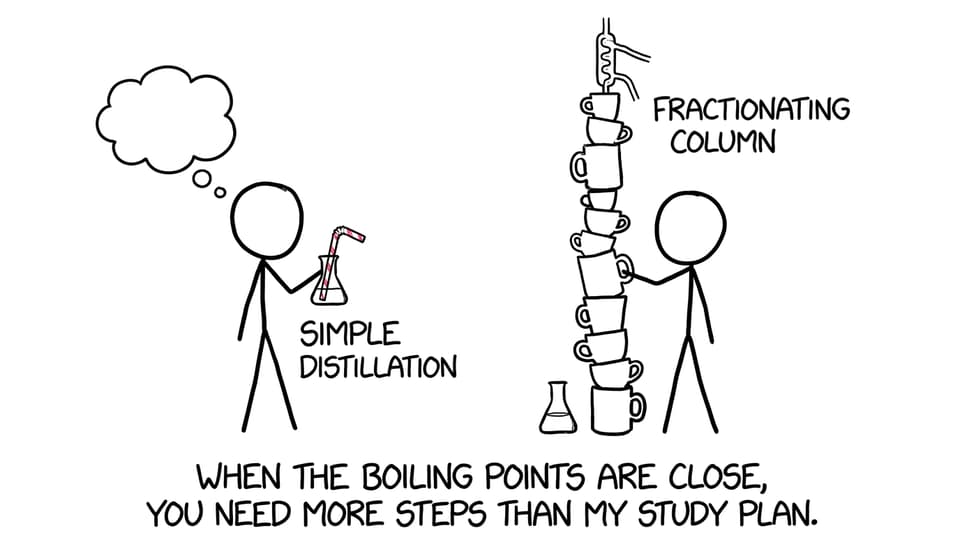
Why IB Chemistry needs fractional (not simple) distillation
Simple distillation works best when boiling points are far apart (a common rule of thumb is around 30\u00b0C or more). But when boiling points are close, the vapour above the liquid mixture often contains both components in significant amounts.
So if you use simple distillation, you collect a distillate that is still a mixture. In IB Chemistry terms: your separation is inefficient, and your product is not very pure.
Fractional distillation fixes this by creating many mini-separations in the column. If separation techniques blur together for you, comparing distillation with chromatography can help: see Principle of Chromatography Explained.
How fractional distillation works (step-by-step, no fluff)
A typical setup has a distillation flask, a fractionating column, a condenser, and a receiver.
Heating starts the competition
You heat the mixture. Molecules with lower boiling points have higher vapour pressures at a given temperature, so they enter the gas phase more readily.
Vapour rises into the fractionating column
The column is packed with glass beads or plates. In IB Chemistry, the point is simple: more surface area means more places for vapour to condense.
The column forces repeated condensation and evaporation
As vapour rises, it meets cooler surfaces higher up. Higher-boiling components condense sooner and run back down. Lower-boiling components are more likely to stay as vapour and continue upward.
Each cycle of condense-then-evaporate acts like another round of separation. This is why the column is the star of fractional distillation.
The lowest boiling fraction is collected first
The most volatile component reaches the top, enters the condenser, cools into liquid, and is collected. Then, as the temperature increases, less volatile components can make it higher up and eventually distil over as later fractions.
The temperature gradient (the detail examiners love)
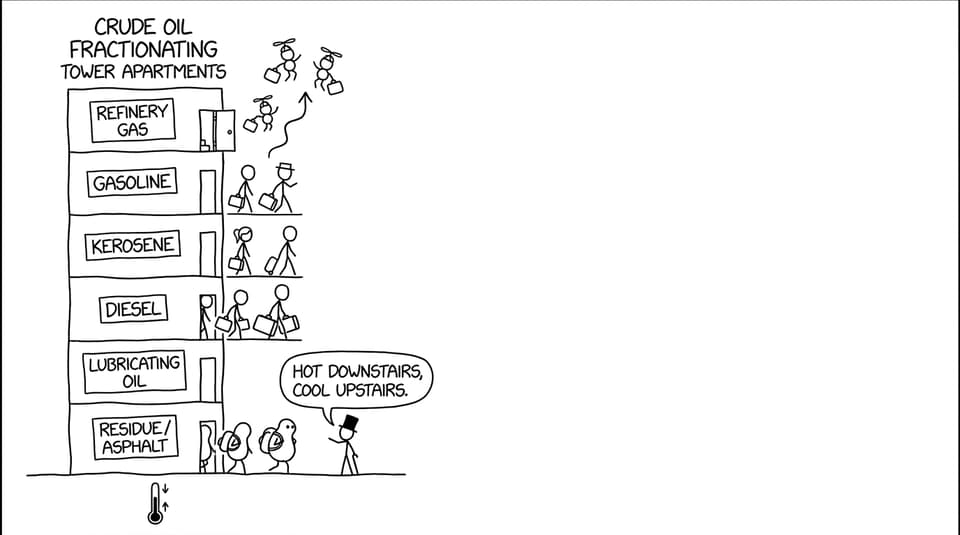
A fractionating column maintains a temperature gradient: hottest at the bottom, cooler at the top.
In IB Chemistry, you can describe the payoff like this:
-
Near the bottom, many substances can exist as vapour
-
Higher up, only the most volatile molecules can avoid condensing
-
So the vapour near the top becomes enriched in the lower boiling component
That’s the mechanism behind the improved separation.
Fractional distillation in industry (crude oil in one picture)
The classic IB Chemistry application is crude oil refining. Crude oil contains hundreds of hydrocarbons with different boiling ranges. A tall fractionating tower separates them into fractions used as fuels and chemical feedstocks.
Common fractions (approximate boiling ranges): refinery gas (below 20\u00b0C), gasoline (about 30-200\u00b0C), naphtha (about 100-250\u00b0C), kerosene (about 150-300\u00b0C), diesel (about 250-350\u00b0C), fuel oil (about 300-400\u00b0C), residue/bitumen (above 400\u00b0C).
How to revise this fast with RevisionDojo
If you’re revising IB Chemistry under time pressure, the goal is to practise explaining, not just rereading.
-
Use the IB Chemistry course hub to combine Study Notes, Flashcards, and the Questionbank.
-
Build a short mixed-topic Mock Exam to force recall.
-
Use AI Chat to test your explanation of “why the fractionating column improves separation,” then refine it.
-
If you’re unsure what an examiner would reward, Grading tools and Tutors can help you align with markscheme language.
For separation-technique context beyond IB, the MYP Filtration, Distillation and Chromatography notes are also a surprisingly clean refresher.
Conclusion: the simplest way to remember fractional distillation
Fractional distillation in IB Chemistry is really a story about patience: separation improves because the apparatus forces molecules to try again and again inside the column. The fractionating column, the temperature gradient, and the repeated condensation-vaporization cycles are the whole game.
If you want this to stick before exams, practise it like an explanation skill: hit a few targeted IB Chemistry questions in RevisionDojo’s Questionbank, generate a short set with Mock Exams and Predicted Papers, then use AI Chat to tighten your wording until it sounds inevitable.