
Faraday’s constant shows up in IB Chemistry the way a key shows up in a mystery novel: quietly at first, then everywhere. You can memorize the number and still feel lost when a question asks for mass deposited, gas produced, or charge needed. But once you see what Faraday’s constant is really doing, electrolysis calculations stop feeling like “random formula time” and start feeling like counting.
Faraday’s constant (F), in one clear sentence
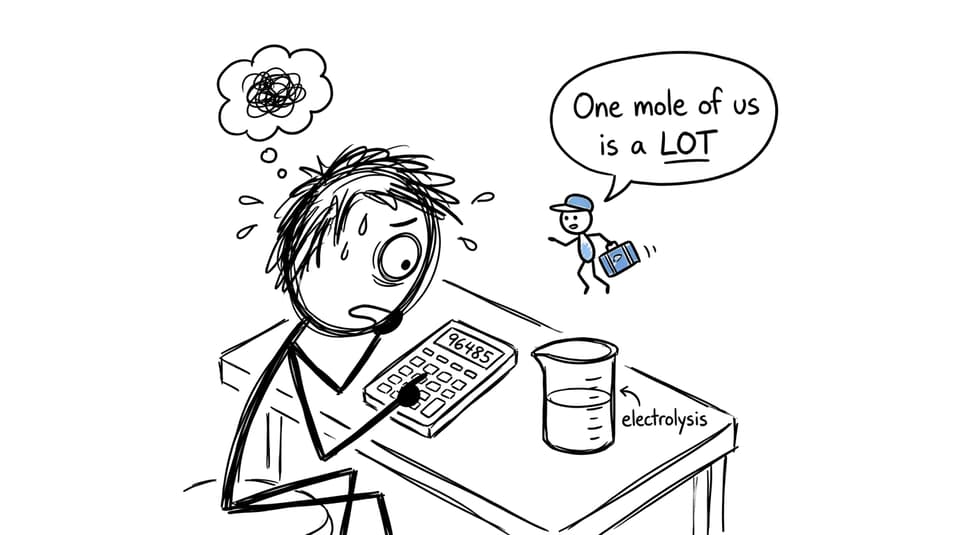
In IB Chemistry, Faraday’s constant (F) is the electric charge carried by one mole of electrons.
F = 96485 C mol⁻¹ (often rounded to 96500 C mol⁻¹ in exam calculations)
That’s it. No extra mythology. The only reason it feels heavy is because it connects two worlds:
-
microscopic particles (electrons)
-
macroscopic measurements (current, time, charge)
If you want the bigger electrolysis picture before diving into calculations, start with Electrolysis Explained for IB Chemistry.
Quick checklist: what Faraday’s constant helps you find
When a question mentions current and time, Faraday’s constant is usually your bridge to:
-
moles of electrons transferred
-
moles of product made (metal, gas, etc.)
-
mass deposited at an electrode
-
charge needed for a required amount of product
A good habit in IB Chemistry is to underline the trio: I, t, and n (electrons in the half-equation). If you have those, Faraday’s constant does the rest.
Why Faraday’s constant equals 96485 (the logic, not the memorization)
Faraday’s constant comes from multiplying:
-
the charge on one electron, e = 1.602 × 10⁻¹⁹ C
-
Avogadro’s number, NA = 6.022 × 10²³ mol⁻¹
So:
F = e × NA ≈ 96485 C mol⁻¹
In IB Chemistry terms, this is the “unit conversion” you didn’t know you needed: it converts a mole concept into a charge concept.
The three formulas that carry most IB Chemistry electrolysis questions
If you remember only one chain, remember this:
Charge passed
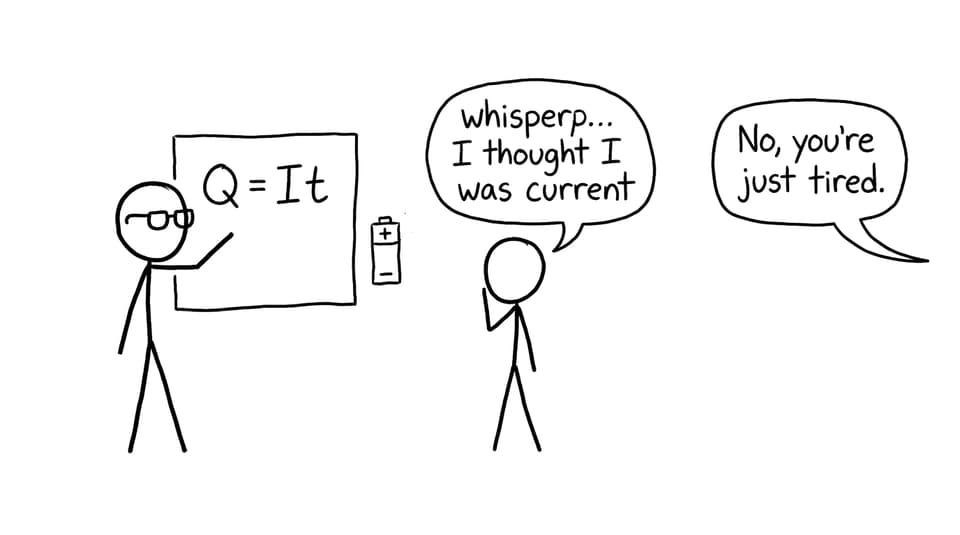
Q = I × t
-
Q in coulombs (C)
-
I in amps (A)
-
t in seconds (s)
Moles of electrons
mol e⁻ = Q / F
Moles of product
If the half-equation uses n electrons:
mol product = (Q / F) / n
From there, mass is just:
mass = moles × molar mass
For targeted practice on redox and electron accounting, the R3.2 Electron Transfer Reactions hub is a strong companion.
Worked example (exam-style, with the thinking made visible)
Question: A current of 2.0 A is passed through molten MgCl₂ for 30 minutes. Calculate the mass of Mg formed.
Step 1: Convert time and find charge
30 min = 30 × 60 = 1800 s
Q = I × t = 2.0 × 1800 = 3600 C
Step 2: Convert charge to moles of electrons (use Faraday’s constant)
mol e⁻ = Q / F = 3600 / 96485 = 0.0373 mol e⁻
Step 3: Use the half-equation to connect electrons to magnesium
Mg²⁺ + 2e⁻ → Mg
So n = 2.
mol Mg = 0.0373 / 2 = 0.0187 mol
Step 4: Convert moles to mass
mass = 0.0187 × 24.3 = 0.454 g Mg
If you want to drill this style until it becomes automatic, use the Electrochemical Cells (HL) Questionbank and filter for electrolysis calculation sets.
Where Faraday’s constant shows up beyond electrolysis (HL link to energy)
In IB Chemistry HL, Faraday’s constant also connects redox to thermodynamics:
ΔG° = -nFE°cell
That equation is the moment when “a voltage” becomes “maximum electrical work.” It’s also why a positive cell potential implies spontaneity (negative ΔG°). If you need a clean refresher on cell potentials first, read Standard Cell Potential Explained.
Common IB Chemistry mistakes (and quick fixes)
-
Mixing up charge and current: current is a rate (C s⁻¹). Charge is the total amount. Always do Q = It first.
-
Forgetting time in seconds: minutes feel harmless, but they silently destroy answers.
-
Ignoring n in the half-equation: Faraday’s constant gives mol e⁻, not mol product. The half-equation is the translator.
A good way to prevent these is to keep the constants and equations visible while practicing. RevisionDojo’s Chemistry Data Booklet is built for that exact habit.
Closing: make Faraday’s constant your advantage
Faraday’s constant isn’t just another fact to carry into IB Chemistry exams. It’s a shortcut to clarity: charge becomes electrons, electrons become moles, moles become mass or volume. When you practice that chain enough times, electrolysis stops being stressful because it stops being mysterious.
To lock it in, use RevisionDojo the way high scorers do: learn the idea with Study Notes and Flashcards, test it with the Questionbank, then tighten your method with AI Chat and Grading tools. Add Mock Exams and Predicted Papers when you want full exam rhythm, and pull from the Coursework Library or Tutors when you want human feedback. Faraday’s constant rewards repetition, and RevisionDojo is built for exactly that kind of repetition in IB Chemistry.