

If you have ever held a cold pack and thought, “How is it getting colder without ice?” you have already met the core idea behind IB Chemistry endothermic reactions. They are the quiet kind of reaction: no flames, no drama, just energy slipping away from the surroundings so smoothly you only notice when your fingertips feel the chill. In exams, that quietness is exactly what makes them tricky. The sign of ΔH, the shape of the energy profile, and the words “system” and “surroundings” can all blur together under time pressure.
Endothermic reactions in IB Chemistry (the definition that scores marks)
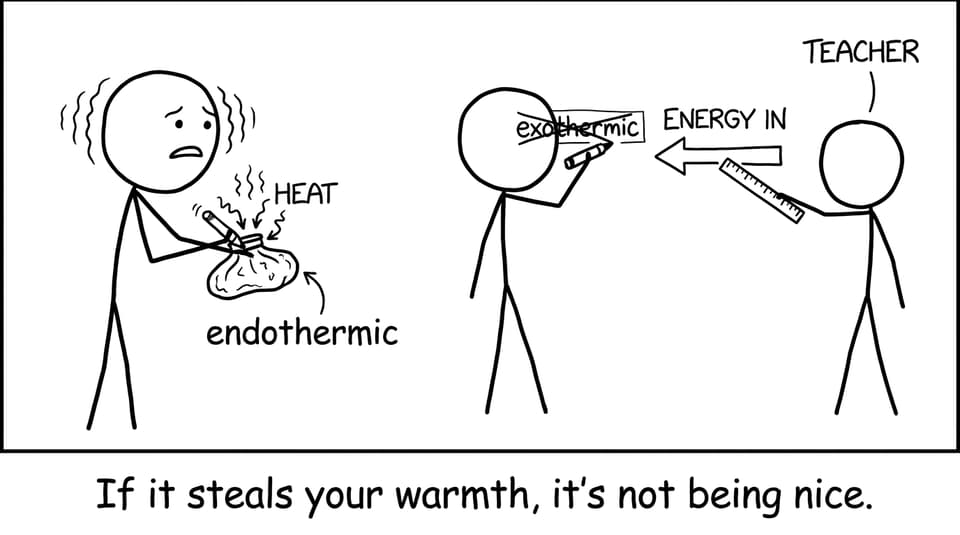
An endothermic reaction is a reaction that absorbs heat energy from the surroundings.
In IB Chemistry, you can translate that definition into three exam-friendly consequences:
-
Products have higher enthalpy than reactants
-
The surroundings cool down
-
The enthalpy change ΔH is positive (ΔH > 0)
If you want a clean foundation before you revise applications, read Enthalpy Change Explained for IB Chemistry.
A quick checklist for spotting an endothermic reaction
Use this when you are scanning questions quickly:
-
Does the temperature of the solution or container decrease? (likely endothermic)
-
Is ΔH given as a positive value? (endothermic)
-
Are the products higher than reactants on an energy profile? (endothermic)
-
Is the process described as needing a “continuous input of heat”? (often endothermic)
For the measurement side of this topic, R1.1 Measuring enthalpy change notes help you connect temperature change to energy transfer.
Why endothermic reactions happen (bond breaking vs bond making)
In IB Chemistry, the most reliable explanation is the bond-energy story:
-
Breaking bonds absorbs energy
-
Forming bonds releases energy
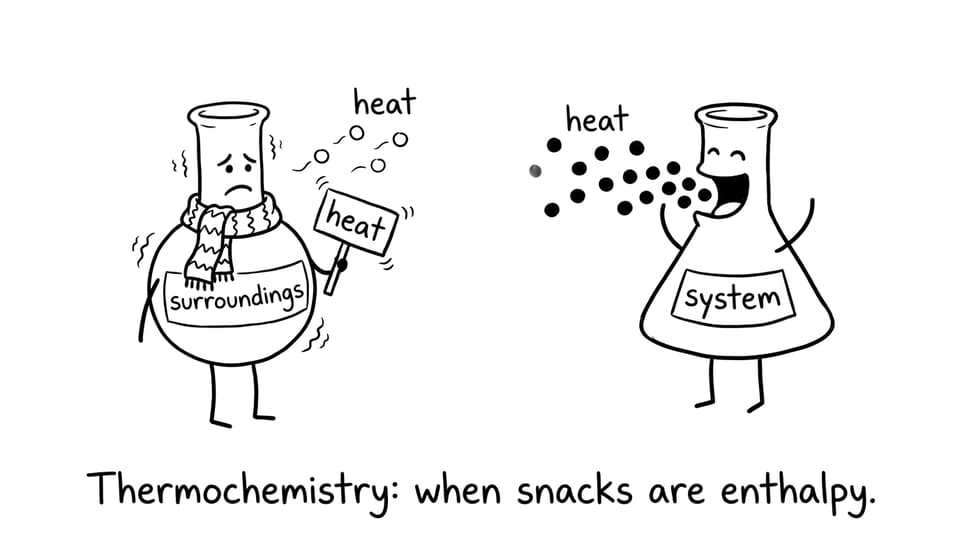
A reaction is endothermic when the total energy required to break bonds is greater than the total energy released when new bonds form. The difference does not vanish. It is taken in from the surroundings as heat.
This is exactly the logic tested in short-response questions that ask you to justify the sign of ΔH using bonding. If you want that phrasing nailed down, revise it with R1.2.1 Bond enthalpy notes.
Endothermic reactions in IB Chemistry: examples that show up often
You do not need a long list. You need a few examples you can explain clearly.
Thermal decomposition
Many decompositions require heating because the reaction will not proceed without energy input.
A classic IB Chemistry example:
- CaCO₃(s) → CaO(s) + CO₂(g) (ΔH > 0)
You will see this kind of example repeatedly in energetics questions and in broader equilibrium contexts.
Dissolving certain salts
Some ionic solids absorb heat when dissolving. The surroundings cool, so it feels cold to touch. This is the core idea behind instant cold packs.
Photosynthesis and physical processes
Photosynthesis absorbs energy (light) to build higher-energy molecules. Physical changes like evaporation and boiling also require energy input, which is why sweating works.
For a structured syllabus view of energetics, keep Energetics and thermochemistry study notes open while you practise.
Reading an enthalpy (energy) profile diagram for endothermic reactions
An enthalpy profile diagram is where many students lose easy marks in IB Chemistry. Remember the two levels and the two arrows:
-
Reactants start lower
-
Products end higher
-
The activation energy goes from reactant level up to the peak
-
The ΔH arrow points upward (positive)
If you want a deeper HL-friendly view (transition states, multi-step profiles), see R2.2.7 Energy profiles and transition states notes.
Endothermic vs exothermic (how to avoid the classic mix-up)
The simplest way to stay consistent in IB Chemistry is to fix your perspective:
-
Endothermic: energy goes into the system; surroundings cool; ΔH > 0
-
Exothermic: energy goes out of the system; surroundings warm; ΔH < 0
When you revise the opposite case, pair this article with Exothermic Reactions Explained for IB Chemistry.
Exam insights: temperature, equilibrium, and “feels cold” questions
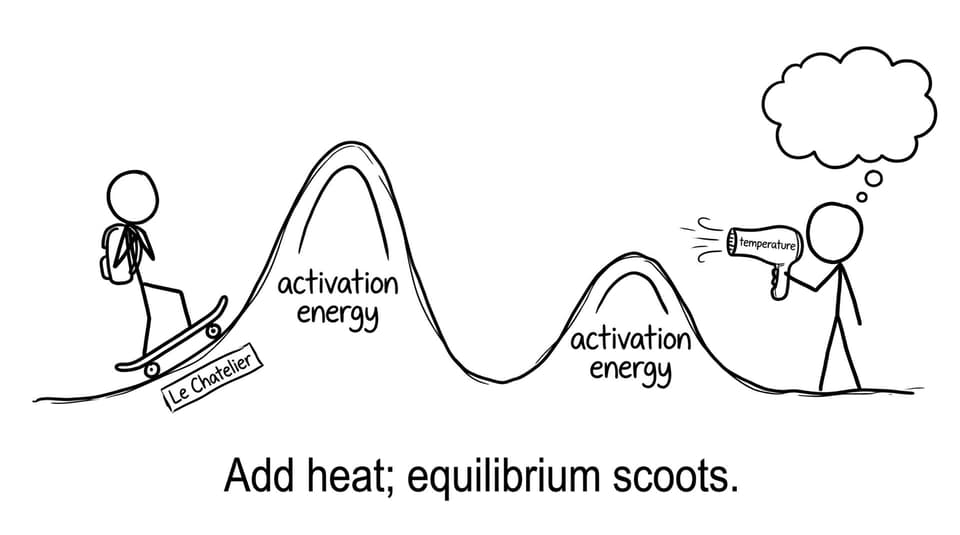
Endothermic reactions often appear with Le Chatelier’s principle: if heat acts like a reactant, increasing temperature tends to favour the endothermic direction at equilibrium. That is not the same as saying the reaction rate always increases or that the reaction becomes spontaneous. You are simply shifting which side is favoured.
Also, “Why does it feel cold?” is a system-surroundings explanation question. The reaction absorbs heat from your skin (surroundings), lowering the temperature you feel.
To lock in precise definitions (and stop losing marks to vague wording), use the IB Chemistry glossary.
Conclusion: turn endothermic reactions into easy IB Chemistry marks
Endothermic reactions in IB Chemistry are about direction of energy flow: heat goes into the system, ΔH is positive, and products sit higher on the enthalpy profile than reactants. Once that is stable in your mind, examples like thermal decomposition and cold-pack dissolutions stop feeling like separate facts and start feeling like the same idea in different outfits.
To make this exam-ready, use RevisionDojo’s Study Notes, targeted Flashcards, and the Questionbank for energetics, then check your explanations with AI Chat and timed Mock Exams. When you can explain endothermic reactions calmly, you are not just revising IB Chemistry; you are practising the kind of thinking examiners reward.