

In IB Chemistry, electron affinity is one of those topics that feels obvious until you try to explain it in a 3-mark question. You know it’s about atoms “wanting” electrons. Then the exam asks for the definition, the state symbols, the sign of the value, and an exception (hello, fluorine). Suddenly, it’s not a vibe anymore; it’s precision.
This guide explains electron affinity simply, but in the exact way IB Chemistry expects: clean definition, first vs second electron affinity, the trends, and the classic halogen twist.
Electron affinity in IB Chemistry (definition you can quote)
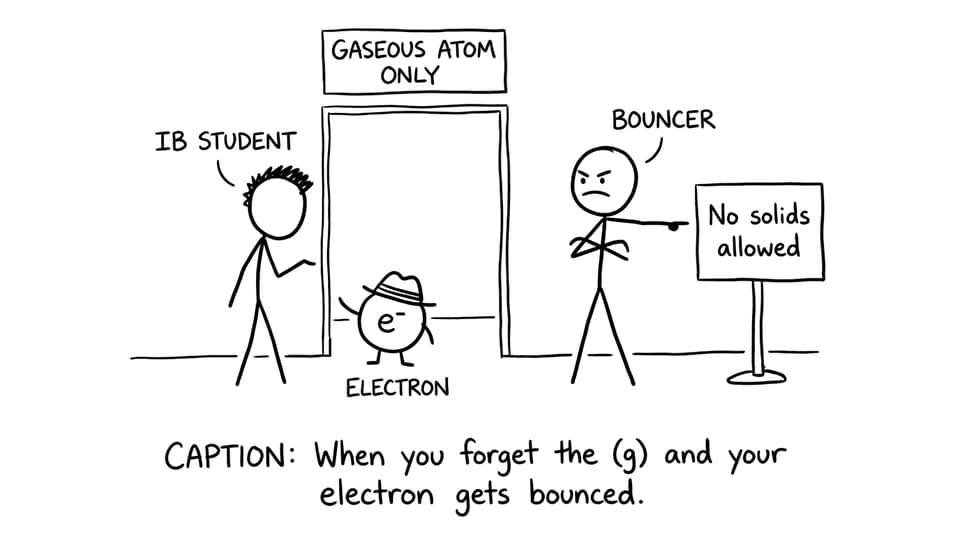
Electron affinity is the energy change when one mole of gaseous atoms gains one mole of electrons to form one mole of gaseous 1ions.
Write it like this:
X(g) + e⁻ → X⁻(g)
Three details are non-negotiable in IB Chemistry:
-
The atom is gaseous (that state symbol matters).
-
You add one electron per atom (this is first electron affinity).
-
You form a negative ion in the gas phase.
If you ever mix this up with electronegativity, anchor yourself with the glossary style wording in the IB Chemistry Key Definitions.
Quick checklist: what examiners want you to say
When you see “electron affinity” in an IB Chemistry question, check these boxes:
-
Use the gas phase in your definition and equation.
-
State whether it is exothermic (usually first EA) or endothermic (always second EA).
-
Explain trends using nuclear charge, atomic radius, and shielding.
-
Mention electron-electron repulsion for exceptions.
To practice wording under time pressure, the S3.1 Periodic Table Questionbank is ideal because it repeatedly forces the “definition + trend + reasoning” pattern.
Is electron affinity exothermic or endothermic?
In IB Chemistry, this is a common trap because students treat electron affinity as “always energy released.” The truth is more nuanced.
First electron affinity is usually exothermic
When a neutral atom gains an electron, the incoming electron is attracted to the nucleus. That attraction releases energy, so the first electron affinity is typically exothermic.
Example idea (not about memorising numbers): halogens release a lot of energy when gaining an electron because they are close to a stable noble-gas configuration.
Second electron affinity is always endothermic
The second electron affinity means adding an electron to an ion that is already negative:
X⁻(g) + e⁻ → X²⁻(g)
That incoming electron is now repelled by the negative ion, so energy must be supplied. In IB Chemistry, you can safely write: second electron affinity is always endothermic due to electron-electron repulsion.
Why electron affinity happens at all (the simple mental model)
Picture an electron approaching a neutral atom.
-
The nucleus attracts it.
-
Inner electrons partially block that attraction (shielding).
-
Once the electron is incorporated into the atom, the system settles into a lower-energy arrangement (often releasing energy).
So, electron affinity is really a competition between attraction to the nucleus and repulsion/shielding effects. That’s also why it sits naturally beside other periodic trends in IB Chemistry like ionization energy and electronegativity.
If you want the broader trend map, use Periodicity Explained Simply as your master reference.
Factors that affect electron affinity
Nuclear charge
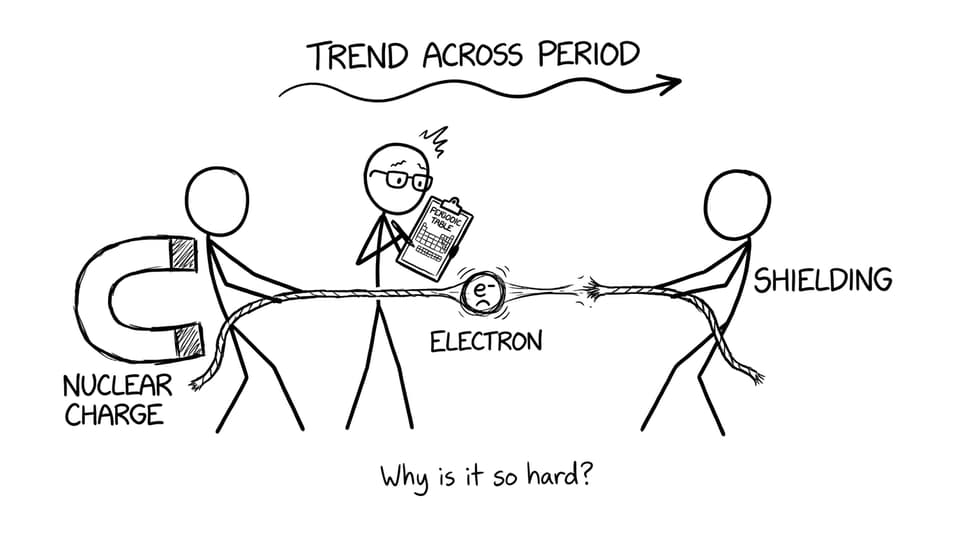
More protons means a stronger pull on the incoming electron. Across a period, nuclear charge increases, so electron affinity generally becomes more exothermic.
Atomic radius and shielding
A larger atom puts the outer region farther from the nucleus. Add shielding from extra shells, and the effective attraction drops. Down a group, electron affinity tends to become less exothermic.
Electron-electron repulsion in subshells
If the added electron enters a crowded subshell, repulsion increases and the process becomes less favourable. This is where the best IB Chemistry explanations pick up marks: you’re not just stating the trend, you’re giving the mechanism.
To connect this to electron configurations, the S3.1.2 Electron configuration and group trends page is a useful companion.
Periodic trends: across a period vs down a group
Across a period: electron affinity becomes more exothermic
In IB Chemistry, the standard explanation is:
-
Nuclear charge increases
-
Atomic radius decreases
-
Shielding changes little
-
Attraction for the incoming electron increases
So elements on the right (especially non-metals) are more likely to gain electrons.
Down a group: electron affinity becomes less exothermic
Down a group:
-
Atomic radius increases
-
Shielding increases
-
The incoming electron feels less attraction
This trend is also tied to reactivity arguments, especially for Group 17, and you can revise that link directly in Reactivity of elements based on periodic trends.
The halogen story (and the fluorine vs chlorine twist)
Halogens are one electron short of a full outer shell. In IB Chemistry, that’s why their first electron affinities are among the most exothermic.
But the classic exception students are expected to know is:
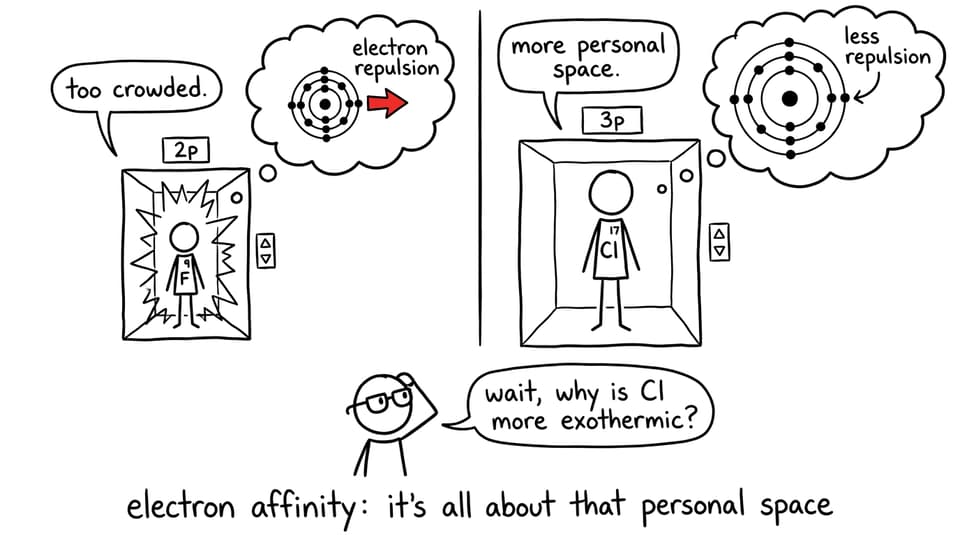
- Chlorine’s electron affinity is more exothermic than fluorine’s.
Why? Fluorine is so small that the added electron is forced into a very compact 2p region where repulsion is significant. Chlorine’s 3p region has more space, so repulsion is reduced and more energy is released overall.
For fast checking of where electron affinity data appears in allowed materials, see the IB Chemistry Data Booklet.
Where electron affinity shows up beyond trends
In IB Chemistry, electron affinity doesn’t live alone. It becomes part of larger explanations:
-
Ionic bonding and anion formation (why non-metals form negative ions)
-
Energetics cycles such as the Born-Haber cycle (HL)
If you’re HL and want to see it used as a step in a full energetics argument, the Born-Haber Cycle notes make the connection explicit.
Conclusion: the exam-ready way to remember electron affinity
Electron affinity in IB Chemistry is the energy change when a gaseous atom gains an electron to form a gaseous 1ion. The first electron affinity is usually exothermic because of nuclear attraction, while the second is always endothermic because of repulsion. Across a period, electron affinity generally becomes more exothermic; down a group it becomes less exothermic. And if you remember only one exception, remember why chlorine beats fluorine.
If you want to turn understanding into marks, build a quick routine on RevisionDojo: learn the phrasing in the Study Notes, drill it in the Questionbank, lock it in with Flashcards, and pressure-test it with Mock Exams and Predicted Papers. Add AI Chat for instant explanations when a trend feels slippery, and use the Grading tools to tighten your wording until it sounds exactly like IB Chemistry.