
Electrolytic cells have a funny way of making smart students doubt themselves. You look at a diagram, you remember “oxidation at anode,” and then the signs flip and suddenly your brain does that thing where it tries to run away from your body.
That confusion is normal in IB Chemistry. And the good news is: an electrolytic cell is simple once you anchor it to one idea: a power supply forces a reaction that would not happen on its own.
The one-sentence definition (the exam-friendly version)
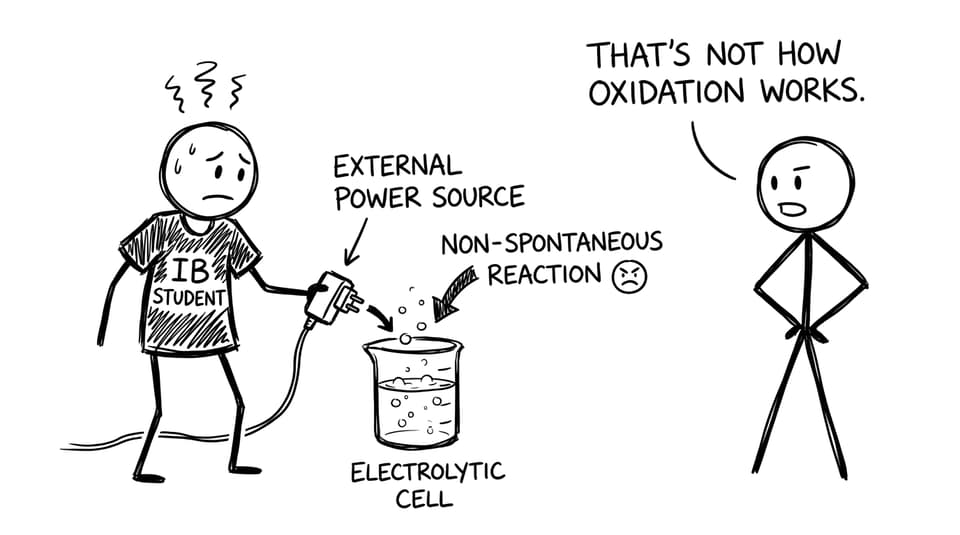
An electrolytic cell uses electrical energy from an external DC power source to drive a non-spontaneous redox reaction.
In IB Chemistry, this sits right inside redox and electrochemistry: you’re learning how electrons and ions can be “told what to do” by electricity.
If you want the broader electrolysis picture, pair this with Electrolysis Explained for IB Chemistry.
Quick checklist: what you must label correctly
When you draw or interpret an electrolytic cell in IB Chemistry, check these every time:
-
Power supply present (this is what makes it electrolytic)
-
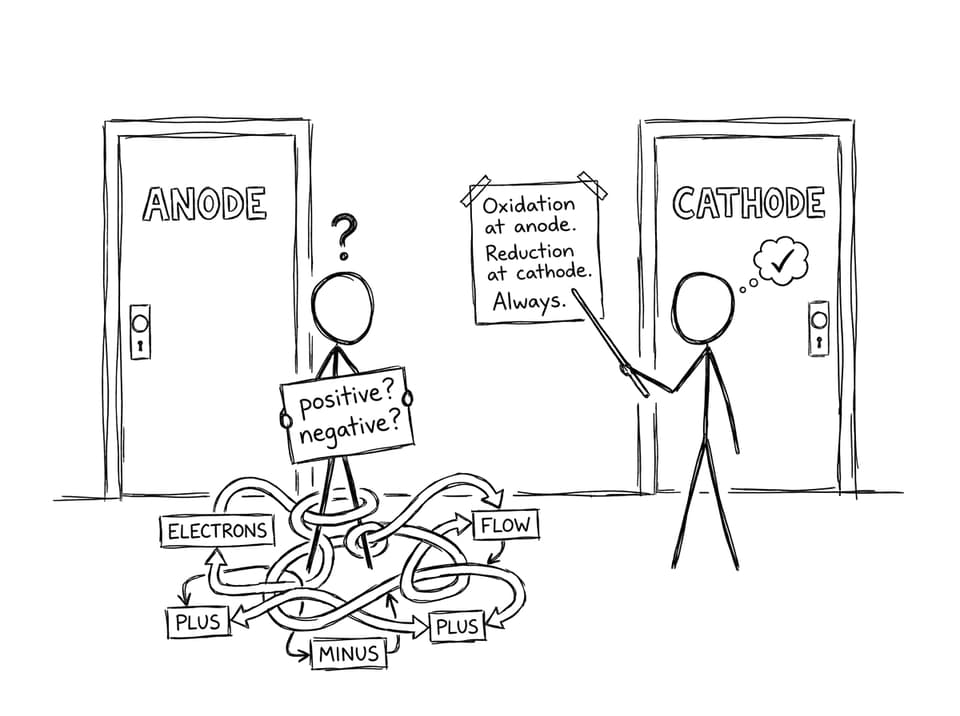
Anode = oxidation (always)
-
Cathode = reduction (always)
-
Anode is positive (electrolytic cells)
-
Cathode is negative (electrolytic cells)
-
Cations go to the cathode, anions go to the anode
For a clean refresher on oxidation/reduction language, see Redox Reactions Explained for IB Chemistry.
How an electrolytic cell works (without the mental gymnastics)
Here’s the story you should keep in your head for IB Chemistry:
The power source is the boss
A battery/DC supply pulls electrons away from one electrode and pushes them toward the other. That external “push” is why the reaction can run even when it’s not energetically favorable.
Why the signs are what they are
-
The anode is connected to the positive terminal of the power supply. The supply removes electrons from it, so oxidation happens there.
-
The cathode is connected to the negative terminal. The supply delivers electrons to it, so reduction happens there.
Oxidation and reduction locations are summarized well in Electrochemical cells: Oxidation and reduction Notes.
Electron flow vs ion movement (the exam trap)
A common IB Chemistry slip is mixing these up.
-
Electrons travel in the external circuit: power supply > cathode > anode (forced direction)
-
Ions move in the electrolyte:
-
Cations > cathode (to gain electrons)
-
Anions > anode (to lose electrons)
-
To tighten your language around ions in solution, review What Electrolytes Do in Chemistry.
Worked example: molten NaCl (the cleanest case)
Molten sodium chloride contains only Na⁺ and Cl⁻, so the electrode products are straightforward.
Cathode (reduction):
Na⁺ + e⁻ > Na(l)
Anode (oxidation):
2Cl⁻ > Cl₂(g) + 2e⁻
In IB Chemistry, molten examples are “clean” because there’s no water competing for discharge.
Aqueous electrolysis: water joins the competition
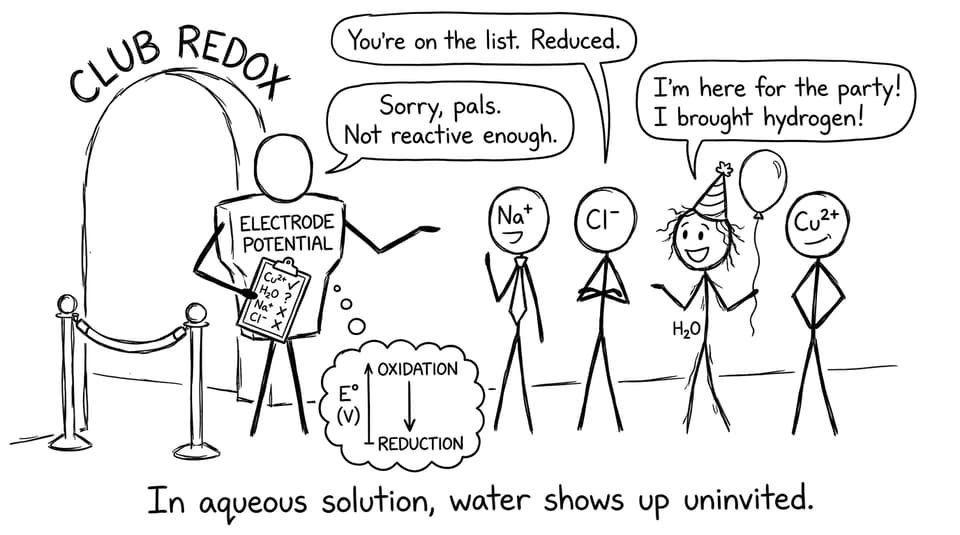
Aqueous solutions include water, so you often have multiple possible oxidations/reductions. This is where IB Chemistry questions get more conceptual.
Example: aqueous CuSO₄ with inert electrodes
Cathode:
Cu²⁺ + 2e⁻ > Cu(s)
Anode (often):
2H₂O > O₂(g) + 4H⁺ + 4e⁻
Sulfate typically stays as a spectator here, so water is oxidized.
Electroplating: the most testable application
Electroplating is a favorite in IB Chemistry because the setup maps neatly onto definitions:
-
Object being plated = cathode (needs electrons to reduce metal ions onto it)
-
Plating metal source = anode (often dissolves to replace ions)
-
Electrolyte contains ions of plating metal (e.g., Ag⁺ for silver plating)
You can drill electroplating-style questions in Electrochemical cells (HL) Questionbank, and lock in definitions using the IB Chemistry Key Definitions.
The fastest way to revise this on RevisionDojo
If you’re revising IB Chemistry under time pressure, use a tight loop:
-
Read the core notes, then test immediately using the Questionbank: Electrochemical cells (HL)
-
Use Flashcards for Electrolysis of aqueous solutions (HL only) for quick recall
-
Ask AI Chat to explain why water is discharged in one setup but not another
-
Build a timed set with Mock Exams and Predicted Papers to practice decision-making
-
If calculations show up, revise Faraday’s constant with Faraday's Constant Explained
And if you want everything organized by syllabus in one place, start at IB Chemistry - RevisionDojo.
Conclusion: make the power supply your anchor
Electrolytic cells in IB Chemistry become much less intimidating when you treat them like a forced story: the power supply pushes electrons, the cathode reduces, the anode oxidizes, and ions move to balance charge. From molten salts to aqueous solutions to electroplating, the same logic keeps repeating.
If you want this to stick under exam pressure, practice it the RevisionDojo way: learn the idea in Study Notes, test it in the Questionbank, cement it with Flashcards, and use AI Chat when your reasoning gets stuck mid-question. That’s how IB Chemistry revision stops being a lecture and starts becoming a skill.