



If you have ever opened a set of IB practice questions and felt your confidence evaporate in the first five minutes, it is not a motivation issue. It is usually a sequencing issue.
The IB rewards students who can climb from clear foundations to flexible, high-pressure performance. But lots of revision resources mix difficulty randomly, like shuffling every level of a game into one boss fight. Difficulty-graded IB questions fix that by matching the challenge to what your brain can realistically build next.
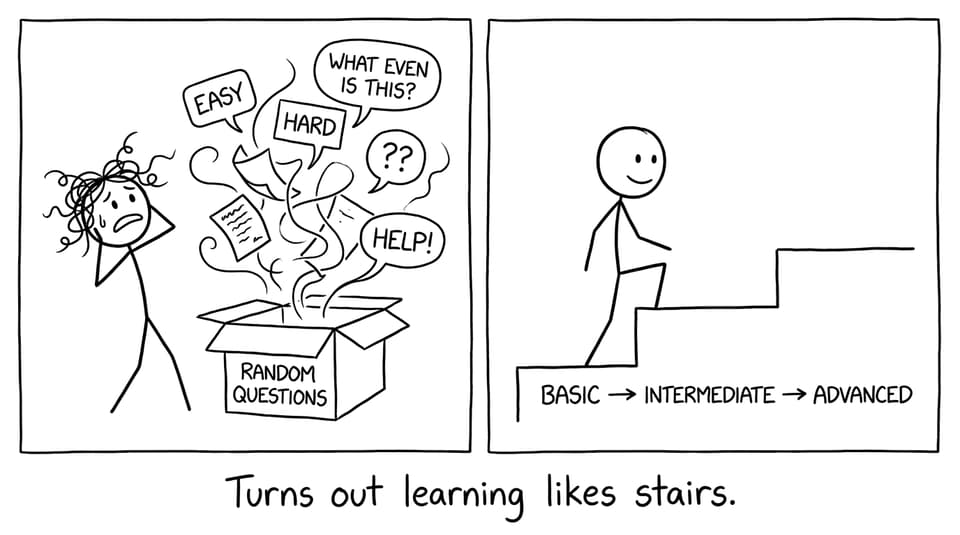
The quick checklist: how difficulty-graded IB practice should feel
Use this as a gut-check when you plan your next IB session:
-
Basic tier: you feel calm, slightly bored, and very precise.
-
Intermediate tier: you slow down, connect steps, and notice patterns in mistakes.
-
Advanced tier: you feel pressure, integrate topics, and get better at staying coherent.
If you feel panic in minute one, you probably started too high. If you feel comfy for an hour, you probably stayed too low.
A good place to run this progression is the RevisionDojo Questionbank, because you can filter practice by topic and difficulty, then immediately see feedback that mirrors markscheme logic.
Why random IB practice backfires
Random practice creates two traps.
First, you spend too long repeating what you already know. That feels productive because it is familiar, but it is mostly performance, not learning.
Second, you hit advanced IB questions before your foundations can support them. When that happens, you do not just miss marks. You learn the wrong lesson: that you are “bad at the subject,” instead of “too early for this question type.”
That is why students who revise intelligently often do fewer questions, not more. They choose the right difficulty at the right time, and they review mistakes like clues.
For a broader view of what makes IB exams feel hard in the first place, read How Hard Are IB Exams? A Realistic Guide.
How difficulty-graded IB questions build real skill
Difficulty tiers work because mastery has stages.
Basic IB questions: build clean fundamentals
At the basic level, you are training accuracy.
You focus on definitions, standard methods, common command terms, and the exact structure of what the question is asking. This is where Study Notes and quick drills pair well: read a small slice, then answer basic questions until your errors stop being random.
If you are unsure how to structure your practice sets, this guide helps: IB Question Bank | How to Use It Effectively.
Intermediate IB questions: turn knowledge into judgment
Intermediate difficulty is where IB performance starts to separate.
Now you are applying concepts, combining steps, and handling unfamiliar wording without falling apart. Your mistakes become more informative: they show conceptual gaps, not just careless slips.
This is also the sweet spot for using Jojo AI Chat and RevisionDojo workflows to ask “what does the examiner want here?” and “what is the shortest path to full marks?” Then turn recurring issues into Flashcards.
Advanced IB questions: rehearse pressure and integration
Advanced questions are not just “harder.” They are more integrated.
They often require you to connect multiple topics, interpret data or arguments, and write with control under time pressure. This is where timed sessions matter, along with fast, criteria-aligned feedback.
When you are ready to stress-test yourself, pair advanced sets with IB Higher Level Mock Exams: Challenge Yourself with Advanced Questions and, when useful, IB Predicted Papers by IB Examiners (Free).
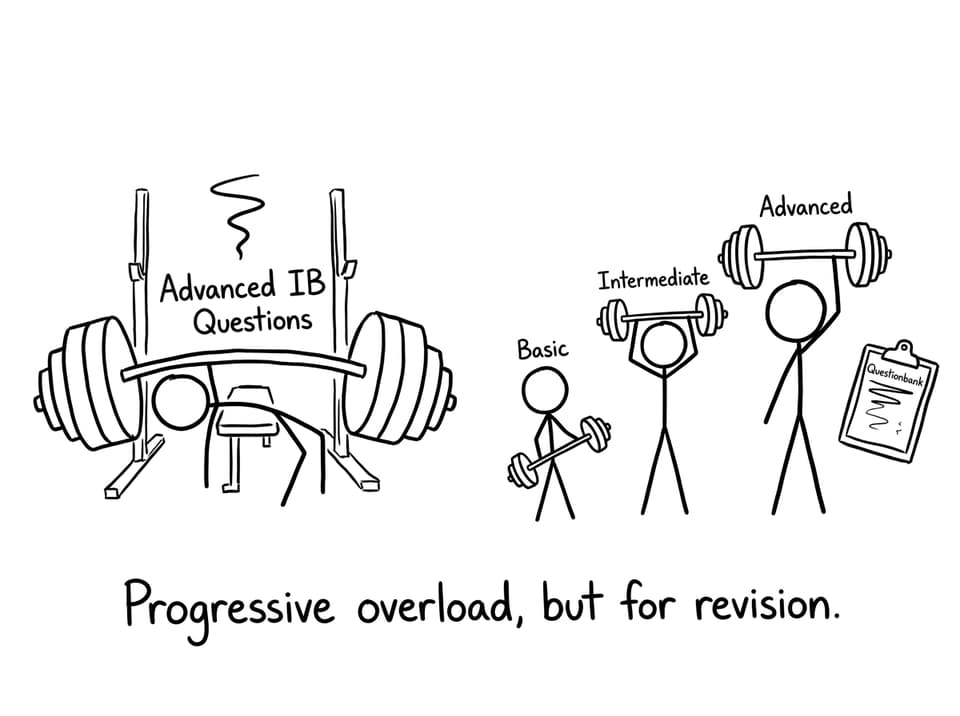
A simple difficulty-graded IB routine (30--60 minutes)
Pick one topic. Keep it small.
-
10 minutes (Basic): 6--10 basic questions for precision. No rushing.
-
20 minutes (Intermediate): 4--6 questions that force explanations or multi-step reasoning.
-
10--20 minutes (Advanced): 1--3 harder questions with light time pressure.
-
5 minutes (Review): write one sentence per mistake: “I lost marks because…”
Then use RevisionDojo tools to close the loop: Questionbank to practice, Flashcards to keep recall alive, AI Chat to clarify, Grading tools to polish written responses, and Mock Exams to rehearse stamina. If coursework is draining your time, the Coursework Library and Tutors can keep you moving without guessing.
To make that topic-first approach even sharper, see Topic-Specific IB Tests: Master One Subject at a Time.
What this looks like across IB subjects
Difficulty progression is universal, even though the questions change.
-
IB Math: basic builds method accuracy, intermediate builds problem selection, advanced builds synthesis and resilience.
-
IB Sciences: basic secures definitions and processes, intermediate pushes application, advanced demands evaluation and interpretation.
-
IB Humanities: basic strengthens knowledge and structure, intermediate improves argument logic, advanced requires nuance and critical evaluation.
The point is not to avoid hard questions. The point is to earn them.
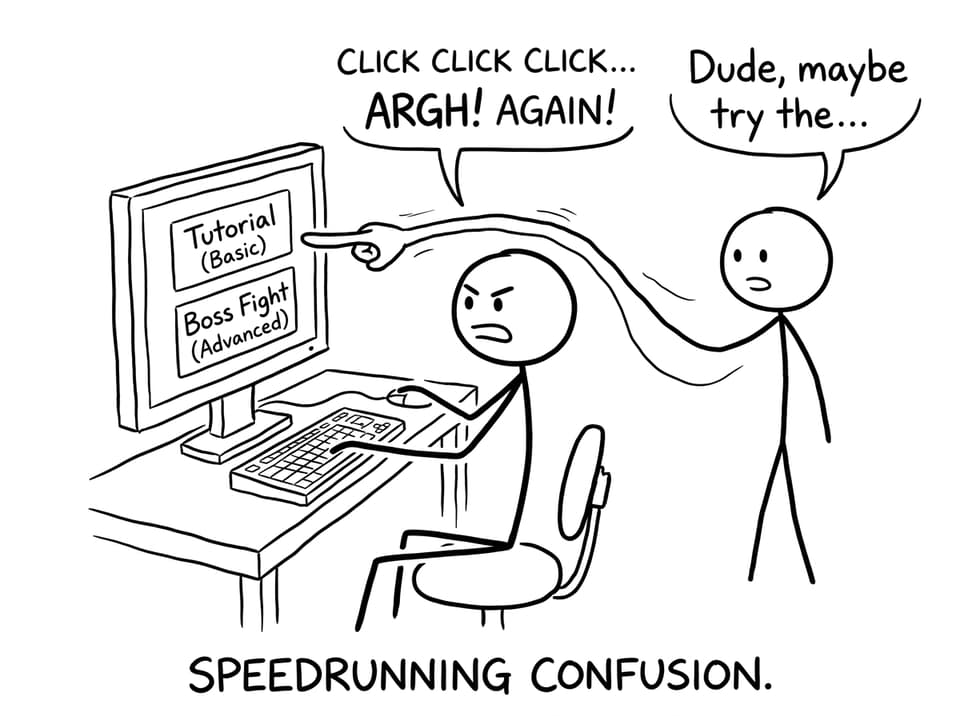
Closing: the calm way to get good at hard IB questions
The quiet secret of strong IB scores is not intensity. It is progression.
When you practice with difficulty-graded IB questions, you stop arguing with your own confidence. You build it. Basic becomes automatic, intermediate becomes manageable, and advanced becomes a rehearsal instead of a surprise.
If you want one place to run the whole loop, RevisionDojo is built for it: Study Notes, Flashcards, Questionbank, AI Chat, Grading tools, Predicted Papers, Mock Exams, a Coursework Library, and Tutors when you need human help. Start at the right tier today, and let the difficulty climb with you.