

If you have ever walked out of an IB class thinking, “I understood it in the room… so why can’t I do the questions?” you have already met the real problem.
It is not effort. It is not intelligence. It is often the shape of learning.
Inquiry-based learning fixes the shape. It turns a topic from a stack of facts into a chain of reasons you can actually use under pressure. And that is the hidden advantage for IB students preparing for exams: when you learn through inquiry, exam questions stop feeling like surprise attacks. They start feeling like familiar conversations.
Below is a student-focused way to design (or redesign) inquiry-based lessons and study sessions so your understanding gets deeper, faster, and more exam-ready.
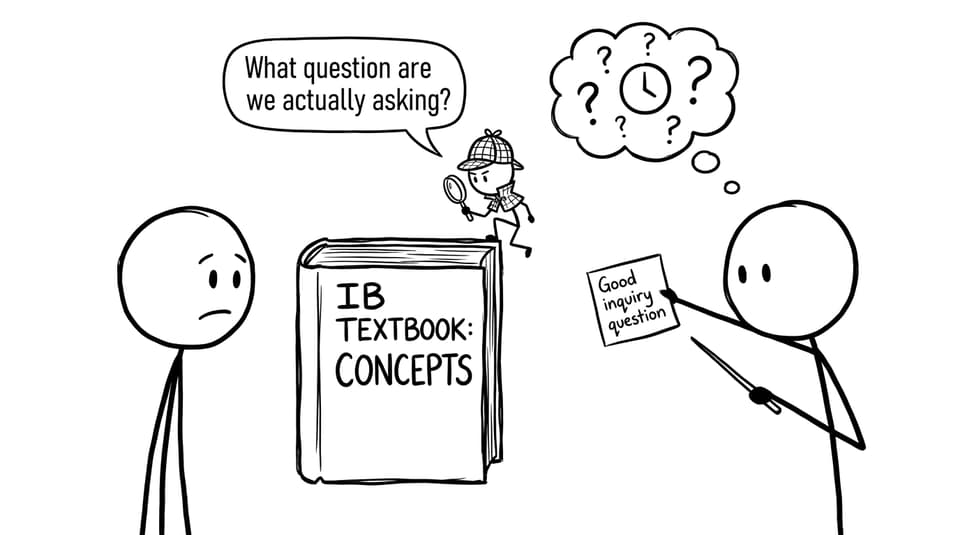
Inquiry-Based Lesson Design for IB Students: A Quick Checklist
Use this checklist whenever you revise a unit, build a study session, or ask a teacher for help in class. It keeps IB inquiry practical.
-
Start with one conceptual question (not a definition).
-
Predict first: write what you think is true before you check notes.
-
Investigate with one reliable source (notes, a worked example, or a model response).
-
Stress-test with exam-style practice questions.
-
Reflect using a mistake log: what did the question actually reward?
To run that loop in one place, use RevisionDojo as your home base and connect understanding to practice.
Why Inquiry Matters for IB Exam Prep (Not Just “Good Learning”)
Inquiry sounds like something that belongs in a classroom poster. But in IB exam prep, it does something measurable: it reduces the gap between “I read it” and “I can score on it.”
Here is why it works:
-
It builds transfer. You learn how an idea changes when the context changes, which is exactly what IB questions test.
-
It trains command-term thinking. Inquiry naturally pushes you to explain, evaluate, compare, and justify.
-
It makes misconceptions visible. When you have to predict and defend an answer, your weak spots show up early.
-
It creates memory hooks. Facts stick better when they are attached to a question you cared about.
If your revision has felt broad but not sharp, you will like the practical loop in How to Study for IB Exams: Step-by-Step Guide. Inquiry is the “why” behind that loop.
Start With Better Questions: The IB Inquiry Upgrade
Most students begin revision with “What is this?”
Inquiry begins with “What would the IB do with this?”
Try upgrading your questions like this:
-
Instead of “What is photosynthesis?” ask “How do changing conditions shift the rate, and what counts as evidence?”
-
Instead of “What is a theme in the text?” ask “How does the author build the theme through choices in tone, structure, and context?”
-
Instead of “What is elasticity?” ask “When would elasticity mislead you in a real market, and why?”
If you want to practice writing concept-based questions that actually trigger deeper thinking, borrow patterns from Teaching with Concept-Based Questions that Inspire Curiosity. Even as a student, you can use those stems to guide your self-study.
A simple rule: one big question per session
In IB, depth usually comes from staying with one strong question long enough to:
- define it, 2) test it, 3) apply it, 4) reflect on it.
That is why “one great question” beats “six chapters skimmed.”
Add Real Context: Inquiry That Matches IB Marking Logic
The most convincing IB answers usually do two things at once:
-
They show conceptual understanding
-
They show context awareness
So build inquiry around contexts that force you to use the concept, not just repeat it.
-
Sciences: ethical trade-offs, experimental limits, real data interpretation
-
Humanities: competing perspectives, causation, bias, reliability
-
Literature: audience, purpose, cultural context, authorial choice
-
TOK: evidence standards, assumptions, implications
When you revise, try this two-column prompt:
-
Column A: “What is the core idea?”
-
Column B: “Where does this idea break, bend, or become controversial?”
That tension is where strong IB writing lives.
Scaffold Without Killing Curiosity: The “Training Wheels” Approach
Students sometimes avoid inquiry because it feels slow. But inquiry is only slow when it is unstructured.
Use a scaffold that still leaves you freedom:
-
Claim: what do you think is true?
-
Because: what is the mechanism or logic?
-
So what: why does it matter in this context?
-
Test: which exam-style question could prove it?
Then do the test immediately using a bank of exam-style prompts. RevisionDojo makes this easy with its IB Question Bank guide and the deeper overview in Comprehensive IB Question Bank: Thousands of Practice Questions.
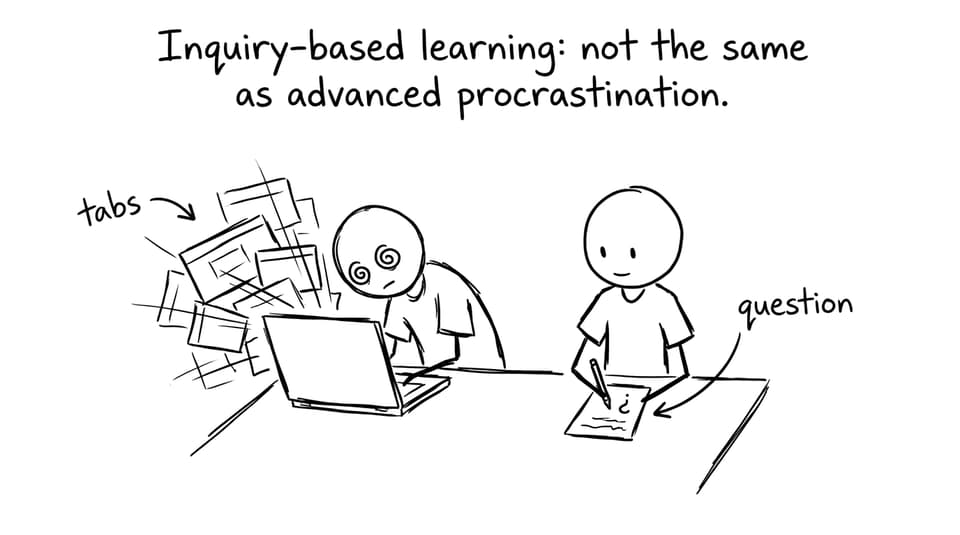
Turn Inquiry Into Marks: Formative Assessment You Can Do Alone
You do not need a teacher to assess inquiry. You need a system.
After every practice set, write a micro reflection:
-
What did the IB reward here?
-
What did I assume that was not justified?
-
Did I lose marks on content, method, or command term?
-
What is one rule I will apply next time?
Then convert the “one rule” into a Flashcard, because rules are only useful if you can recall them under time pressure.
To make recall automatic, use IB Flashcards with Spaced Repetition (SRS) and learn the strategy behind it in IB Flashcard System: Active Recall for Better Memory.
Inquiry becomes powerful when it leaves behind artifacts: questions you wrote, mistakes you tagged, rules you can recall.
A Student Workflow: Inquiry-Based IB Revision in 45 Minutes
This is a repeatable inquiry routine you can run during exam season.
-
5 min: choose one inquiry question (concept + context)
-
10 min: patch understanding with Study Notes or a targeted note collection like IB Subject Note Collections
-
20 min: answer exam-style questions in the Questionbank (timed if possible)
-
10 min: review errors, write 3 rules, turn 1 into a Flashcard, ask one question to AI Chat if you are stuck
When you want a calmer, sustainable schedule around that loop, see How to Study for IB Exams Without Burning Out.
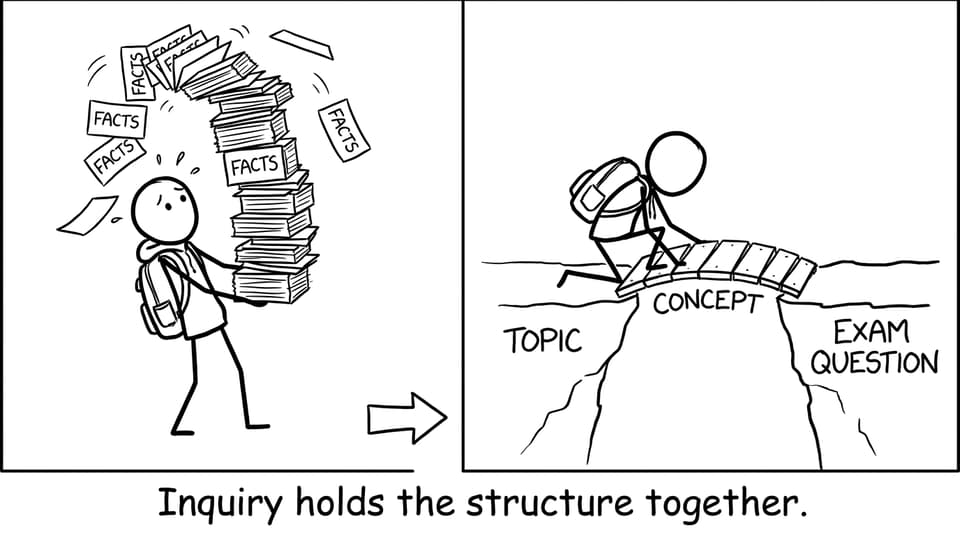
Make Inquiry Exam-Real: Timed Rehearsal Without Panic
Inquiry is not only discussion and exploration. In IB, it has to survive timing.
Once per week, run a timed rehearsal:
-
a timed section, or
-
a mini mock, or
-
a full paper when you are ready
Then review longer than you attempted.
RevisionDojo supports this realism through Mock Exams and Predicted Papers, so you can practice like an exam and then close the loop with feedback and targeted drills. If you are unsure how to use predictions responsibly, read IB Predicted vs Specimen Papers: What They Mean and explore IB Predicted Papers by IB Examiners (Free).
Closing: Make IB Feel Smaller With Inquiry
The quiet secret of IB success is that the best students do not just “cover content.” They run a loop: question, test, reflect, repeat. Inquiry makes that loop feel natural, because it turns revision into a search for the next best question rather than a desperate attempt to hold everything at once.
If you want a single place to run inquiry-based IB revision with less friction, use RevisionDojo: Study Notes to get clear, Flashcards to retain, Questionbank to apply, AI Chat to get unstuck, Grading tools to understand what earns marks, and Predicted Papers plus Mock Exams to rehearse exam conditions. Pick one inquiry question for your next session and build your next set of marks from it.