Join 650k+ students breezing through the IBReady to breeze through the IB?
The first time most IB students meet a phase diagram, it feels calm. Three regions. A few lines. A neat little dot.
Then an exam question asks, “Explain what happens at the critical point,” and suddenly that neat little dot feels like the entire syllabus is balancing on a pin.
In IB Chemistry, the critical point is one of those concepts that is simple in definition but easy to muddle in explanation. This article keeps it clean: what it is, what changes physically, why pressure stops helping you, and how to write it in an exam-ready way.
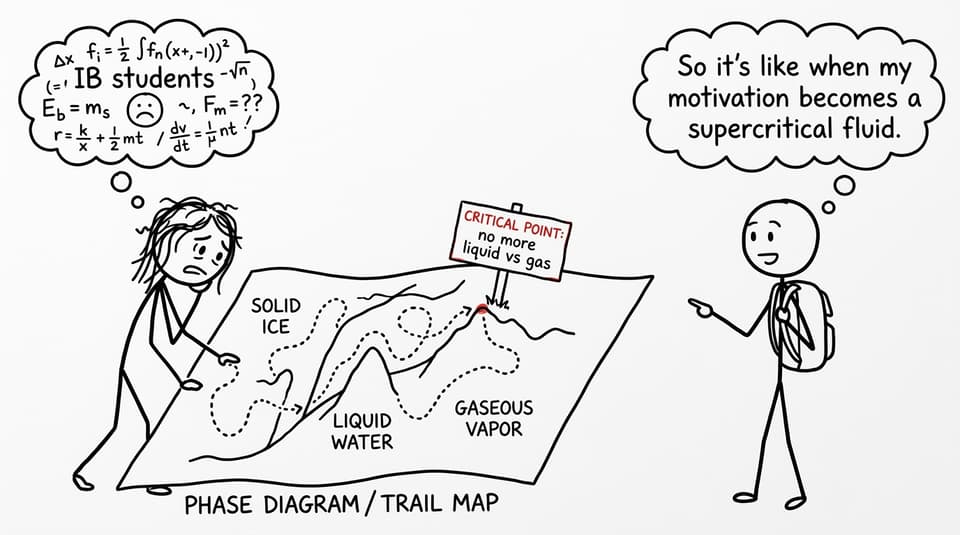
A phase diagram feels like a hiking map in exam week
Critical point in IB Chemistry (one-sentence definition)
In IB Chemistry, the critical point is the unique temperature and pressure where the liquid/gas equilibrium line ends, and liquid and gas become indistinguishable.
That “ends” part matters. The boundary doesn’t continue. It finishes.
Why the critical point exists (the particle story)
Here’s the quiet logic behind the dot.
As temperature increases, particles move faster. In IB Chemistry, that means kinetic energy rises and intermolecular attractions become less able to keep particles “together” in a liquid-like way.
At the same time, something subtle happens:
Liquids expand as temperature rises, so liquid density decreases.
Gases become denser under higher pressures near the boiling curve, so gas density increases.
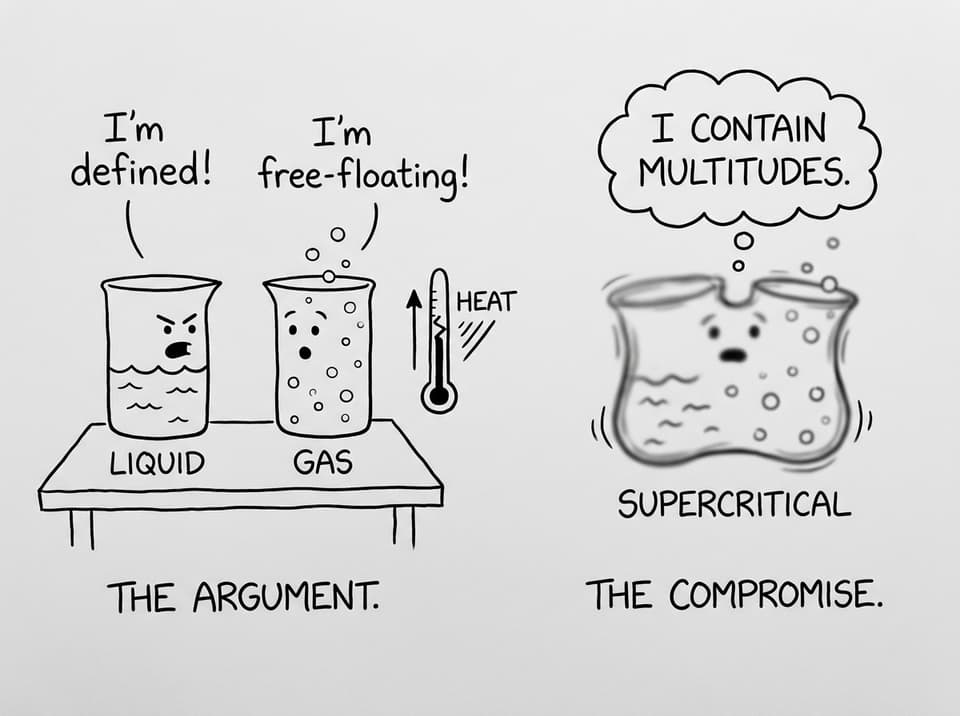
Eventually, the two densities meet. When the density difference disappears, the interface that depends on that difference disappears too. No interface means no meniscus. No meniscus means no clear line between liquid and gas.
Critical temperature vs critical pressure (don’t swap them)
In IB Chemistry, the critical point always comes as a pair:
Critical temperature (Tc)
Tc is the highest temperature at which a substance can exist as a liquid, regardless of pressure.
This is the “pressure stops saving you” idea. Above Tc, particles have too much kinetic energy for intermolecular forces to pull them into a liquid state.
Critical pressure (Pc)
Pc is the minimum pressure required to liquefy a gas at Tc.
So Pc tells you how hard you must compress at that knife-edge temperature where liquefaction is just barely possible.
A helpful link conceptually is intermolecular forces: stronger attractions generally relate to higher boiling points and influence critical constants. Review those forces in Intermolecular forces notes.
The supercritical fluid region (why it’s not “just hot gas”)
Above the critical point, the substance becomes a supercritical fluid. In IB Chemistry, you describe it as a state with mixed properties:
Liquid-like: relatively high density, good solvent power
Gas-like: diffuses quickly, can be compressed, flows easily
That hybrid behavior is exactly why industry cares. It’s also why exam questions love it: it tests whether you understand properties, not just definitions.
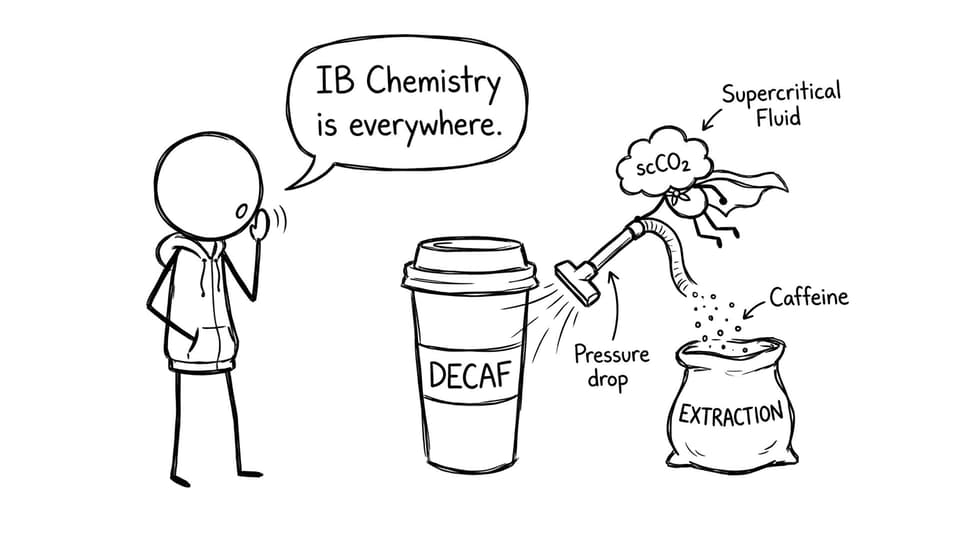
Supercritical CO2 doing a coffee "heist"
Real examples you can quote in IB Chemistry
You don’t need to memorize many numbers, but knowing typical examples makes your explanation feel grounded.
Water: Tc ≈ 374°C, Pc ≈ 218 atm
Carbon dioxide: Tc ≈ 31°C, Pc ≈ 73 atm
CO₂ is the classic classroom example because its critical temperature is relatively low, making supercritical CO₂ practical in real processes.
Common uses of supercritical fluids (high-value exam context)
In IB Chemistry, you can connect the critical point to applications quickly:
Final takeaway (and the RevisionDojo way to lock it in)
The critical point in IB Chemistry is where the liquid/gas line ends, the meniscus vanishes, and the substance becomes a supercritical fluid. Once you understand the particle story (densities converge, surface tension goes to zero), your explanations stop sounding memorized and start sounding inevitable.
If you want this to stick before exams, use RevisionDojo as your loop: clarify with Study Notes, test with the Questionbank, cement recall with Flashcards, ask “why” using AI Chat, and rehearse under pressure with Predicted Papers and Mock Exams. That’s how IB Chemistry concepts become exam reflexes, not last-minute hopes.