
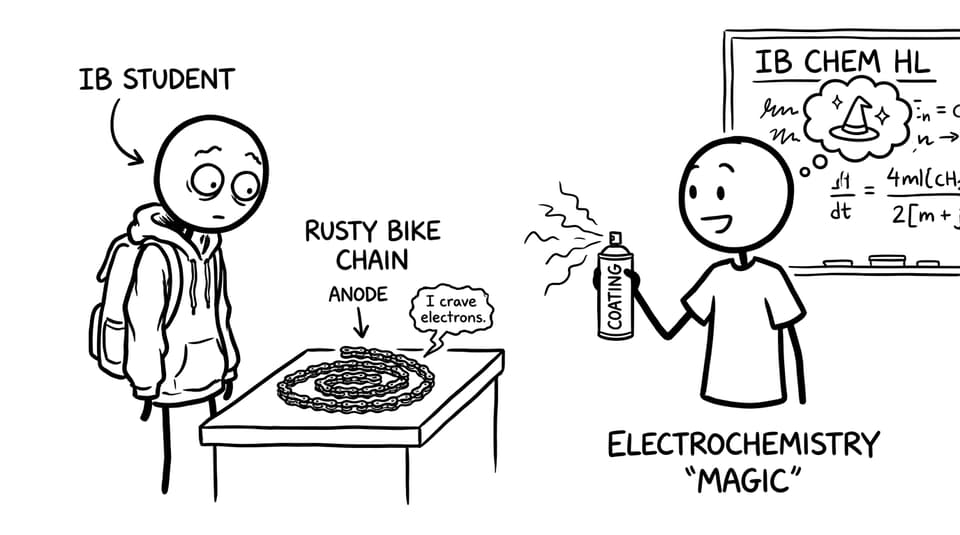
Corrosion is the kind of chemistry you can spot without trying. A bike chain turns orange. A ring goes dull. A railing near the sea flakes as if it is shedding layers of time.
In IB Chemistry, corrosion is one of those topics that feels simple until you realise it is secretly an electrochemical cell running in plain sight. The metal becomes a battery you did not ask for, and the environment provides everything it needs to keep going.
If you can explain corrosion clearly, you are not just memorising rust facts. You are showing exam-level understanding of IB Chemistry redox, half-equations, electrolytes, and why protection methods actually work.
Corrosion in IB Chemistry: the exam definition you can use
In IB Chemistry, corrosion is best described as the gradual deterioration of a metal due to redox reactions with its environment, usually involving oxidation of the metal.
A tight checklist to remember:
-
The metal is oxidised (it loses electrons).
-
Something else is reduced (often oxygen in neutral conditions, or H⁺ in acidic conditions).
-
Water helps ions move, so corrosion often speeds up when surfaces are moist.
-
The process forms new surface compounds (oxides, hydroxides, carbonates) that may or may not be protective.
For a fast redox refresher before you tackle corrosion questions, use Redox Reactions Explained for IB Chemistry and Oxidation and Reduction Explained for IB Chemistry.
Rusting: the classic corrosion case study for IB Chemistry
Rusting is corrosion specific to iron (and steel). In IB Chemistry, it matters because it is an applied example of redox happening at different sites on the same metal surface.
Rusting typically needs:
-
O₂
-
H₂O
-
An electrolyte (like dissolved NaCl) to increase conductivity and speed things up
The half-equations you should know
At anodic regions (oxidation):
Fe(s) → Fe²⁺(aq) + 2e⁻
At cathodic regions (reduction in neutral conditions):
O₂(g) + 2H₂O(l) + 4e⁻ → 4OH⁻(aq)
Then Fe²⁺ and OH⁻ form hydroxides that are further oxidised and hydrated into hydrated iron(III) oxide, often written Fe₂O₃·xH₂O.
Key IB Chemistry point: rust is porous and flaky, so it does not seal the surface. Oxygen and water keep reaching fresh iron underneath, so corrosion continues.
If half-equations are where you lose marks, practise them using R3.2.2 Redox half-equations and the linked R3.2.2 Questionbank. That combination (Study Notes + Questionbank + instant feedback) is exactly how RevisionDojo helps you turn understanding into exam performance.
Why corrosion is basically an unwanted electrochemical cell
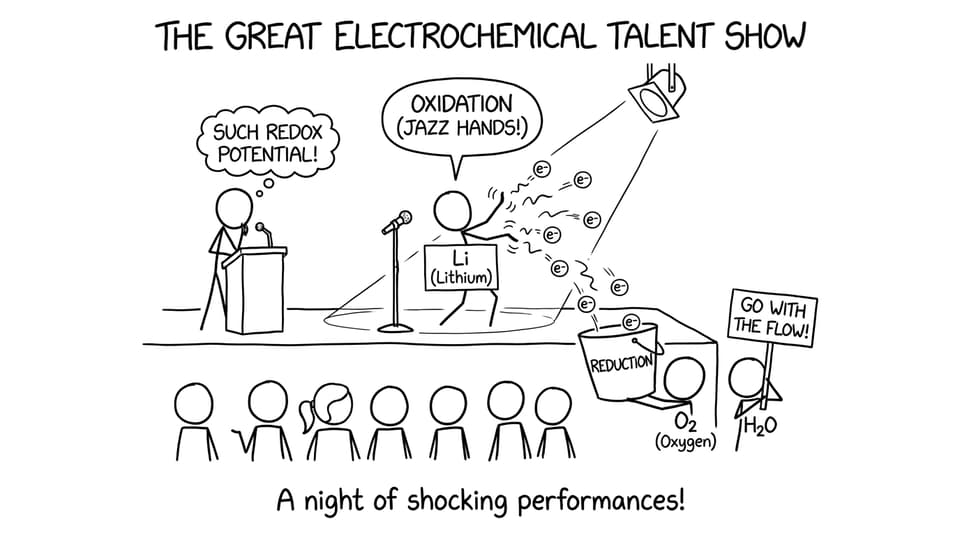
This is the story examiners love: in IB Chemistry, corrosion behaves like a tiny galvanic cell spread across a metal surface.
-
Some spots act as anodes where oxidation happens.
-
Other spots act as cathodes where reduction happens.
-
Electrons travel through the metal from anode to cathode.
-
Ions travel through the thin film of water on the surface.
That is why moisture matters so much. Dry air slows the ion movement. A wet surface turns the whole situation into a better circuit.
To connect corrosion to the wider electrochem chapter, see R3.2.5 Electrochemical cells: Oxidation and reduction Notes and Standard Electrode Potential Explained.
What speeds corrosion up (and how to phrase it in IB Chemistry)
Electrolytes (especially salt)
Dissolved ions increase conductivity, so charge can move more easily between anodic and cathodic regions. In IB Chemistry wording: electrolytes increase the rate by improving ion transport.
Acidity (low pH)
More H⁺ can create alternative cathodic reduction reactions in acidic environments, increasing overall corrosion rate.
Oxygen availability
More oxygen supports faster reduction at cathodic sites.
Temperature
Higher temperature increases reaction rates, so corrosion is faster in warm, humid conditions.
Impurities and stress in the metal
Different compositions or stressed regions can set up more micro-cells, increasing corrosion.
Why some metals seem “immune” in IB Chemistry questions
Protective oxide layers (passivation)
Aluminium forms a tough Al₂O₃ layer that clings well and blocks further attack. This is protective corrosion.
Noble metals
Gold and platinum resist oxidation because they are difficult to oxidise (linked to their electrode potentials).
Alloys
Stainless steel contains chromium, which forms a protective oxide layer. It can still corrode, but much more slowly.
Preventing corrosion: methods tied to redox logic
In IB Chemistry, protection methods make sense when you say what they do to the redox system.
-
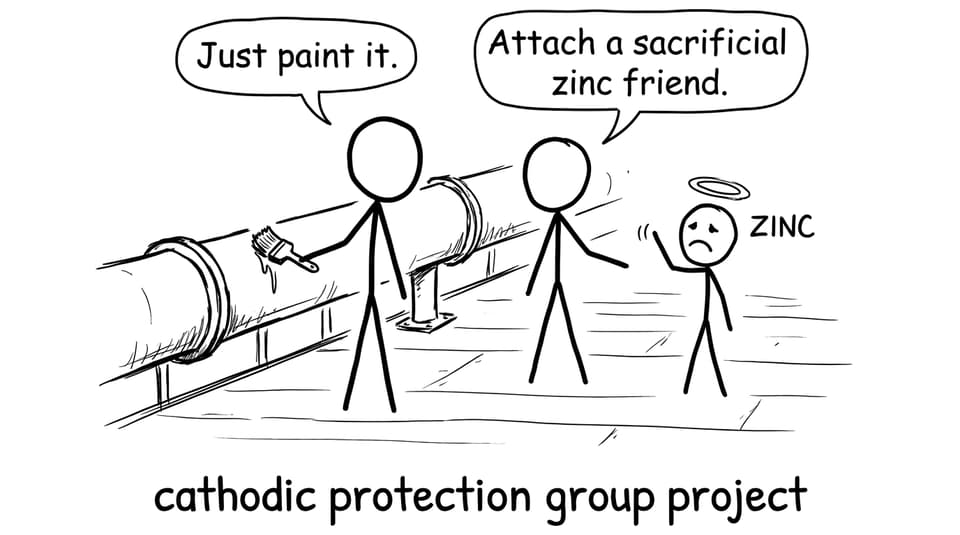
Painting/coating: blocks water and oxygen, so the cell cannot run.
-
Galvanising (zinc coating): zinc oxidises preferentially (sacrificial protection).
-
Cathodic protection: attach a more reactive metal so it becomes the anode instead.
-
Alloying: changes reactivity and/or forms protective surface layers.
-
Inhibitors: chemicals that slow oxidation or strengthen protective films.
Want exam-style practice on electrochemical applications? Use Electrochemical cells (HL) Questionbank.
Conclusion: turn corrosion into easy IB Chemistry marks
Corrosion is not random damage. In IB Chemistry, it is a predictable redox process where a metal is oxidised and a species in the environment is reduced, often across microscopic anode and cathode regions. Once you see rusting as an electrochemical cell, factors like salt, acidity, oxygen, and temperature become logical, not list-memorisation.
To lock this in before exams, build a short routine on RevisionDojo: read the Study Notes, drill the Questionbank, reinforce with Flashcards, then use AI Chat to check your half-equations and explanations. Add Grading tools for written responses, and when you are close to exam season, use Predicted Papers and Mock Exams to practise timing. That is how IB Chemistry stops feeling like separate chapters and starts feeling like one connected story you can explain under pressure.