


Staging a play text can feel like you’re holding a match near a pile of fireworks. One choice can light up the room. Another can fizzle out before it reaches the audience.
In IB Theatre, the frustrating part is that students often work hard and still lose marks for predictable reasons: choices that look busy but mean little, research that never reaches the stage, or reflections that say what happened without proving why it mattered. If you’re preparing for exams and coursework, fixing these patterns is one of the fastest ways to level up.
This guide breaks down the most common staging mistakes in IB Theatre and shows you exactly how to fix them so your performance choices and written analysis finally point in the same direction.
A quick staging checklist you can use today
Before rehearsal, run this short IB Theatre checklist:
-
Can you state your central intention for the scene in one sentence?
-
Does every design choice earn its place (set, props, costume, lighting, sound)?
-
Can you name the practitioner, style, or world theatre influence behind at least two choices?
-
Do your blocking and proxemics show relationships changing, not just people moving?
-
Do you have a reflection plan (what you will test, what feedback you will collect, what you will evaluate)?
If you want a more complete workflow, keep How to Approach Staging Play Texts in IB Theatre Coursework open while you plan.
Common IB Theatre staging mistakes (and how to fix them)
Treating the script like a museum artifact
The mistake: You stage the play “correctly” by following stage directions literally, but you never reveal an interpretation. The result is competent, but examiner-unfriendly: it’s hard to see what you’re saying.
How to fix it: In IB Theatre, clarity comes from an argument. Write a one-line directorial thesis (e.g., “This scene shows love as negotiation, not comfort”). Then annotate the text for: beats, shifts in status, silence, subtext, and recurring images.
A helpful companion skill here is close reading. See How to Analyze Dialogue and Stage Directions in Plays and borrow its approach to pauses, interruptions, and power shifts.
Ignoring cultural and historical context (or treating it as trivia)
The mistake: You either forget context entirely or list facts about time and place without letting them shape performance.
How to fix it: Decide which of these you’re doing, then commit:
-
Context-respectful staging: Keep period logic (social rules, space, rhythm of speech) and show you understand the world of the play.
-
Deliberate re-contextualization: Modernize or relocate with a reason that strengthens theme.
Your examiners don’t need you to “be accurate.” They need you to be intentional. If you’re building your wider course foundation, Dive into the World of IB Theatre: An In-Depth Syllabus Overview helps you frame context as something you apply, not something you paste in.
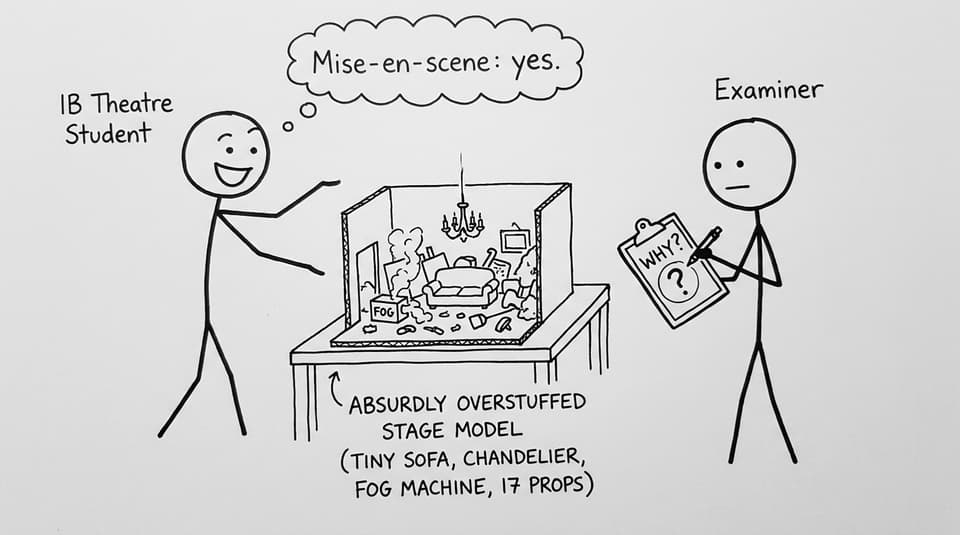
Overloading mise-en-scene until meaning disappears
The mistake: Your stage picture becomes a storage unit: too many props, too many costume ideas, too many symbols competing.
How to fix it: Reduce everything to signal and function.
-
Keep one dominant visual metaphor per scene.
-
Choose a limited palette (color, texture, light quality).
-
Make props do double duty: practical action + thematic echo.
If you want a step-by-step method, use Using Mise-en-Scène Effectively When Staging Play Texts to audit every element you place onstage.
Name-dropping practitioners instead of letting them change the work
The mistake: You mention Brecht or Stanislavski in your writing, but nothing in rehearsal looks different because of it.
How to fix it: Build a simple “practitioner-to-stage” bridge:
-
Technique: What specific convention are you using?
-
Choice: Where does it appear in your staging?
-
Effect: What should the audience notice, feel, or question?
Even if you’re not sure which influences fit, browsing All IB Theatre Posts can help you find language and examples that match your project.
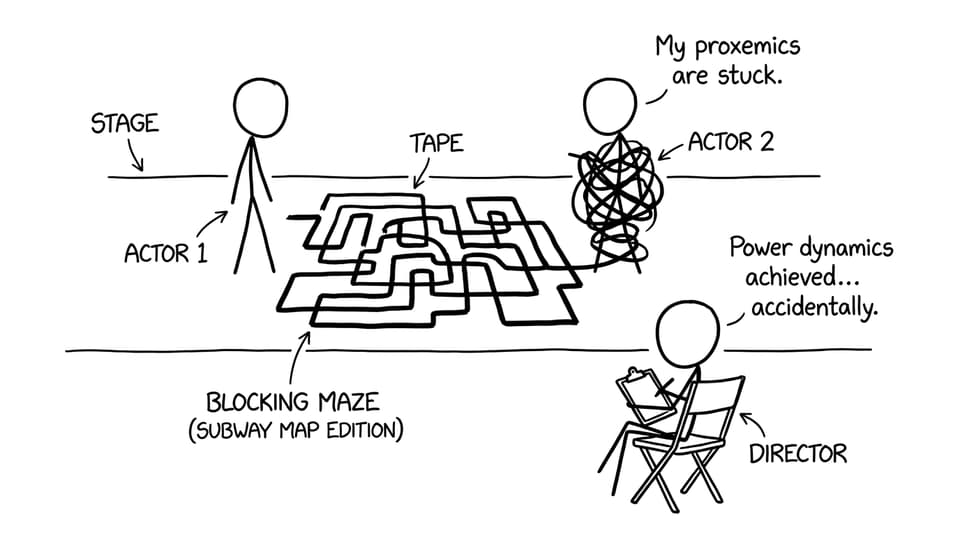
Blocking that fills space but doesn’t tell a story
The mistake: Actors wander, cross for no reason, or freeze in symmetrical patterns. The staging looks “organized,” but relationships remain flat.
How to fix it: Let proxemics do your analysis for you.
-
Use distance to show comfort vs threat.
-
Use levels to show status.
-
Use angles (facing toward/away) to show alliance and avoidance.
-
Change blocking only when the power changes.
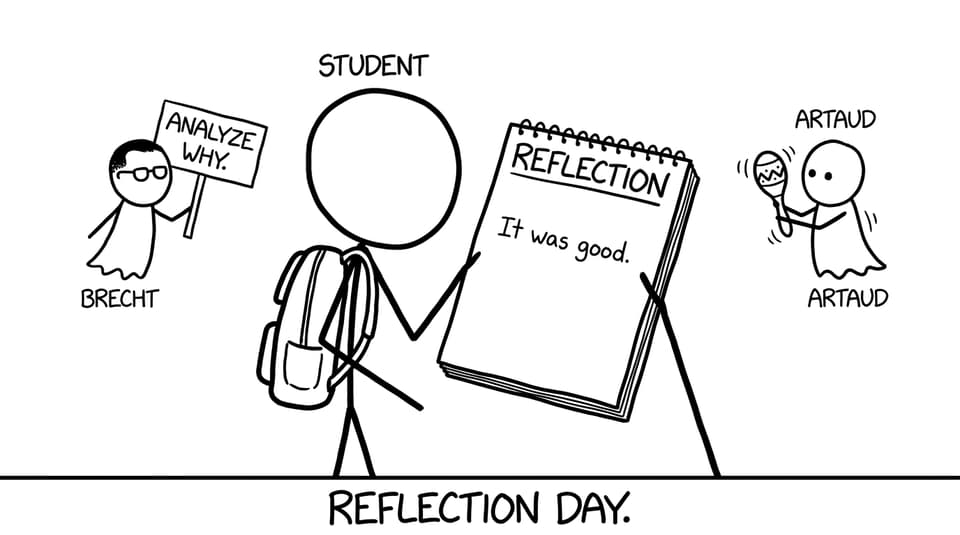
Reflection that describes, but never evaluates
The mistake: Your portfolio reads like a timeline: “We tried X, then we did Y.” It’s accurate, but it doesn’t prove learning.
How to fix it: In IB Theatre, reflection is a mini-argument. For each major choice, write:
-
Intention: What were you trying to communicate?
-
Evidence: What happened in rehearsal or feedback?
-
Evaluation: Why did it succeed or fail?
-
Next step: What you changed and what improved.
If your overall study system feels scattered, Best Study Strategies for IB Theatre Students (SL & HL) is a strong reset for balancing practical work with written clarity.
How RevisionDojo helps you fix these mistakes faster
Most staging mistakes persist because students don’t have a feedback loop. RevisionDojo gives you one.
Use Study Notes to clarify theatre vocabulary and structure your analysis, then lock ideas in with Flashcards (especially practitioner conventions and staging terminology). When you get stuck mid-process, AI Chat helps you turn “I have an idea” into “I can justify this.” If you’re writing up reflections or related coursework, RevisionDojo’s Grading tools push your evaluation beyond description. And when deadlines pile up, the Coursework Library and Tutors can keep your project grounded in clear criteria.
Closing: make your staging choices legible
The best IB Theatre staging doesn’t feel complicated. It feels inevitable, as if every light cue, gesture, prop, and pause had to be there.
Avoid the common traps: don’t treat the script too literally, don’t overload mise-en-scene, don’t name-drop practitioners without applying them, and don’t let reflection become a diary. Build a small, repeatable loop: interpret, test, gather feedback, refine, evaluate.
When you’re ready to tighten that loop, use RevisionDojo’s Questionbank-style practice mindset across your theatre work: Study Notes for clarity, Flashcards for recall, AI Chat for fast problem-solving, Grading tools for stronger reflection, Predicted Papers and Mock Exams for exam readiness, plus the Coursework Library and Tutors when you need an extra edge. That’s how your IB Theatre staging stops being “a cool idea” and becomes a high-scoring, examiner-ready process.