

A 30 in IB feels like a door closing. It isn’t.
The night you see 30 next to your IB Diploma total, your brain does something dramatic: it compresses two years of work into one number and calls it a verdict.
But university admissions rarely work like that.
Yes, the most selective programs (think the narrowest funnel at Oxbridge or certain Ivy League pathways) often expect higher totals. Yet plenty of top universities and highly respected programs admit students in the IB 30-34 range, especially when the rest of the application has clarity, evidence, and direction.
This article is your practical answer to the question: Can I still apply to top universities if I got a 30 in IB? Yes. Here’s how.
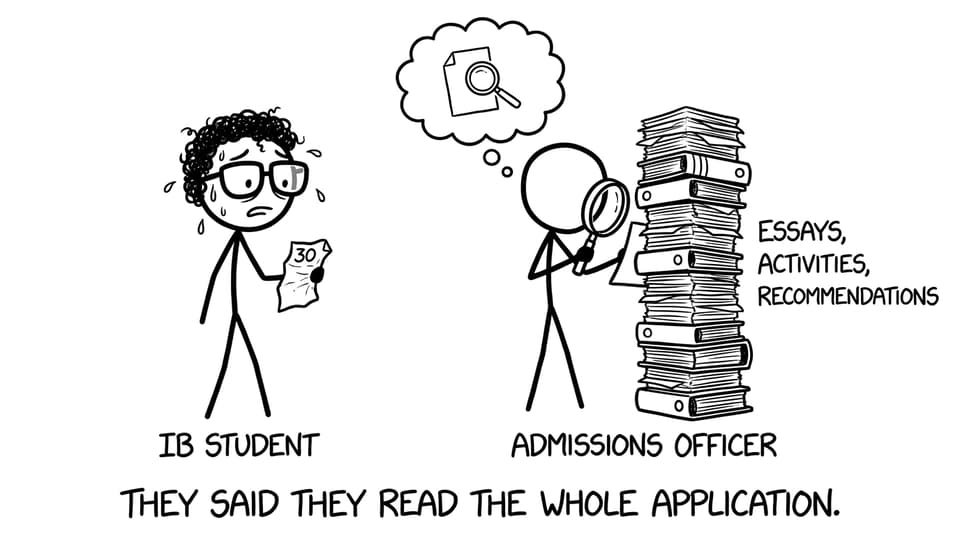
What a 30 in IB actually says (and what it doesn’t)
A 30 in IB is not a “bad score.” It’s broadly in the range of the global average, depending on the session, and it still represents successful completion of a demanding curriculum: six subjects, plus TOK, EE, and CAS.
More importantly, a 30 usually signals something specific rather than something permanent:
-
You had some strong areas and a few weak links (often one or two subjects pull the total down).
-
Your performance may have been affected by exam technique, timing, stress, or inconsistent revision, not intelligence.
-
You can still show readiness for university through subject fit, written communication, and trajectory.
Universities know that the IB is challenging. Many admissions teams are more interested in whether you can thrive in their program than whether your number looks perfect in isolation.
Quick checklist: How to compete with a 30 in IB
If you want a simple plan before we go deeper, use this:
-
Clarify what “top university” means for your course and country
-
Build a list where 30 is within range (or where there’s a pathway)
-
Highlight HL strengths and subject relevance
-
Write a personal statement/Common App essay that shows direction + proof
-
Use references and activities to add credibility
-
If applicable, explain the 30 briefly and responsibly
-
Strengthen performance now using a tight IB revision loop (practice, feedback, retest)
For the broader process and timelines across countries, keep this guide open: How to Apply to University as an IB Student: Step-by-Step Guide.
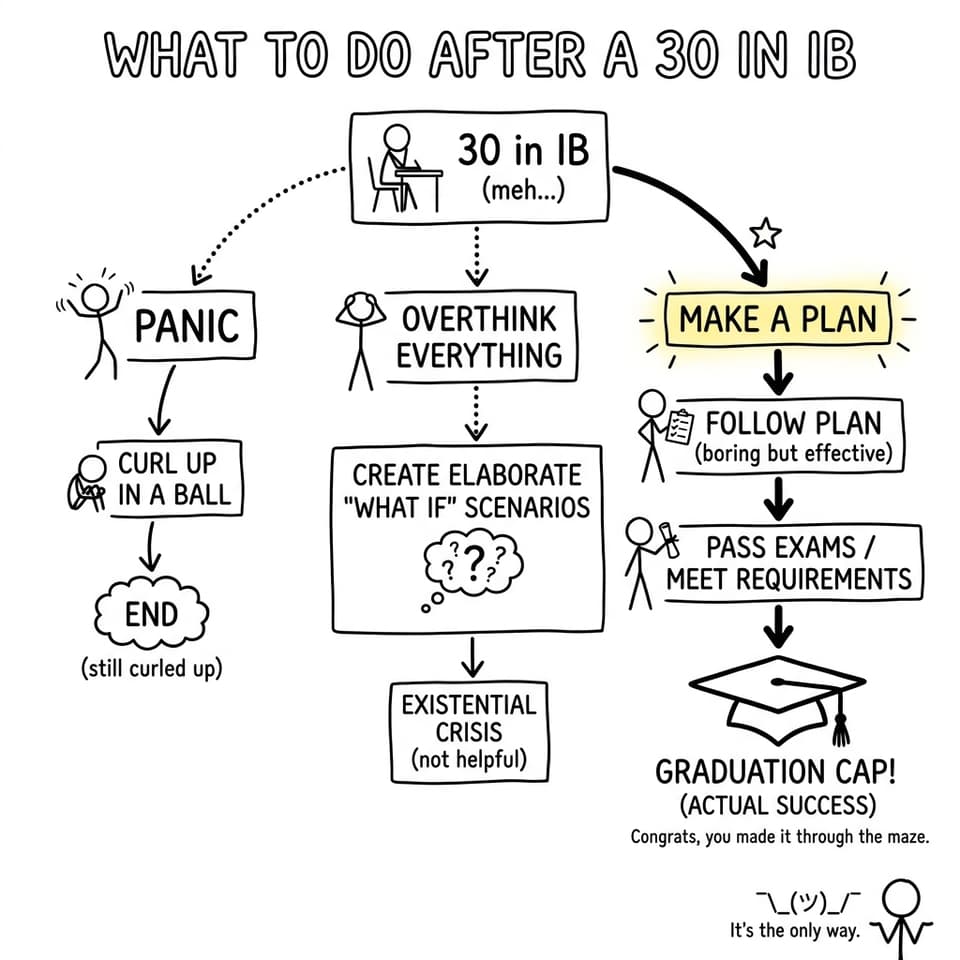
“Top universities” is not one bucket
Students often use “top university” like it’s a single category. In reality, it splits into at least three:
Globally elite, extremely high cutoff programs
Some programs are brutally numbers-driven and want very high totals. If you’re targeting those with a 30 in IB, you’ll likely need an alternative route (foundation year, transfer pathway, or a different entry point).
Highly ranked universities with flexible requirements
Many excellent universities are selective but not rigid in the same way. They may publish typical IB ranges, consider your subject profile, and weigh essays, recommendations, and fit.
Strong specialist programs
Some courses care more about what you’ve built (portfolio, interview performance, subject depth, research interest) than your total points.
The goal is not to “lower your ambition.” The goal is to define ambition accurately: course quality, outcomes, environment, and opportunities.
Where a 30 in IB can still be competitive (examples by region)
Admissions requirements change by program, so always verify with the university. But as a practical starting point, students with a 30 in IB commonly find realistic options across:
-
Canada (program-dependent at schools like UBC, Toronto, McGill)
-
UK (many Russell Group-adjacent or strong universities offer routes; foundation years can help)
-
Europe (a range of respected English-taught programs accept 28-32)
-
Asia and Australia (requirements vary widely by course and institution)
A helpful mindset shift: you’re not searching for “the best school that will take me.” You’re searching for “the best fit where I can prove I’ll thrive.” That’s a very different search.
What universities look at beyond the IB total
Especially in holistic systems (common in the US and increasingly elsewhere), the IB score is only one signal.
Here’s what can outweigh a 30:
-
Personal statement / essays that show maturity, curiosity, and direction
-
Teacher references that confirm how you work, not just what you scored
-
Extracurriculars and CAS that show initiative and sustained commitment
-
EE/TOK choices that reveal academic identity (what you care about and why)
-
Interviews or portfolios where relevant
If you haven’t read it yet, this perspective helps you see how the IB is interpreted by admissions teams: What Do Universities Think of the IB Diploma?.
How to position a 30 in IB without sounding defensive
A strong application doesn’t argue with the number. It places it in context and moves forward.
Use the “arc” approach
Admissions readers respond to trajectory:
-
What you wanted to do (interest)
-
What you did (evidence)
-
What you learned (reflection)
-
What you’re ready for now (direction)
A 30 in IB can sit inside that arc without becoming the headline.
If you need to explain the score, keep it short
Use the additional information section (or the appropriate area in your system) to explain extenuating circumstances. Be factual, not emotional. Take responsibility where appropriate. Then pivot to what changed: new study system, improved consistency, better planning.
The best explanations sound like: “Here’s what happened. Here’s what I did about it. Here’s what my recent evidence shows.”
Predicted grades, final results, and what you can still control
Many offers are made using predicted grades, then confirmed with final results. If your predicted grades were higher than 30 and something clearly disrupted performance, you can sometimes clarify that context.
But more useful is the forward-facing piece: you can still demonstrate academic readiness through current performance signals (school assessments, new writing samples, improved subject mastery, better timed practice).
If you want a calm, practical reset, this is worth reading: IB Predicted Grades Don’t Define You (Here’s What Does).
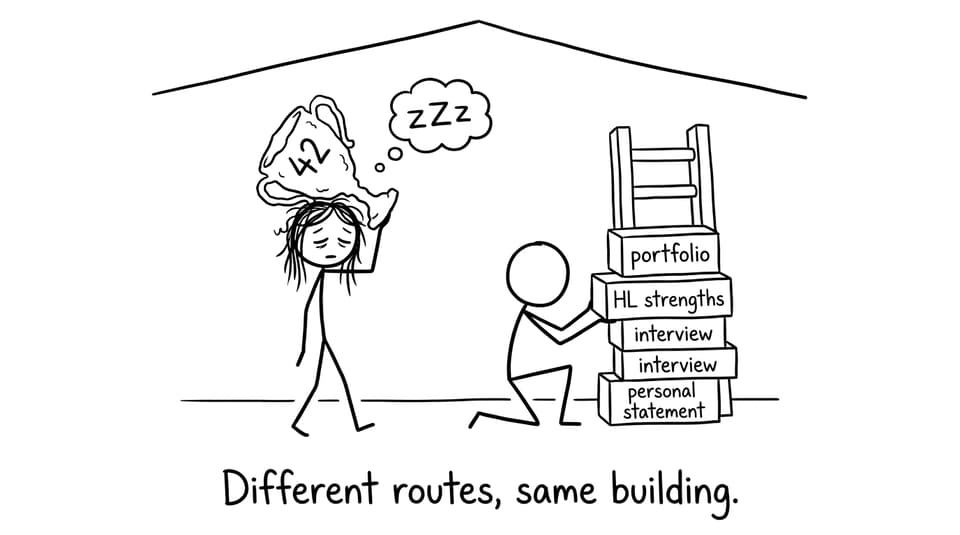
The overlooked lever: your HL profile
A 30 total can hide a powerful detail: your HL grades.
Many universities care deeply about subject fit. If your intended major aligns with your strongest HLs, highlight that:
-
Choose examples that show you can handle university-level thinking in that area
-
Use coursework (IA/EE) to prove depth
-
Show consistent effort patterns (not just one-off achievement)
This is where being an IB student can actually help you: your subject combination tells a story about breadth and depth. Use it.
A practical IB revision loop that raises outcomes (and confidence)
Even if your final 30 is already set, many readers here are current IB students preparing for exams and trying to avoid landing below their targets.
The simplest system is a tight feedback loop:
-
Learn one concept quickly with clear notes
-
Test it immediately
-
Get feedback aligned to mark schemes
-
Fix one mistake pattern
-
Retest within 48 hours
RevisionDojo is built around that loop:
-
Use the Study Notes to stop rewriting content and start understanding it
-
Drill with the free Questionbank so practice is targeted, not random
-
Use Flashcards for daily recall (small, consistent, and surprisingly powerful)
-
Ask AI Chat when you’re stuck so you don’t waste an hour on one confusion
-
Use Grading tools to see why an answer earns marks, not just whether it’s “right”
-
Rehearse with IB Predicted Papers and Mock Exams to train timing and decision-making
-
Reduce coursework stress using the Coursework Library
-
Add Tutors when you need a human to diagnose the real bottleneck
To build a full workflow, bookmark: RevisionDojo App: The Smarter Way to Prep for IB Exams.
If you want to estimate where your marks currently land, use the IB Grade Calculator to translate practice performance into realistic outcomes.

Conclusion: A 30 in IB is not the end of the story
A 30 in IB is a data point, not a definition.
If you choose programs wisely, highlight your subject strengths, and tell a clear story backed by evidence, you can still apply to top universities and land somewhere that opens real doors.
And if you’re still in the IB right now, preparing for exams, the most empowering move is simple: stop guessing and start running a feedback loop. Use RevisionDojo’s Questionbank, Study Notes, Flashcards, AI Chat, Grading tools, Predicted Papers, Mock Exams, Coursework Library, and Tutors to build the kind of consistency that turns “I hope” into “I can prove it.”
Explore your subjects and start your next study session here: RevisionDojo for IB.