


If you have ever reread a TOK paragraph and felt a strange emptiness, likelike the sentences are individually fine, but together they do not go anywhere, youyou are not alone. Most IB students do not lose marks in TOK because they lack “big ideas.” They lose marks because their thinking arrives in pieces.
Coherence in TOK is what turns pieces into a line of reasoning: a reader can trace how you moved from the prescribed title to a knowledge claim, to a real-life example, to analysis, to a counterclaim, and finally to what all of that suggests about knowledge itself.
A quick TOK coherence checklist
Use this as a pre-submit scan. If you can tick these boxes, your TOK writing will feel controlled and examiner-friendly.
-
Knowledge question focus: every paragraph clearly loops back to the prescribed title or knowledge question.
-
Claim is specific: not “Science is reliable,” but “In the natural sciences, replication increases confidence by filtering out individual bias.”
-
Example is concrete: a named study, event, artwork, or case, notnot “social media shows…”
-
TOK concept is explicit: AOKs, WOKs, perspectives, assumptions, methods, or communities of knowers are stated and used.
-
Counterclaim is a real limit: not a polite “however,” but a genuine challenge.
-
Reflection closes the loop: you weigh implications, conditions, or what “to what extent” really means.
For broader skills that feed directly into this checklist, keep TOK Thinking and Skills: How to Succeed in IB TOK nearby while you plan.
The TOK argument backbone: claim to counterclaim (and back again)
A coherent TOK argument often feels like a careful walk down a hallway with doors on both sides. You open one door (the claim), then you open a second door (the counterclaim), and only then do you decide what the hallway actually leads to.
A reliable paragraph flow looks like this:
-
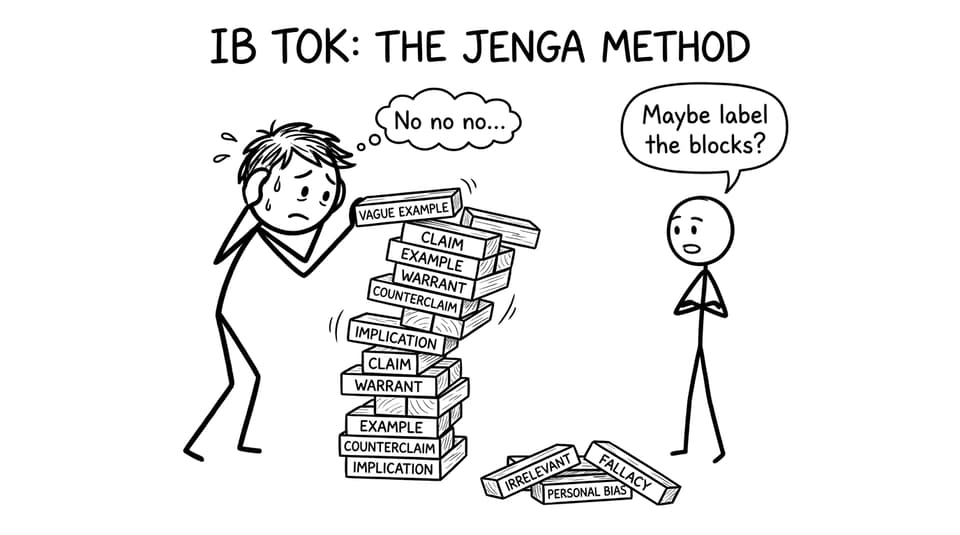
Claim: your answer to the knowledge question in one AOK
-
Example: a specific real-life situation that supports the claim
-
Warrant (TOK analysis): why that example supports the claim, using TOK vocabulary
-
Counterclaim: a limitation, alternative perspective, or exception
-
Counter-example: evidence that makes the counterclaim believable
-
Mini-conclusion: what this tension suggests about knowledge (often your “to what extent” move)
If you want a full essay-level structure that keeps this rhythm throughout, see How to Write a Good TOK Essay - A 10-Step Guide for IB Students and Structuring for Success in IB TOK Essays.
Linking the knowledge question to AOKs (so you do not drift)
TOK essays drift quietly. One minute you are answering the title, the next you are explaining a subject you like.
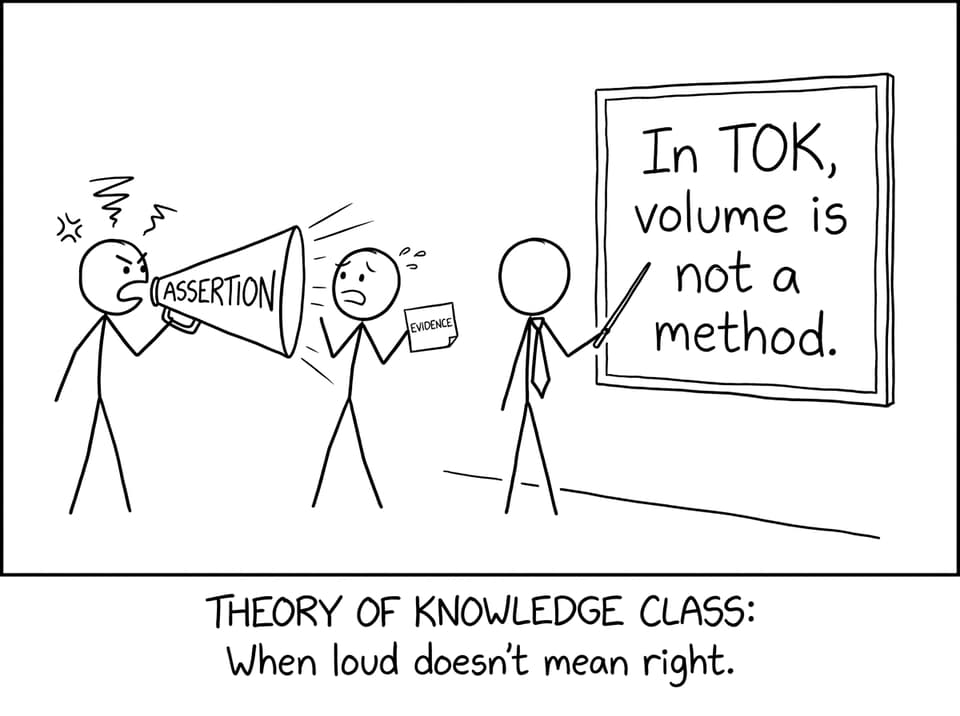
A simple coherence habit: write your knowledge question in the margin next to every body paragraph, then underline the sentence where you explicitly connect back to it. If you cannot find that sentence, the paragraph is probably not doing TOK.
Choosing AOKs becomes easier when you pick them for contrast, not comfort. Natural sciences vs history. Arts vs human sciences. Mathematics vs ethics. The point is not coverage; it is comparison.
For a fast refresher on what each AOK is for, read TOK Areas of Knowledge: A Guide to the Five AOKs. And if you are working with current titles, RevisionDojo Ultimate TOK May 2026 Essay Guide: Mastering All 6 Prompts is built to keep your focus tight.
Using real-life examples in TOK without turning them into stories
Examples do not earn credit for being interesting. They earn credit for being useful.
A high-yield TOK example has three properties:
-
It is specific enough to test: names, dates, studies, policies, artworks, or public controversies.
-
It creates an interpretive problem: ambiguity, bias, uncertainty, conflicting methods, or value judgments.
-
It forces you to analyze knowledge: how evidence is produced, validated, and trusted.
When your examples are vague, coherence breaks because the reader cannot see what exactly your claim is resting on. One practical fix is to build an “example bank” as you revise. RevisionDojo makes this easier: use Study Notes for the TOK concept, then ask AI Chat to suggest 5 example directions, and finally convert the best one into Flashcards so you can recall details under time pressure.
Want model standards? Browse IB Theory of Knowledge (TOK) Examples to see what “specific + analyzed” looks like.
The reflection move that makes TOK feel mature
Many TOK paragraphs stop right after the counterclaim, as if balance alone is the goal. But the examiner is looking for what you do with that tension.
Reflection is where you show intellectual control:
-
Under what conditions is the claim stronger?
-
What assumptions are required for it to hold?
-
What are the implications if a community of knowers accepts one method over another?
-
What does “to what extent” mean in this AOK?
This is also where RevisionDojo’s Grading tools become unusually helpful. Draft a paragraph, upload it for rubric-aligned feedback, and use the comments to target coherence: missing warrants, weak counterclaims, or reflection that never returns to the knowledge question. Pair that with the Coursework Library to compare your paragraph to high-scoring samples, and with Tutors if you want a human to stress-test your line of reasoning.
Common TOK coherence breakers (and the quick repairs)
-
Too broad claims
Repair: add an AOK, a condition, and a mechanism (“because…”). -
Examples dropped in and left there
Repair: add a warrant sentence using TOK terms (method, evidence, bias, perspective). -
Counterclaim that is just disagreement
Repair: make it a limitation (scope, reliability, ethics, authority, interpretation). -
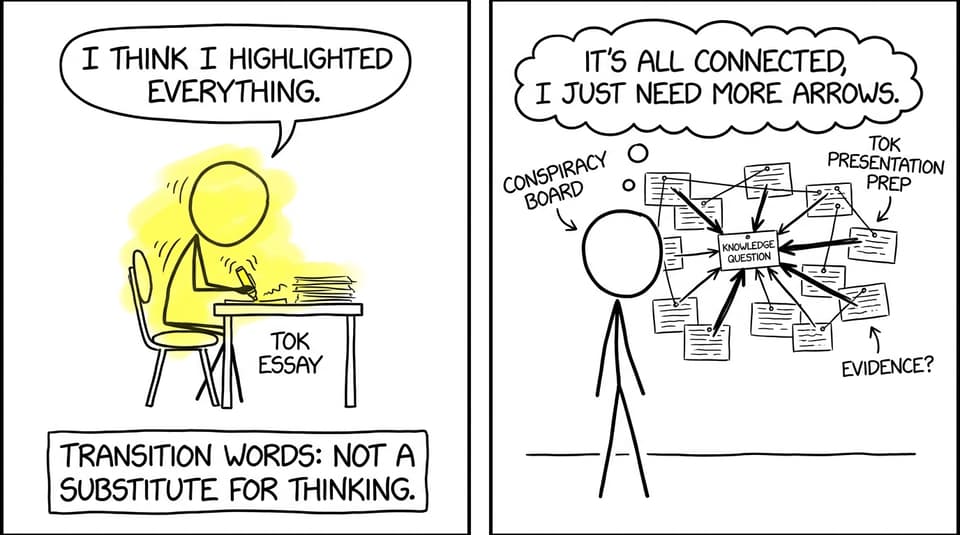
Transitions that sound smooth but do not connect ideas
Repair: write the connection explicitly: “This matters because…”
For more exam-focused polishing, use Tips for Writing a Clear and Coherent TOK Essay, How to Improve Your TOK Essay- A Student's Guide to Scoring Higher, and, when time is tight, Last-Minute Tips for the TOK May 2026 Essay.
Bringing it all together (and building it faster)
Coherence in TOK is not about sounding sophisticated. It is about making your reasoning traceable: knowledge question to claim, claim to example, example to analysis, analysis to counterclaim, and then back to a reflective answer.
If you want one place to practice that loop, RevisionDojo can be your TOK home base: sharpen concepts with Study Notes, memorize key vocabulary with Flashcards, test argument moves with the Questionbank, ask for quick clarity in AI Chat, pressure-test drafts with Grading tools, learn patterns from the Coursework Library, and get unstuck with Tutors. Start with the Theory of Knowledge (TOK) hub, then pick one paragraph today and rebuild it for coherence, youryour future self will feel the difference when TOK starts to flow.