
In IB Chemistry, there’s a specific kind of panic that shows up right before you flip the page and see an energetics question. Not the loud kind. The quiet kind. The one that says: I know this… but why does it feel like the numbers are judging me?
Bond enthalpy is one of those topics that looks like pure data booklet arithmetic, yet it’s secretly a story about stability. Reactions happen because systems can trade one set of bonds for another and end up lower (or higher) in energy. Once you see bond enthalpy as a “budget” for breaking and forming bonds, IB Chemistry energetics becomes much easier to reason through under exam pressure.
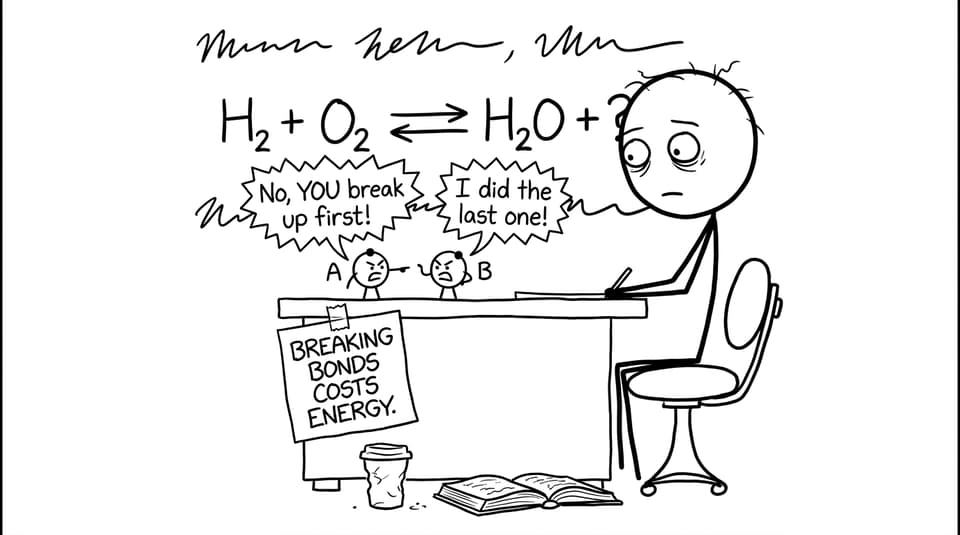
Bond enthalpy in IB Chemistry: the definition you must know
Bond enthalpy (also called bond dissociation enthalpy or bond energy) is defined in IB Chemistry as:
The energy required to break one mole of a specific covalent bond in the gaseous state.
A few exam-critical implications:
-
Bond breaking is always endothermic (energy in, so ΔH is positive for that step).
-
Units are kJ mol⁻¹.
-
The definition assumes gaseous molecules to avoid extra complications like intermolecular forces.
-
Higher bond enthalpy generally means a stronger, shorter bond.
If you want the syllabus-aligned wording and examples in one place, keep this open while you revise: Bond enthalpy study notes (R1.2.1).
A quick bond enthalpy checklist for IB Chemistry questions
Use this mini-checklist whenever a bond enthalpy calculation appears in IB Chemistry:
-
Are all species treated as gas phase for the method?
-
Have you listed every bond broken in reactants?
-
Have you listed every bond formed in products?
-
Did you apply the sign logic correctly using:
ΔH = Σ(bonds broken) − Σ(bonds formed)
-
Did you use the data booklet average bond enthalpies (not values from memory)?
For quick access to the tables you’re actually allowed to use, bookmark: IB Chemistry data booklet (RevisionDojo).
Why breaking bonds is endothermic (and why this matters in IB Chemistry)
It’s tempting to memorize “breaking bonds is endothermic” and move on. But IB Chemistry questions reward the reason.
A covalent bond is a lower-energy arrangement than two separate atoms. When atoms share electron density, the electrostatic attractions (nuclei to shared electrons) pull the system into a more stable state. To separate them, you must supply energy to climb back out of that stability.
That is why:
-
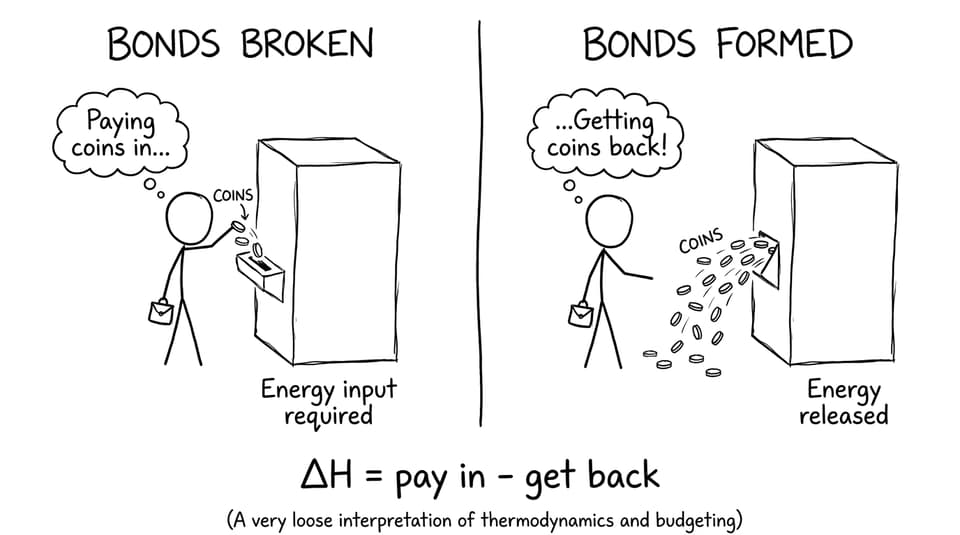
Bond breaking absorbs energy (endothermic).
-
Bond formation releases energy (exothermic).
If you want a clean conceptual explanation you can paraphrase in extended responses, read: Why does breaking chemical bonds require energy?
Average bond enthalpy: why your IB Chemistry answers are “close enough”
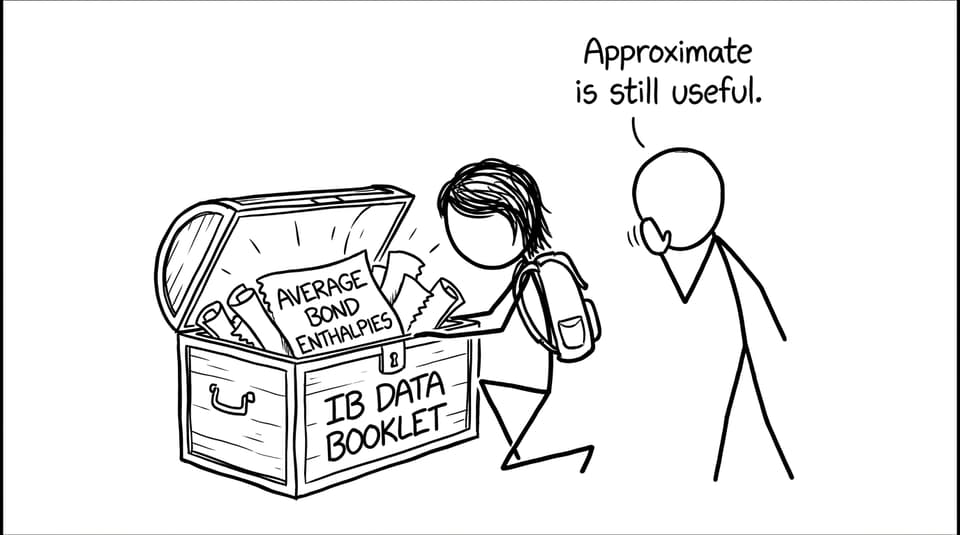
In real molecules, the same “type” of bond can have slightly different strengths depending on its environment. An O-H bond in water is not identical to an O-H bond in an alcohol. So IB Chemistry uses average bond enthalpies:
-
They are averages taken across many compounds.
-
They are good for estimating reaction enthalpy changes.
-
They explain why your computed ΔH may not match a value from calorimetry or formation data.
This is also why practice matters. The math is straightforward, but the interpretation (and the approximation) is where students lose marks. You can drill this skill with Energy cycles in reactions questionbank (R1.2) and get fast feedback.
How to calculate ΔH using bond enthalpies in IB Chemistry
Here’s the method written the way your brain can follow when it’s tired:
Bonds broken (reactants)
-
Draw the reactants.
-
Count each bond you must break to turn reactants into separate atoms.
-
Add their bond enthalpies.
Bonds formed (products)
-
Draw the products.
-
Count each new bond formed.
-
Add those bond enthalpies.
Combine using the IB Chemistry formula
ΔH = Σ(bonds broken) − Σ(bonds formed)
If your result is:
-
Negative: overall exothermic.
-
Positive: overall endothermic.
For a quick refresher on the sign and meaning of ΔH across energetics, see: Enthalpy change explained for IB Chemistry.
Worked IB Chemistry example: H₂ + Cl₂ → 2HCl
Reaction:
H₂ + Cl₂ → 2HCl
Bond enthalpies (kJ mol⁻¹):
-
H-H = 436
-
Cl-Cl = 242
-
H-Cl = 431
Bonds broken
-
1 × (H-H) = 436
-
1 × (Cl-Cl) = 242
Total broken = 436 + 242 = 678 kJ mol⁻¹
Bonds formed
- 2 × (H-Cl) = 2(431) = 862 kJ mol⁻¹
Enthalpy change
ΔH = 678 − 862 = −184 kJ mol⁻¹
So the reaction is exothermic.
To lock this into muscle memory, use RevisionDojo’s Flashcards for R1.2 (short, definition-heavy topics stick better with spaced repetition): Reactivity 1 flashcards.
What affects bond enthalpy (the patterns IB Chemistry loves)
In IB Chemistry, you’ll often be asked to compare bonds qualitatively. The usual drivers:
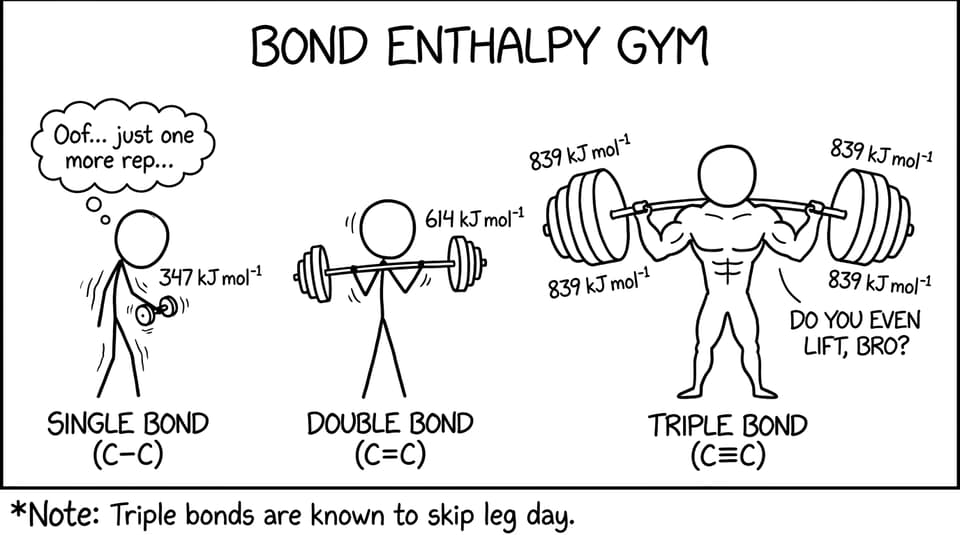
Bond order
Triple > double > single (generally stronger and higher bond enthalpy).
Bond length
Shorter bonds tend to be stronger and have higher bond enthalpy.
Polarity and electronegativity
Greater electronegativity differences can change electron density distribution and influence bond strength.
Molecular environment
Delocalization and resonance can shift bond character, making “average bond enthalpy” a blunt tool in some contexts.
Limitations of bond enthalpy calculations in IB Chemistry
Bond enthalpy is powerful, but it has boundaries:
-
Values are averages, so results are approximate.
-
It’s built for gas-phase covalent bonds.
-
It’s less reliable when strong delocalization changes bond character.
-
It won’t replace lattice enthalpy methods for ionic solids (different tool, different model).
For the broader topic context and related energetics skills, study through: R1.1 Measuring enthalpy change and then test yourself with the R1.1 questionbank.
Bring bond enthalpy practice into your IB Chemistry routine
Bond enthalpy is one of the fastest ways to turn structure into energy reasoning in IB Chemistry. It trains you to see reactions as swaps of connections: pay energy to break, get energy back when forming, and keep the difference.
If you want this to feel automatic before exams, RevisionDojo is built for it: use the Study Notes to learn the method, Flashcards to lock definitions, the Questionbank to practice under time pressure, and AI Chat to clarify any step you can’t explain yet. Then level up with Predicted Papers and Mock Exams that simulate the real exam experience, plus Grading tools to spot patterns in your mistakes. Start here: IB Chemistry resources hub and move from understanding to consistency, the skill that actually scores marks in IB Chemistry.