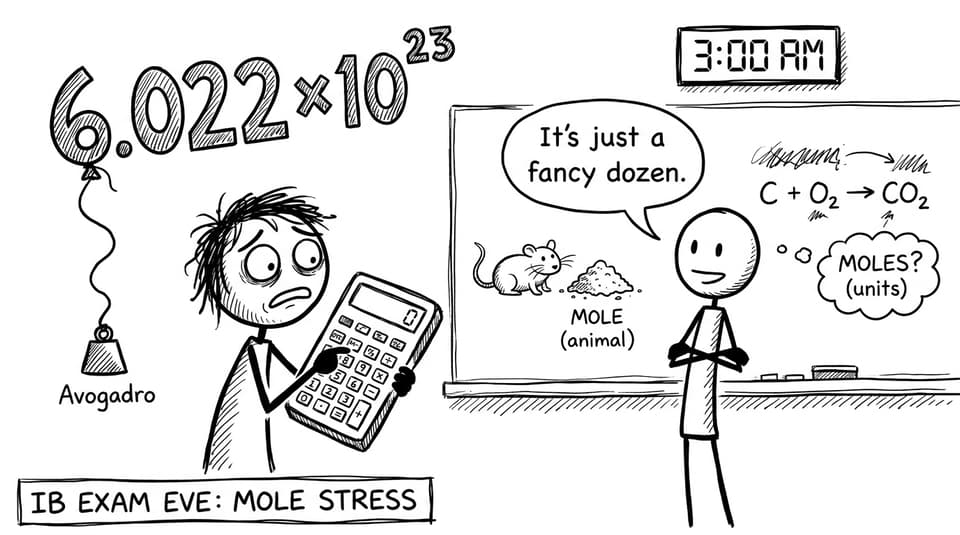
If you have ever stared at 6.022 × 10²³ and felt like it was mocking you, you are not alone. In IB Chemistry, Avogadro’s constant shows up so often that it can start to feel less like a number and more like a recurring character in your exam storyline: always present, rarely introduced properly.
The good news is that Avogadro’s constant is not meant to be mysterious. It exists for a simple reason: chemists needed a bridge between the invisible world (atoms, molecules, ions) and the world you can actually measure (grams, volumes, concentrations). Once you see that bridge clearly, a lot of IB Chemistry calculations stop feeling like magic tricks.
Quick exam checklist for Avogadro’s constant
Keep these on a mental sticky note whenever IB Chemistry turns quantitative:
-
Avogadro’s constant: N_A = 6.02214076 × 10²³ mol⁻¹ (exact by definition).
-
It means: particles per mole.
-
“Particles” can be atoms, molecules, ions, electrons, or formula units.
-
The mole is a counting unit (like “dozen,” but enormous).
-
Two core relationships: N = n × N_A and n = N ÷ N_A.
For targeted practice on this exact syllabus point, use S1.4.1 The mole and Avogadro constant.
What Avogadro’s constant actually is (and what it is not)
In IB Chemistry, Avogadro’s constant (N_A) is defined as the number of elementary entities in one mole. Think of the mole as a label that tells you how many things you have, not what they weigh.
A dozen eggs is 12 eggs whether they are small or large. A mole is similar: 1 mol of carbon atoms contains 6.022 × 10²³ carbon atoms, and 1 mol of water molecules contains 6.022 × 10²³ water molecules.
What it is not:
-
It is not a mass.
-
It is not a volume.
-
It is not a “size” of a molecule.
It is a conversion key between counting and measuring.
If you want the definition plus rapid recall prompts, pair your study with the S1.4.1 flashcards.
Why Avogadro’s constant matters in IB Chemistry exams
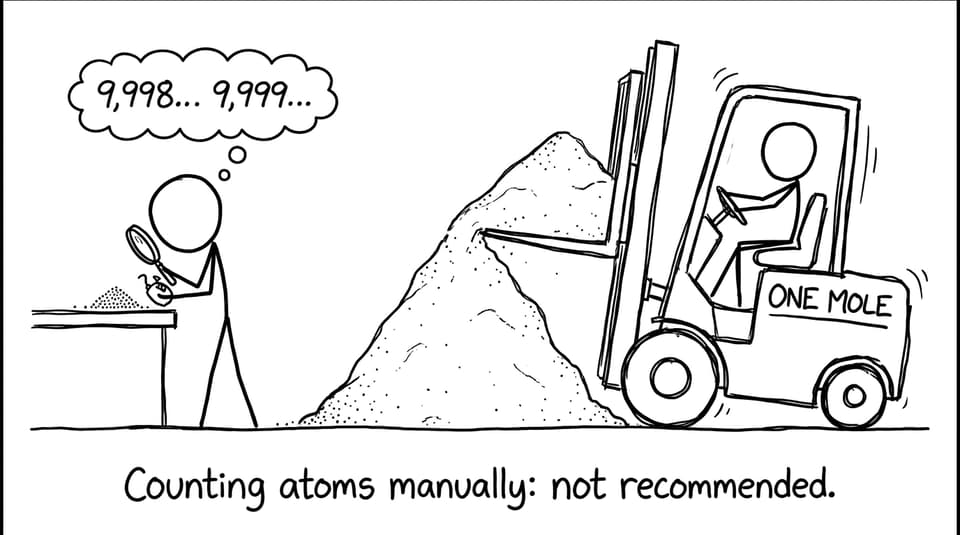
Most IB Chemistry exam pressure comes from conversions. You are rarely being tested on whether you can memorize the number 6.022 × 10²³. You are being tested on whether you can move confidently between:
-
mass (m)
-
molar mass (M)
-
amount of substance (n)
-
number of particles (N)
Avogadro’s constant is the step that turns “moles” into an actual count. That matters in stoichiometry, redox (electrons are “particles” too), gases, and solutions.
For a strong foundation across the syllabus, keep IB Chemistry Notes 2025 nearby as your overview map.
The two formulas you must be fluent with
These are the workhorses of IB Chemistry particle counting:
-
Number of particles: (N = n × N_A)
-
Amount in moles: (n = N ÷ N_A)
A quick example (typical Paper 1A logic, but also common in structured questions):
If you have 0.50 mol of water molecules, then:
The most common mistake is forgetting what you are counting. In IB Chemistry, always label the entity: atoms? molecules? ions? electrons? That single word often separates full marks from “method was right but meaning was wrong.”
Want exam-style drills with feedback? Use the S1.4.1 Questionbank.
Avogadro’s constant inside stoichiometry (where marks are won)
Stoichiometry is where IB Chemistry starts to feel like a language: coefficients become “sentences” about mole ratios.
The flow is almost always:
-
Balance the equation.
-
Convert a given quantity into moles (n).
-
Use the mole ratio.
-
Convert to what the question wants (mass, volume, concentration, or particles using N_A).
This is why Avogadro’s constant is never really isolated. It is the last step when the examiner wants you to express an answer as “how many molecules/ions/electrons,” not “how many moles.”
To practice the full chain, go to R2.1.1 Chemical equations and stoichiometry and the matching R2.1.1 Questionbank.
If limiting reagent questions are where you lose time, read Limiting Reagent Explained for IB Chemistry and notice how often the “convert to moles first” habit saves you.
Avogadro’s constant in gases (same count, different containers)
In IB Chemistry, gases are the great equalizer: the identities change, but the counting logic does not.
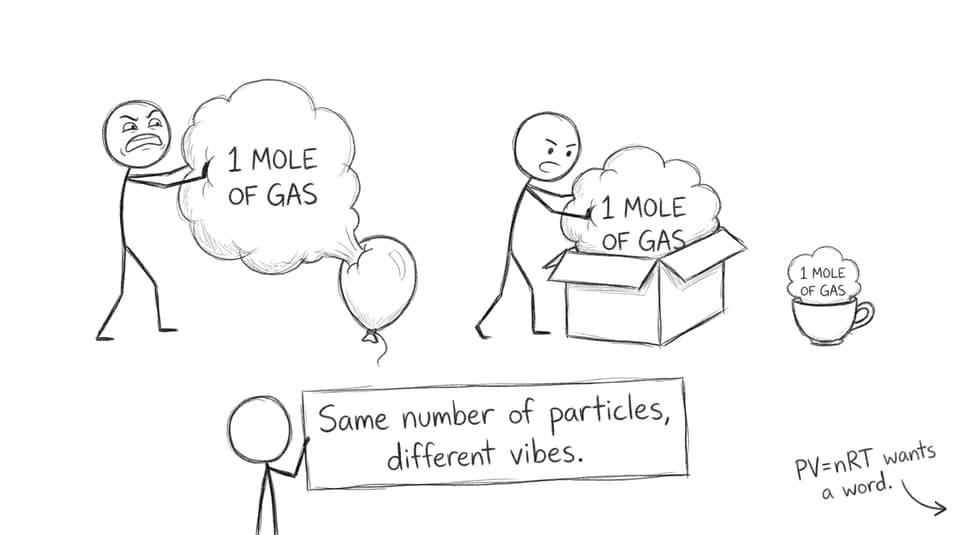
Because 1 mol of any gas contains N_A molecules, equal amounts (in moles) mean equal numbers of particles. This is why molar volume and gas-law questions feel repetitive once you see the pattern.
At STP, 1 mol of gas ≈ 22.7 dm³ (a commonly used IB value). The key idea is not the memorized volume; it is the meaning: that volume corresponds to 6.022 × 10²³ molecules.
For a cross-subject reinforcement of this same relationship, see IB Physics Gas Laws Notes.
How RevisionDojo helps you turn this into exam points
Knowing Avogadro’s constant is one thing. Performing under time pressure is another. RevisionDojo is built for the second part.
-
Use the Study Notes to lock in definitions and meaning (start with S1.4 counting particles by mass notes).
-
Use Flashcards for recall when you are tired.
-
Use the Questionbank for repetition with variety.
-
Use AI Chat when your mistake is conceptual, not arithmetic.
-
Use Grading tools to see what an examiner would credit.
-
Build Mock Exams and use Predicted Papers when you need timing practice (see IB Chemistry Predicted Papers).
-
If you are stuck for weeks, the Tutors and Coursework Library can help you fix foundations before they become permanent gaps.
Conclusion: make IB Chemistry feel measurable again
Avogadro’s constant is not just a fact to memorize in IB Chemistry. It is the reason chemistry can be calculated at all: a bridge between what you cannot see and what you can weigh, measure, and test.
If you want this topic to feel automatic under exam conditions, combine targeted practice from the mole and Avogadro constant syllabus page with RevisionDojo’s Questionbank, Flashcards, AI Chat, Mock Exams, and Predicted Papers. In IB Chemistry, confidence is usually just familiarity in disguise, and familiarity is built one well-checked question at a time.


