



The email subject line is always too short.
“Predicted grades.”
In the IB, that phrase can feel like a verdict. Not because it is final, but because it arrives right when your brain is most vulnerable to narratives: This is who I am. This is where I’m going. This is what’s possible.
But predicted IB grades are not a prophecy. They’re closer to a bank statement: a snapshot of what’s currently true, based on receipts. Universities treat them the same way. They don’t ask, “Is this student brilliant forever?” They ask, “Given this evidence, what is the most likely outcome by results day?”
This article will help you decide whether your IB predicted grades are “good” for your goals, how admissions teams read them, and what to do next if the numbers feel lower than you hoped.
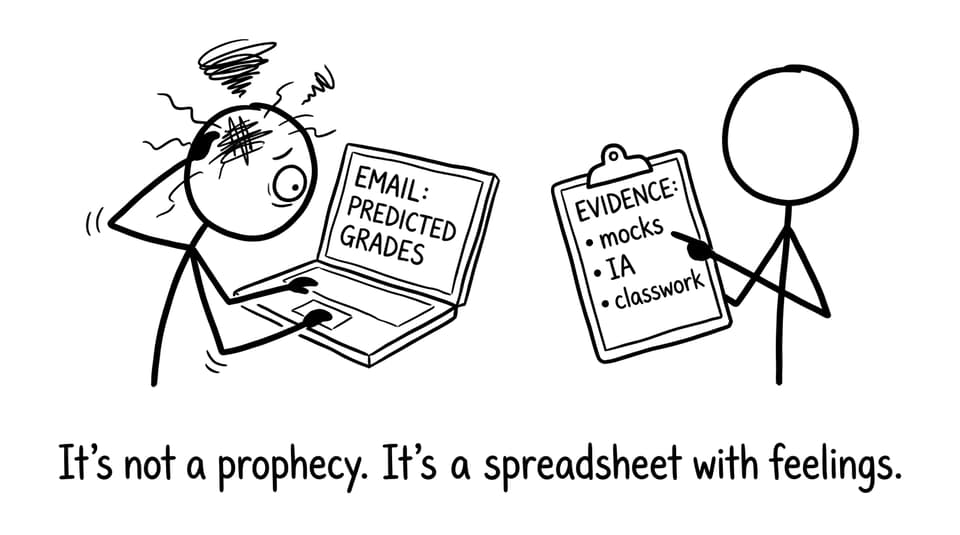
Quick checklist: how to judge your IB predicted grades
Use this quick IB checklist before you spiral:
-
Compare your total to common IB benchmarks (average and competitive ranges).
-
Check your HL profile first (universities weight it heavily).
-
Match your predicted grades to course requirements (not vibes).
-
Separate “meets minimum” from “competitive for scholarships.”
-
Identify whether your gap is one subject or many.
-
Build an evidence plan using timed practice, feedback, and repeatable routines.
If you want a fast way to convert paper scores into a realistic diploma estimate, the IB Grade Calculator can help you sanity-check targets against typical boundaries.
What predicted IB grades actually are (and what they are not)
Predicted IB grades are teacher-submitted estimates of what you’re likely to score at the end of the course, based on consistent evidence. In the IB, teachers usually lean on a mix of mock exams, in-class assessments, Internal Assessment progress, and your reliability under pressure.
They are not “random guesses,” and they’re not purely “effort grades” either. They’re a professional judgment built from the data your school has right now.
If you want a deeper breakdown of what goes into that teacher decision, read How to Interpret IB Predicted Grades and Improve Them.
What is considered a “good” predicted IB score?
A useful anchor: the global IB Diploma average is roughly 30-31 out of 45. “Good” depends on your destination and your course, but universities often interpret predicted grades relative to that benchmark and to how demanding your subject combination is.
Here’s a practical IB framework many students use:
-
38-45: exceptional profile; competitive for the most selective universities and high-demand courses.
-
34-37: strong profile; competitive for many top universities globally.
-
30-33: solid; meets entry requirements for a wide range of universities.
-
Below 30: risk zone; not hopeless, but you’ll need a smarter strategy (and often clearer evidence of improvement).
That said, an IB 36 with the “right” Higher Levels can beat an IB 39 with mismatched subjects for certain degrees. Admissions is not only arithmetic. It’s fit.
Why HL grades matter more than the total in IB admissions
If there’s one IB truth that shows up across countries, it’s this: HL performance carries the story.
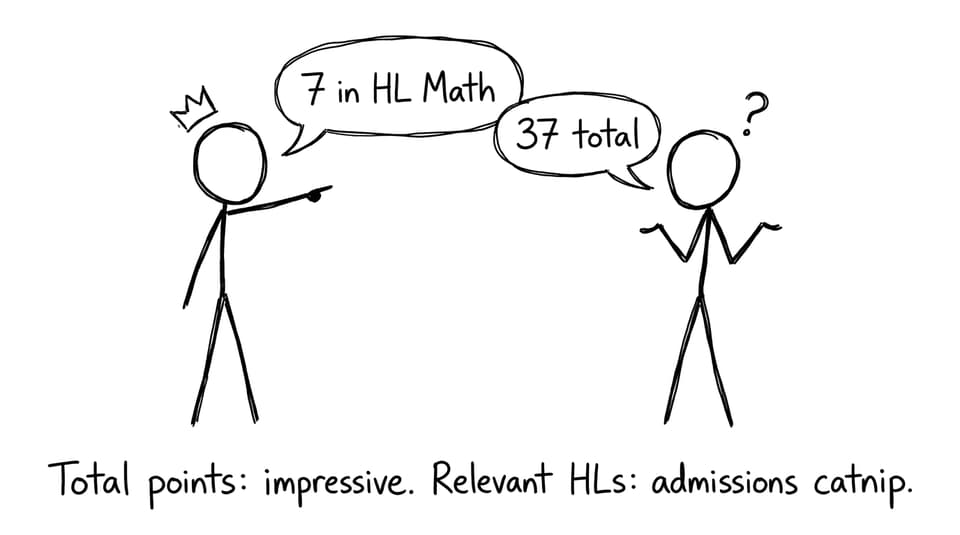
Many competitive applicants present 6s or 7s in at least two HL subjects, especially when those HLs align with the intended major (Math, sciences, economics, literature, etc.). An admissions reader doesn’t just see “points.” They see academic readiness.
Higher Level (HL): the signal universities trust
HL grades answer a very specific university question: Can this student handle first-year difficulty?
-
A 6 or 7 in a relevant HL is a strong signal.
-
A slightly lower total with excellent HLs can still look impressive.
-
Improvement trend matters: a rising HL often reads as “will peak at the right time.”
Standard Level (SL): the stability check
SL grades are still important in the IB, but universities tend to read them with more flexibility.
-
A 5+ at SL is usually fine for many programs.
-
Consistency across SL subjects reduces perceived risk.
-
Weak SL grades can matter if they create a pattern (e.g., multiple 4s).
If you’re trying to raise predicted grades (or later, your final performance), building one repeatable system matters more than heroic one-off study sessions. The workflow in RevisionDojo App: The Smarter Way to Prep for IB Exams is a good starting point.
How predicted IB grades affect university admissions (by region)
Predicted IB grades don’t matter equally everywhere. The same IB score can function like a gate in one country and like a data point in another.
UK and Canada: conditional offer logic
In the UK (and in many Canadian programs), predicted IB grades are often the foundation of a conditional offer.
You might see something like: “36 overall with 666 at HL” or “6 in HL Mathematics.” The offer is real, but it’s conditional. If your final IB results miss the conditions, your place can be reconsidered.
This is why your predicted grades feel heavy: they can determine whether you get the offer in the first place.
US and other holistic systems: readiness plus context
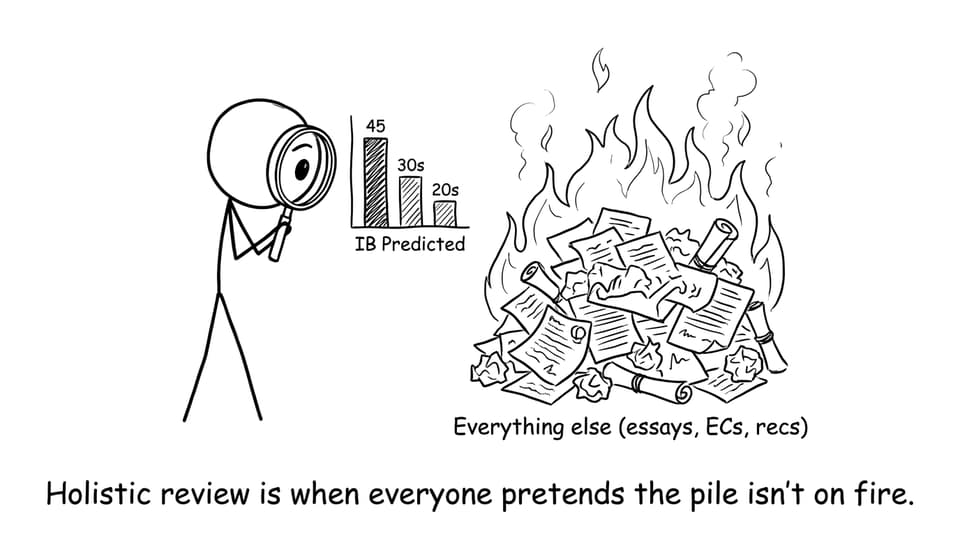
In the US, predicted IB grades can still matter a lot, especially at selective universities. But they are typically weighed alongside essays, recommendations, extracurricular depth, and your overall transcript.
Predicted grades function as a readiness signal: Will this student succeed when the workload becomes self-directed?
Scholarships and university credit: when IB predicted grades matter more than admission
Some students only think about admission. But predicted IB grades can influence:
-
Merit scholarships (often decided before final results)
-
Honors programs
-
Potential course credit for strong HL outcomes
This is where small improvements in the IB can have outsized impact. One point in an HL can shift not only where you’re admitted, but what you pay and where you start academically.
To build those small improvements, you need feedback loops. RevisionDojo’s Questionbank helps you practice exam-style questions with instant, mark-scheme-aligned feedback, and Flashcards keep recall alive when your schedule gets crowded.
What to do if your predicted IB grades feel low
First: you’re allowed to feel disappointed. But don’t negotiate with the feeling for too long. In the IB, the fastest recovery comes from turning emotion into evidence.
A practical starting point is IB Predicted Grades Missed? What to Do Next. Then move into action.
Ask for the evidence, not the sympathy
Speak to your IB coordinator or teachers and ask specific questions:
-
What evidence did you use (mocks, tests, IA progress)?
-
What would a “grade higher” performance look like?
-
What upcoming assessments could change the prediction?
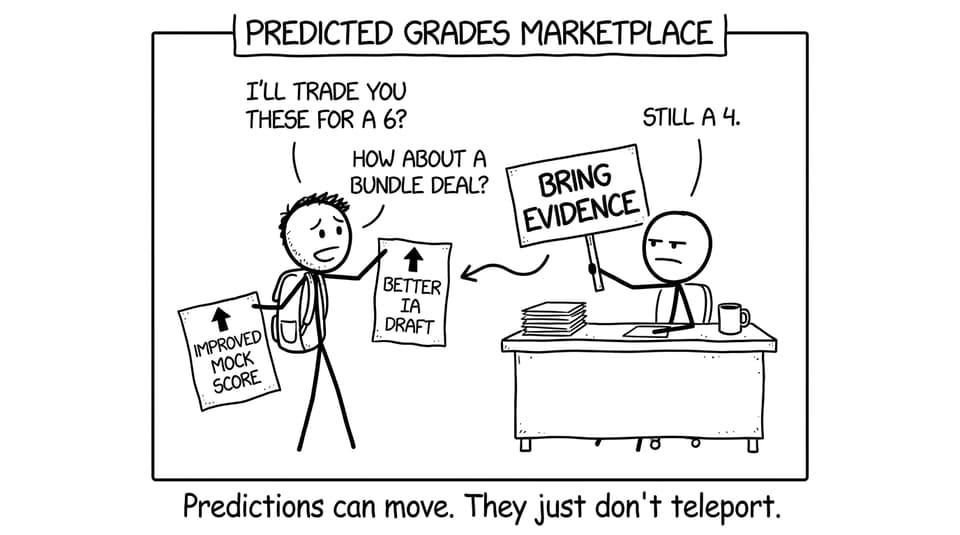
Predicted grades are rarely changed without new data, but they can be reconsidered before final submission if your school policy allows it.
Build a two-week “proof loop”
If you want movement in predicted grades, you need proof that you can reproduce a higher level.
Here’s a calm IB loop you can run using RevisionDojo:
-
Study Notes for clarity on one weak subtopic (short, syllabus-aligned).
-
Flashcards daily (10 minutes) to stop forgetting.
-
Questionbank sets (15-25 questions) to train application.
-
AI Chat to diagnose mistakes fast, not to comfort you.
-
Grading tools to see what your written answers are missing.
-
One weekly timed sit using IB Predicted Papers or Mock Exams for realism.
If you need a mindset reset that still stays practical, IB Predicted Grades Don’t Define You (Here’s What Does) is worth reading.
Closing: use predicted IB grades as a plan, not a label
The quiet truth about the IB is that your predicted grades are often less about your ceiling and more about your current system. Universities read predicted IB grades as a summary of evidence, not a statement of identity.
So if your predicted grades are good, use them to apply confidently and keep training so you meet conditions comfortably. If your predicted grades are disappointing, treat them as a map: they tell you where the evidence is thin.
Build the loop. Practice with RevisionDojo’s Study Notes, Flashcards, and Questionbank. Use AI Chat and Grading tools to learn exactly how marks are awarded. Rehearse with Predicted Papers and Mock Exams. Lean on the Coursework Library and Tutors when you need deeper feedback.
That’s how you turn an IB prediction into an outcome you can live with.