

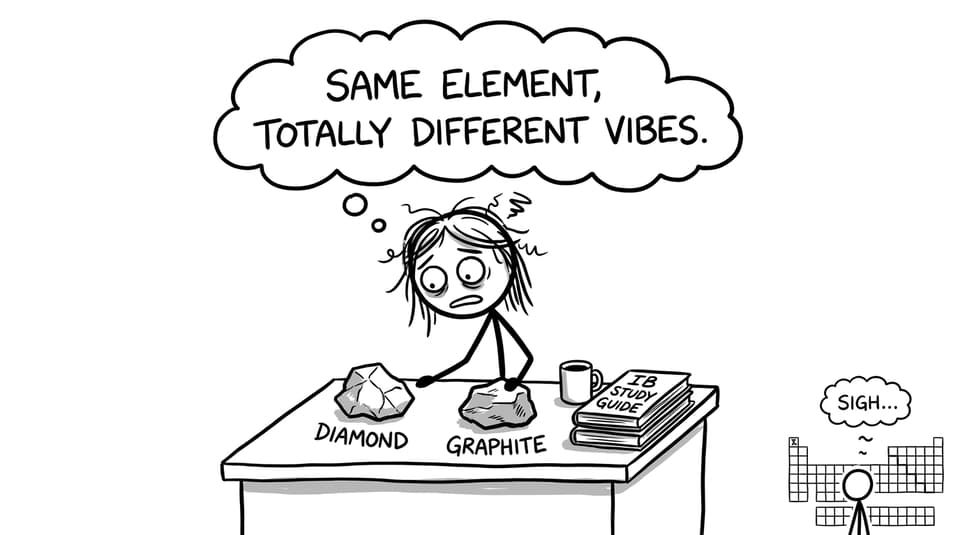
Carbon has a strange talent: it can be the hardest natural substance you can hold, and also the soft stuff that smudges across your page when you panic-write a definition.
That contrast is exactly why IB Chemistry loves carbon allotropes. Same element, same physical state, wildly different properties. If you can explain why diamond and graphite behave differently, you unlock a whole set of exam questions about bonding, structure, and conductivity.
Allotropes in IB Chemistry: the definition that earns marks
In IB Chemistry, an allotrope is a different structural form of the same element in the same physical state. The atoms are identical, but their arrangement and bonding change.
That one change ripples outward into properties examiners love to test:
-
hardness vs softness
-
electrical conductivity
-
melting point
-
density
-
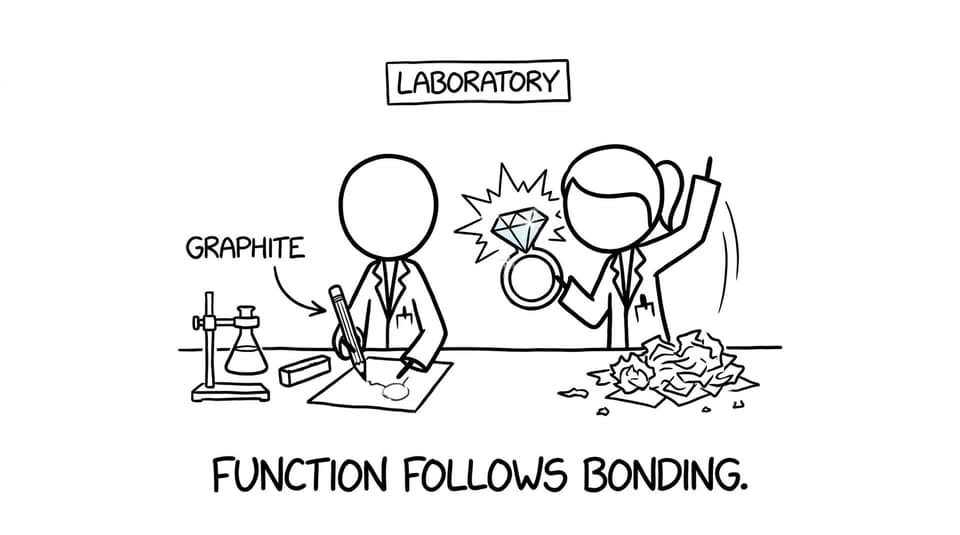
typical uses (and whether those uses make sense from bonding)
If you want the bigger bonding picture, it helps to skim Structure 2: Models of bonding and structure before drilling allotrope questions.
Quick checklist: how to compare carbon allotropes fast
When a data-based question drops “diamond” and “graphite” into the same paragraph, run this mental checklist (classic IB Chemistry marks):
-
Hybridization: sp\³ vs sp\²
-
Number of bonds per carbon: 4 vs 3
-
Shape: tetrahedral network vs trigonal planar layers
-
Delocalized electrons? none vs yes
-
Forces between layers? not applicable vs weak London dispersion forces
You can review giant covalent structures in Covalent network structures notes (S2.2.7) and then lock it in using the S2.4 questionbank practice.
Diamond allotrope (IB Chemistry): structure, properties, uses
Structure of diamond
Diamond is a giant covalent lattice. Each carbon forms four single covalent bonds in an sp\³ tetrahedral arrangement (bond angle ~109.5°). The result is a rigid 3D network.
For a bonding refresher, 4.2 Covalent bonding notes pairs nicely with diamond explanations in IB Chemistry.
Properties of diamond (and why)
-
Extremely hard: you would need to break many strong covalent bonds across the lattice.
-
Very high melting point: melting means disrupting a huge network, not separating molecules.
-
Does not conduct electricity: all valence electrons are used in sigma bonds, so there are no mobile charge carriers.
-
Transparent and lustrous: structure and bonding influence how it interacts with light.
Uses
Cutting tools, drill bits, jewelry, and high-pressure instruments. In exam answers, connect the use to the property: “hard because strong covalent network” is stronger than listing uses alone.
Graphite allotrope (IB Chemistry): structure, properties, uses
Structure of graphite
Graphite is also a giant covalent structure, but it’s built from layers. Each carbon forms three covalent bonds in sp\² hybridization, giving trigonal planar geometry (bond angle ~120°) and hexagonal rings.
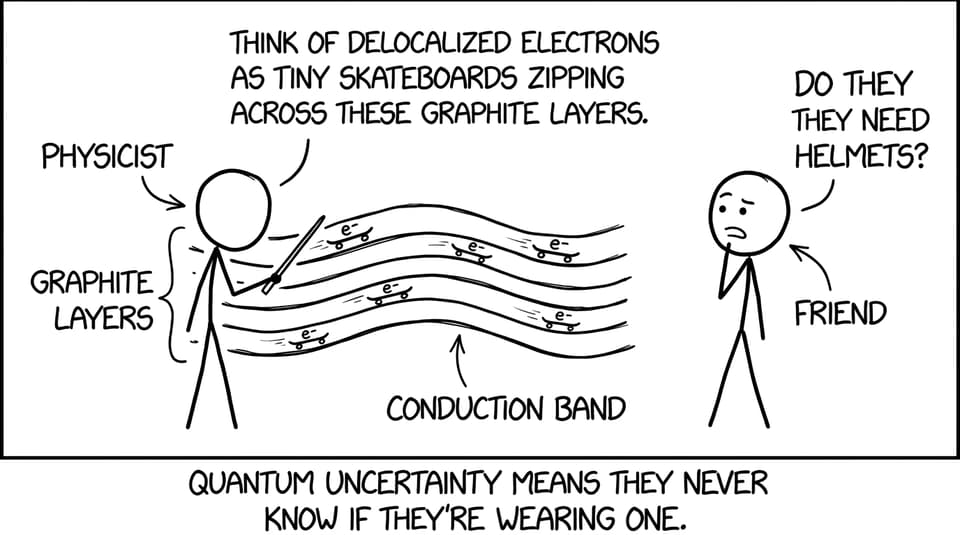
The fourth electron per carbon becomes delocalized across the layer.
Properties of graphite (and why)
-
Conducts electricity (along layers): delocalized electrons move through the sheet, making graphite a famous non-metal conductor in IB Chemistry.
-
Soft and slippery: layers are held together by weak London dispersion forces, so they slide.
-
High melting point: within each layer, the covalent bonds are still strong.
-
Black and opaque: delocalized electrons absorb light.
Uses
Pencils (“lead”), lubricants, electrodes, and conductive materials.
Why diamond and graphite differ (the exam-ready explanation)
In IB Chemistry, the best comparison answers are built from three ideas:
Hybridization and structure
-
Diamond: sp\³, 4 bonds, 3D tetrahedral lattice.
-
Graphite: sp\², 3 bonds per atom, planar layers.
Delocalized electrons
-
Diamond: none, so it is an insulator.
-
Graphite: one delocalized electron per carbon, so it is a conductor (primarily within layers).
Weak forces (graphite only)
Diamond has no layers. Graphite does, and the weak forces between them explain softness.
If you want a wider properties-by-structure framework, the MYP notes on properties of elements and compounds give a clear bridge into IB Chemistry style reasoning.
Extension allotropes worth knowing for IB Chemistry
Even if your core comparison is diamond vs graphite, HL-style prompts may mention:
-
Graphene (one layer of graphite)
-
Fullerenes (C\₆\₀)
-
Carbon nanotubes
-
Amorphous carbon (soot/charcoal)
To practice how these show up in unfamiliar contexts, use IB Chemistry resources and target weak spots with RevisionDojo’s Questionbank and Study Notes.
Closing: turn carbon allotropes into easy IB Chemistry marks
Carbon allotropes look like a small topic, but in IB Chemistry they’re a gateway question: structure leads to bonding, which leads to electrons, properties, and uses. If you can explain diamond and graphite with hybridization, delocalized electrons, and forces between layers, you can handle most “deduce the structure” prompts.
When you’re ready to convert understanding into exam performance, RevisionDojo is built for that final step: drill the Questionbank, revise with Study Notes and Flashcards, ask AI Chat to check your explanations, and tighten timing with Mock Exams, Predicted Papers, and Grading tools. If you need extra clarity, the Tutors and Coursework Library round out the support.