



In IB Chemistry, there’s a moment in every reaction that feels like a near-miss. Reactants rush toward each other, bonds strain, electrons shift, geometry twists out of comfort… and then it’s over. Either the system tips forward into products or slides back into reactants like nothing happened.
That blink-and-you-miss-it peak is the activated complex. And if you can explain it clearly, you’ll suddenly find energy profile diagrams, activation energy, and catalysts in IB Chemistry questions feeling far less mysterious.
Activated complex in IB Chemistry (exam-ready definition)
In IB Chemistry, the activated complex is the short-lived, highest-energy arrangement of atoms formed as reactants pass through the transition state on the way to products.
Keep the examiner-friendly features in your head:
-
Unstable (it cannot be isolated)
-
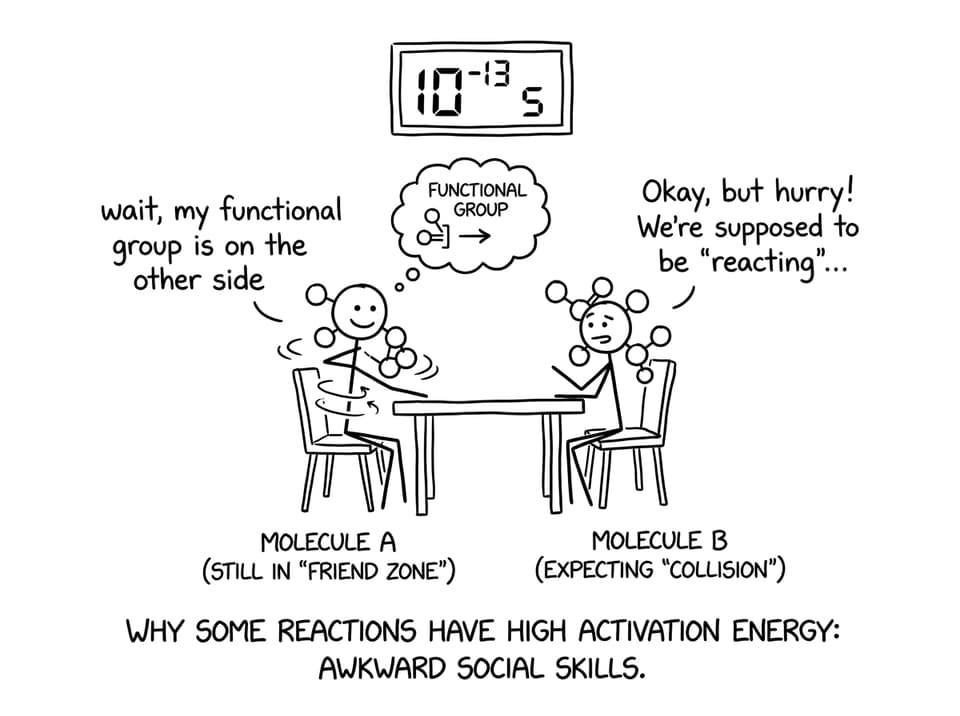
Momentary (exists for ~10⁻¹³ s or less)
-
High potential energy (it sits at the top of the barrier)
-
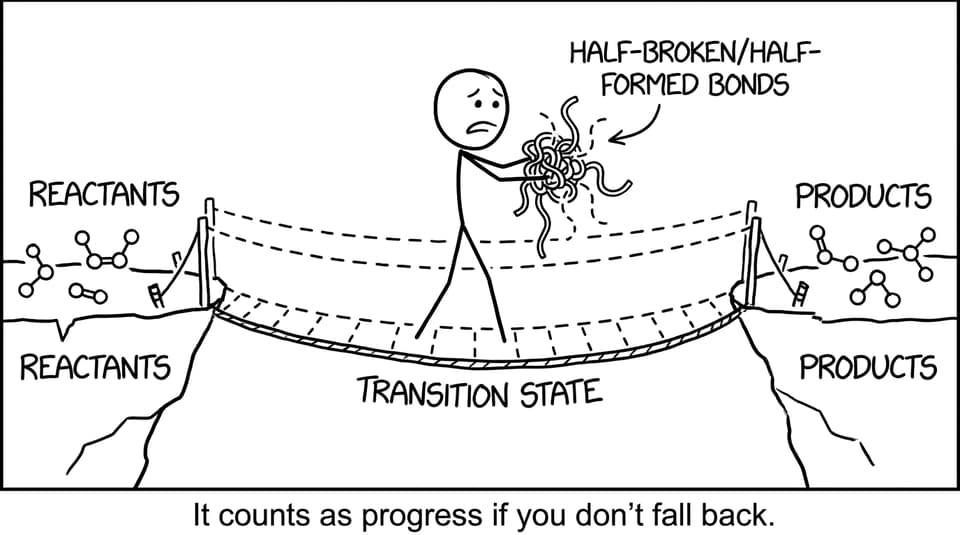
Bonds are partially broken and partially formed
-
It forms only when collisions have enough energy and correct orientation
If you want to lock in the phrasing IB expects, pair this with RevisionDojo’s IB Chemistry Key Definitions.
Quick checklist: how to spot the activated complex fast
When an IB Chemistry question shows an energy diagram or asks about reaction pathways, use this mini-checklist:
-
Find the peak on the reaction coordinate diagram
-
Label that peak as the transition state
-
Describe the structure at that peak as the activated complex
-
Define activation energy (Ea) as the energy needed to reach that peak from reactants
For activation energy phrasing and common traps, revise with Activation Energy Notes (R2.2.4).
Where the activated complex appears on an energy profile
In IB Chemistry, the activated complex sits at the highest point on a reaction coordinate diagram:
-
Reactants begin at one energy level
-
The curve climbs to a maximum
-
Products finish at another energy level
That maximum point is the transition state, and the molecular arrangement there is the activated complex.
This is exactly the skill tested in HL energy profile work (including multistep mechanisms), so it’s worth practicing with Energy Profiles and Transition States Notes (R2.2.7 HL) and the broader Energy Profiles topic page.
Why the activated complex is so high-energy
Students often memorize “it’s unstable” without saying why. In IB Chemistry, you get extra credit when the explanation mentions what’s happening to bonding and electron density.
The activated complex is high-energy because:
-
Old bonds are being stretched (bond breaking requires energy)
-
New bonds are not fully formed yet (so you don’t get the full stabilization)
-
Repulsions can increase due to awkward geometry and electron cloud distortion
-
The structure is strained and therefore energetically unfavorable
That’s why you can’t bottle it, filter it, or store it. It is not a “thing you keep” but a “moment you pass through.”
How the activated complex forms (a story you can write in Paper 2)
A clean IB-style explanation usually follows this chain:
Collisions happen, but most are ineffective
Particles collide constantly. In IB Chemistry, only a small fraction collide with both:
-
Energy ≥ Ea
-
Correct orientation
Energy goes into rearranging bonds
The energy isn’t “lost”; it is temporarily stored as:
-
bond stretching
-
weakening interactions
-
unstable electron distribution
The activated complex appears
At the top of the barrier, bonds are “halfway” between reactants and products. This is the activated complex at the transition state.
It collapses forward or backward
From the activated complex:
-
if the system continues, you form products
-
if it doesn’t, you revert to reactants
To drill these explanations under time pressure, use RevisionDojo’s Activation Energy Questionbank and then reinforce definitions with Activation Energy Flashcards.
Activated complex vs transition state (what IB Chemistry actually means)
In IB Chemistry, the terms are often used interchangeably, but there’s a useful distinction:
-
Transition state = the point of maximum potential energy on the diagram
-
Activated complex = the arrangement of atoms at that exact point
So when you’re labeling diagrams, you can label the peak “transition state.” When you’re describing what exists there (unstable, bonds partially broken/formed), call it the activated complex.
Catalysts and the activated complex: what changes and what doesn’t
Catalysts are a favorite because they connect diagrams to reasoning.
In IB Chemistry, a catalyst:
-
provides an alternative pathway
-
creates a different activated complex with lower energy
-
therefore lowers Ea
But it does not change:
-
ΔH (overall enthalpy change)
-
the energies of reactants and products
If you want a focused catalyst explanation with diagram language, use How Catalysts Affect Activation Energy and extend it with Heterogeneous vs Homogeneous Catalysis.
Conclusion: make the activated complex your diagram superpower
The activated complex is the smallest moment in a reaction, but it carries a lot of scoring power in IB Chemistry. It explains why activation energy exists, why most collisions fail, why catalysts work, and why energy profiles have peaks you can label with confidence.
If you want to turn this into marks quickly, revise the definitions in RevisionDojo’s notes, then train your timing with the Questionbank. Combine that with Study Notes, Flashcards, AI Chat for quick clarification, Grading tools for feedback, Predicted Papers, Mock Exams, and the Coursework Library when school gets busy. And if you want a human plan, RevisionDojo Tutors can help you build one that fits your actual week.
For a wider kinetics foundation in IB Chemistry, you can also review What Is Activation Energy? and the Arrhenius Equation guide.


