


Trade can feel unfair when you picture a tiny economy negotiating with a global giant. Like watching a featherweight step into a ring with a heavyweight and hoping the rules still matter.
But in IB Economics, the point of trade theory is almost the opposite: the “rules” (opportunity cost, specialization, and incentives) are exactly why trade can be beneficial even for unequal countries. Size differences change who has power, but they don’t erase why exchange creates gains.
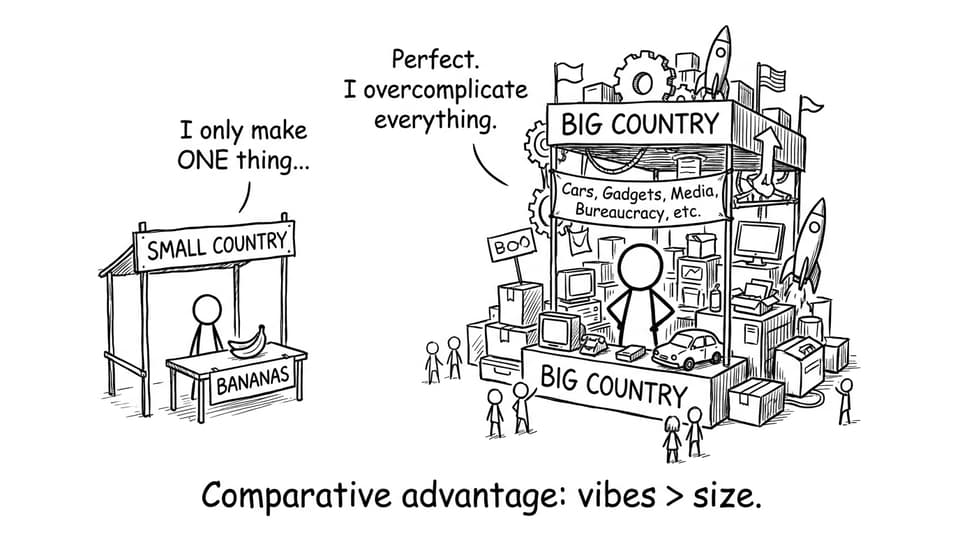
The IB Economics exam checklist: what to mention
If you get a trade question about unequal countries in IB Economics, your best answers usually include:
-
Comparative advantage (lower opportunity cost, not higher productivity)
-
Access to unavailable/expensive goods (variety, inputs, capital goods)
-
Economies of scale for small markets
-
Technology transfer and learning-by-doing
-
A quick nod to limitations and adjustment costs (to show evaluation)
For syllabus-aligned definitions and examples, use 4.1.2 Absolute and Comparative Advantage (HL) Notes and 4.1.1 Benefits of International Trade Notes.
Comparative advantage: the quiet reason trade still works
A common trap in IB Economics is assuming the more productive country “wins” and the less productive country “loses.” That’s absolute advantage thinking.
Comparative advantage asks a different question: What does each country give up to produce one more unit? Even if a richer country is more efficient at producing everything, opportunity costs can still differ. And if opportunity costs differ, specialization and trade can raise total output.
That’s why the smaller or poorer country can still gain: it shifts scarce resources toward what it sacrifices least to produce, then trades for the rest. In exam terms, you’re explaining how consumption possibilities expand beyond what a country could achieve alone.
To practice how this is assessed, try 4.1.2 Absolute and Comparative Advantage (HL) Questionbank.
Small countries benefit from access, variety, and crucial inputs
Unequal countries often differ in resources, capital, and market size. A small economy may not have the scale to produce advanced pharmaceuticals or complex machinery at a competitive cost. Importing isn’t a weakness; in IB Economics it’s a way to avoid inefficient domestic production.
At the same time, larger economies benefit because imports can be cheaper inputs for their own firms (think components, raw materials, intermediate goods). This lowers costs, raises productive efficiency, and supports export competitiveness.
If you want broader trade benefits language for Paper 1/2 style responses, review 4.1 Benefits of International Trade.
Economies of scale: the “small market” problem trade solves
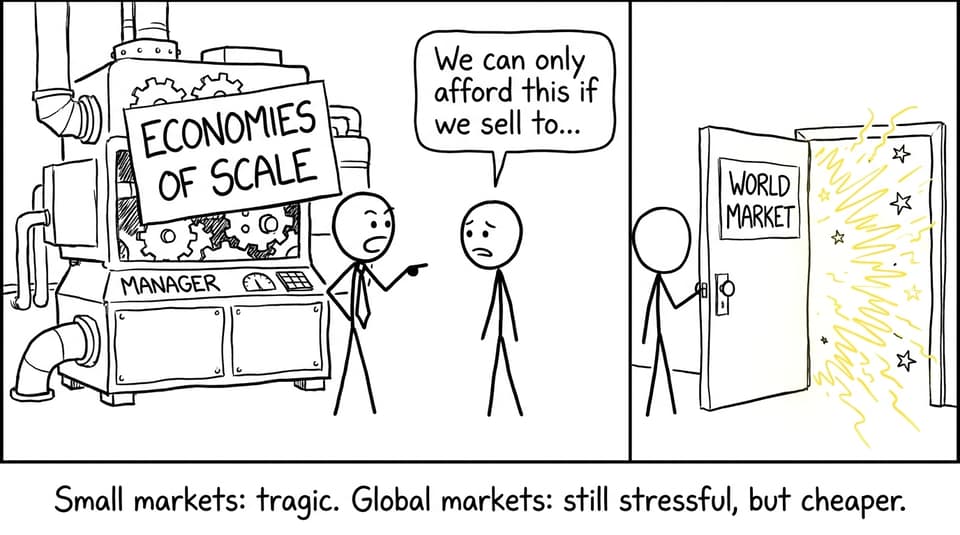
Small countries face a basic math issue: fixed costs are real, but domestic demand is limited. Trade gives firms a bigger market, allowing them to produce more, lower average costs, and compete.
In IB Economics, this is a clean chain:
access to world markets -> higher output -> lower average costs -> improved efficiency -> potential growth.
Technology transfer: trade as a learning channel
Unequal partners often differ most in technology. Trade can move more than products; it moves methods.
When a developing economy imports capital goods, partners with foreign firms, or joins global value chains, it can adopt new production processes. Over time, productivity can rise and comparative advantage can evolve. This matters for long-run development arguments in IB Economics, especially when you add evaluation about institutions, infrastructure, or education shaping the outcome.
For balanced evaluation, pair your gains-from-trade explanation with 4.1.3 Limitations of the Theory of Comparative Advantage Notes.
Bringing it home to RevisionDojo
Unequal countries trading isn’t a feel-good story; it’s a logic story. In IB Economics, that logic is comparative advantage, bigger markets, and the slow compounding of knowledge.
If you want to turn that logic into marks, RevisionDojo helps you practise it the way the exam demands: targeted Questionbank drills, crisp Study Notes, rapid Flashcards, and AI Chat when a diagram or definition won’t stick. When you’re close to exam season, use Predicted Papers and Mock Exams, then tighten your technique with Grading tools and focused support from Tutors. Start with the full IB Economics Resources hub and build from there.