
Why do some molecules form polar bonds while others form nonpolar bonds?
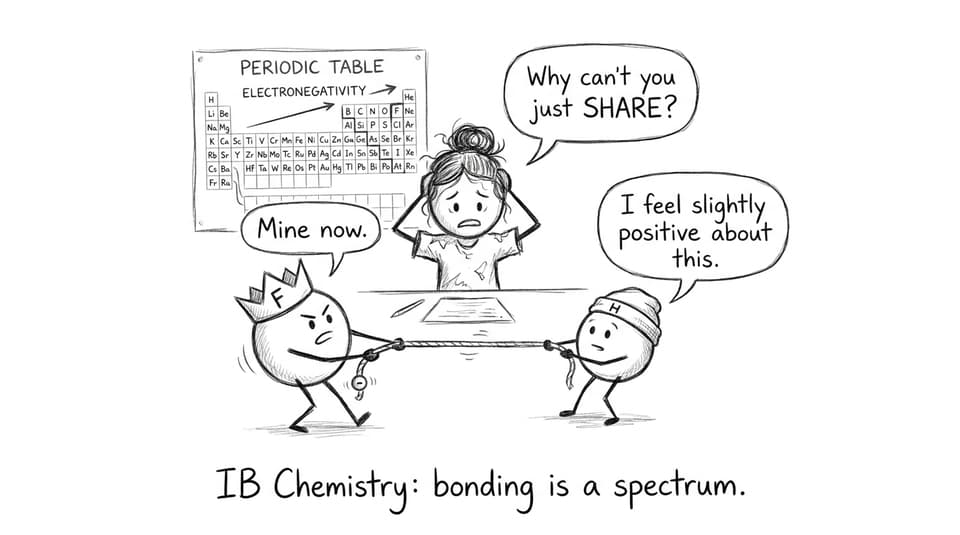
Some molecules form polar bonds while others form nonpolar bonds because electronegativity differences between atoms determine how electrons are shared. Electronegativity is an atom’s ability to attract shared electrons. When two atoms have similar electronegativities, they pull on shared electrons with nearly equal strength, creating a nonpolar covalent bond. When electronegativity differences are larger, electrons are pulled more toward one atom than the other, resulting in a polar covalent bond with partial charges on each atom.
If the electronegativity difference is extremely large, electron transfer may occur instead of sharing, producing an ionic bond, which represents the extreme end of polarity. Thus, the continuum of bonding—from nonpolar to polar to ionic—is determined by how unevenly the electrons are distributed.
In polar bonds, the unequal sharing of electrons creates dipoles. The more electronegative atom gains a partial negative charge (δ–), while the less electronegative atom becomes partially positive (δ+). Water is a classic example: oxygen strongly attracts electrons, creating polar O–H bonds that give water its unique properties. In contrast, molecules like N₂ or O₂ have identical atoms, so electrons are shared equally and the bonds are nonpolar.
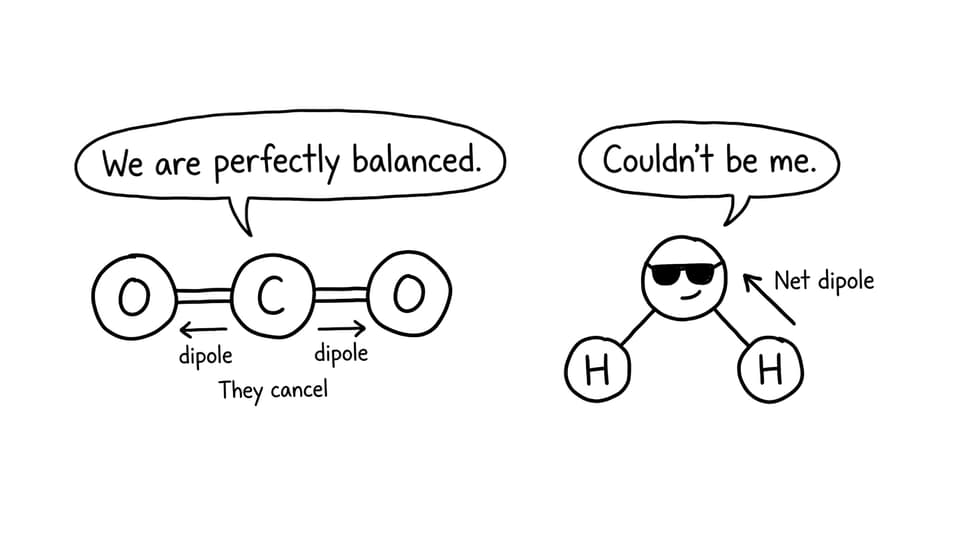
However, bond polarity alone does not determine molecular polarity. A molecule may contain polar bonds but still be overall nonpolar if its shape causes dipoles to cancel. For example, carbon dioxide contains polar C=O bonds, but because the molecule is linear and symmetrical, the dipoles oppose and cancel out. In contrast, bent or asymmetrical molecules such as H₂O or NH₃ retain net dipoles and are polar overall.
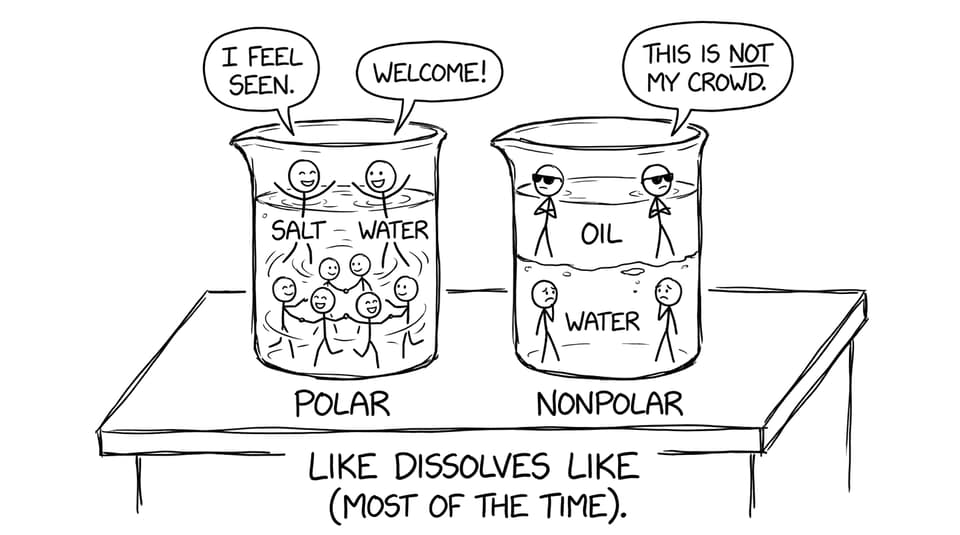
Polarity influences boiling points, solubility, intermolecular forces and reactivity. Polar molecules interact strongly with other polar substances and ionic solutes, while nonpolar molecules dissolve better in nonpolar environments. Many reaction mechanisms also rely on differences in electron density created by polar bonds.
Ultimately, molecules form polar or nonpolar bonds based on how unequally electrons are shared, which depends on electronegativity differences and molecular geometry. These factors shape nearly all chemical behavior at the molecular level.
Frequently Asked Questions
How big must the electronegativity difference be to form a polar bond?
Generally, a difference of 0.4–1.7 indicates a polar covalent bond.
Can a molecule with only nonpolar bonds be polar?
No. Polar molecules require at least one polar bond.
Why do molecular shapes matter for polarity?
Shapes determine whether dipoles cancel or add to produce an overall molecular dipole.
RevisionDojo Call to Action
Need polarity, electronegativity and molecular geometry explained clearly? RevisionDojo helps IB Chemistry students master bonding concepts with confidence and real understanding.