In IB Economics, development can feel like a simple story: invest, grow, and living standards rise. But in the real world, some countries run forward while others feel stuck in place, even when they try to do the “right” things. That tension is exactly what makes development economics so examinable. If you can explain why progress stalls, you can write clearer chains of reasoning, evaluate policies more convincingly, and score more consistently.
A quick IB Economics checklist: the usual suspects
When an exam question asks why some countries struggle to develop, scan for these recurring barriers:
-
Weak institutions (corruption, unstable governance, weak property rights)
-
Low human capital (education, healthcare, skills)
-
Infrastructure gaps (transport, power, water, internet)
-
Export dependence and external vulnerability (commodities, debt, terms of trade)
-
Social barriers (inequality, discrimination, conflict)
For syllabus-aligned coverage, keep a home base open: IB Economics Resources.
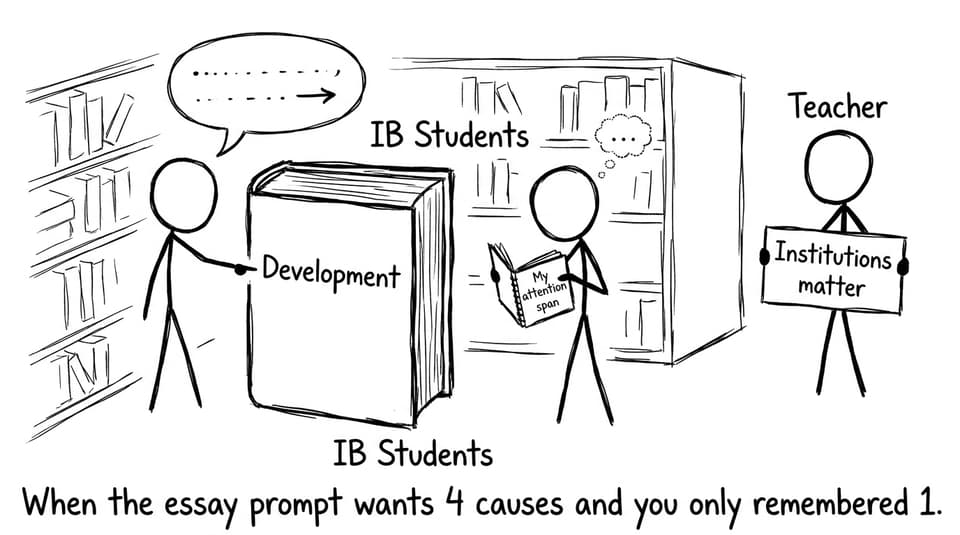
Weak institutions: the hidden tax on everything
In IB Economics, institutions matter because they determine whether incentives work as intended. If contracts are hard to enforce or corruption is normal, doing business becomes a gamble. Investors demand higher returns to compensate for risk, or they leave entirely. Government budgets can also leak away from public goods into private pockets, which means fewer teachers, fewer clinics, and fewer roads.
This is why “good governance” is not a vague moral idea; it’s an economic variable that shapes productivity, investment, and long-run planning. If you want precise phrasing for essays, RevisionDojo’s notes on barriers are a strong reference point: Barriers to Economic Growth and Economic Development (4.9) Notes and Political and social barriers (4.9.3) Notes.

Low human capital: the quiet development trap
A country can have natural resources and still struggle if its people are held back by poor health or limited schooling. In IB Economics, you can frame this as a productivity problem: fewer skills and higher disease burdens reduce output per worker, making firms less competitive and limiting diversification into higher-value industries.
The trap is circular. Low incomes reduce tax revenue, which limits public spending on education and healthcare, which then keeps productivity low. For measuring and writing about living standards, connect this to development indicators: Lessons on Measuring Development (4.8) and 4.8 Measuring Development Flashcards.
Infrastructure deficits: when distance becomes expensive
Infrastructure is the difference between potential and performance. If electricity is unreliable, production costs rise. If roads and ports are weak, firms cannot reach markets efficiently. If internet access is limited, knowledge and services do not scale.
In IB Economics essays, infrastructure is a strong “link” factor because it connects to multiple outcomes: lower foreign direct investment, reduced competitiveness, slower structural change, and weaker job creation.
External vulnerability: commodity dependence and shocks
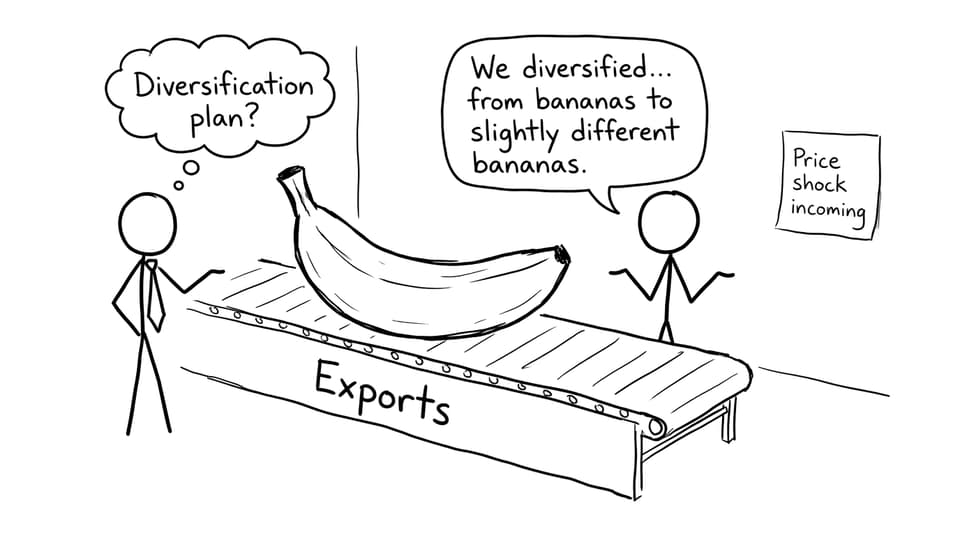
Many countries rely on a narrow export base, often primary commodities with volatile prices. When prices drop, export revenues fall, government budgets tighten, and development projects stall. This can push countries toward more borrowing, creating debt burdens that reduce fiscal space later.
A strong exam move is to show that this is not just “bad luck” but a structural risk. Then evaluate solutions: diversification, export promotion, improved education and training, or strategic government support. For policy angles, use Strategies to Promote Economic Growth and Development (4.10.1) and the deeper detail in 4.10.1 Notes.
Social barriers: exclusion wastes talent
If large groups are excluded from education, jobs, or political participation, the economy underuses its own people. Inequality can also weaken social cohesion and make reforms harder to implement. In IB Economics, this is a powerful evaluation point: policies may look good “on paper,” but their effectiveness depends on whether institutions and social conditions allow benefits to reach households.
Bring it back to IB Economics exam performance
The best development answers in IB Economics sound calm and connected: one barrier leads to another, and your evaluation explains why fixes are difficult but possible. If you want that structure on repeat, RevisionDojo is built for it; use the Questionbank for exam-style practice, Study Notes and Cheatsheets for clean chains of reasoning, Flashcards for definitions, and AI Chat plus Grading tools to tighten evaluation. When you’re ready, layer in Predicted Papers and Mock Exams, then sharpen real assessment skills with the Coursework Library and Tutors.
For exam technique, pair this topic with Step-by-Step Approach to Writing IB Economics Essays and Methods for Effective IB Economics Revision.


